
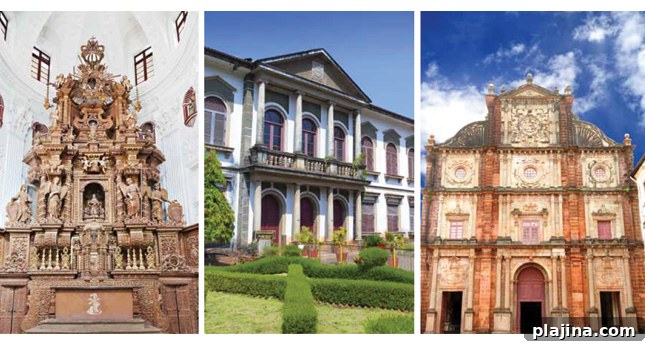
For all its tourist-packed beaches and famous Christmas parties, the Indian state of Goa preserves a rich cultural and historical legacy in Old Goa, a window into the region’s past. Before the Portuguese arrived in 1510, Old Goa was home to temples, mosques and palaces, including the expansive palace of Adil Shah, which was defended by walls, towers and a moat. Today, only the gateway to that palace survives among the ruins.
During Portuguese rule, efforts to convert the population to Roman Catholicism led to the replacement of many temples and mosques with churches and chapels built in styles reminiscent of Lisbon. Under Portuguese administration, the city prospered and was once nicknamed the “Rome of the Orient.” However, by the late 16th century Old Goa began to decline, suffering epidemics that greatly reduced its population. In the 1750s the capital was moved to Panaji, which now serves as a base for visitors exploring the historic churches and monuments of Old Goa.
A major attraction in Old Goa is the Sé Cathedral, recognized as one of the largest churches in Asia and larger than any church in Portugal. Construction began in 1562 at the command of King Dom Sebastião of Portugal and took roughly 90 years to complete. The cathedral contains 14 altars; one of its bell towers collapsed after a lightning strike in 1776, while the remaining tower houses the famous Golden Bell, known locally as the Sino de Ouro, celebrated for its clear, resonant tone.
Close by stands the Chapel of St. Cajetan, whose design was inspired by St. Peter’s Basilica in Rome. To the west of the Sé Cathedral sits the former Archbishop’s palace, which connects the cathedral complex to the Convent and Church of St. Francis of Assisi, originally built in 1521.
Part of the Franciscan monastery behind the Church of St. Francis of Assisi has been converted into an archaeological museum, displaying sculptural fragments from Hindu temples across Goa. The museum’s eight galleries exhibit artifacts spanning prehistoric and early historic times through the late medieval period. Highlights include portrait paintings of governors and viceroys, wooden sculptures, carved pillars and other objects from the Portuguese era in Goa.
Directly opposite, the Basilica of Bom Jesus houses the preserved remains of Saint Francis Xavier, a widely venerated missionary and the patron saint of Goa. The basilica remains an important pilgrimage destination for Christians and Hindus alike, who come to pay their respects to the saint’s remains, enshrined in a silver casket since 1553.