
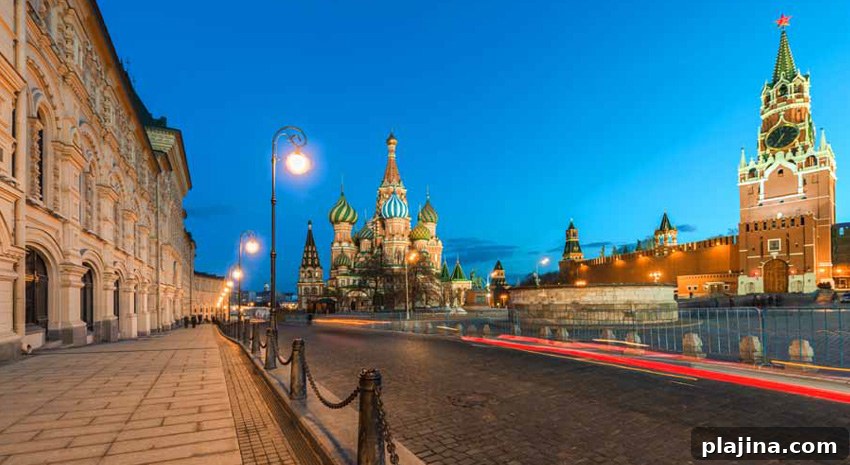
Moscow has long held an air of mystery for me, shaped by Cold War secrecy, espionage stories and conspiracy theories. So when the chance arose to visit the largest city on the European continent—home to about 12.1 million people—we booked the next flight to Russia, despite the often cumbersome Russian visa requirements.
Situated near the 56th parallel north, Moscow is one of the northernmost and coldest major cities in the world. Yet its climate contrasts with a rich architectural tapestry: the candy-colored onion domes of historic churches, the monumental Stalinist towers known as the Seven Sisters, and modern developments from the 1990s through the early 2000s. The result is an eclectic architectural collage that reflects Russia’s layered history and varied identities.
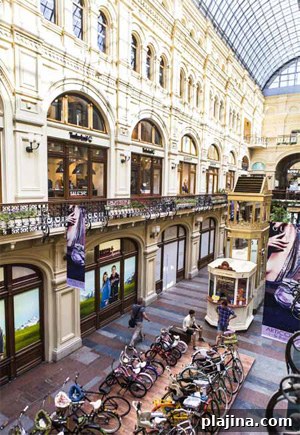
GUM Department Store © Hoang Bao Nguyen | Dreamstime.com
If Moscow is the nation’s heart, Red Square is unquestionably the heart of the city. Dominating the square is the multicolored onion-domed St. Basil’s Cathedral—an enduring symbol of Russo-Byzantine architecture. No visit to Moscow feels complete without the obligatory photograph of this iconic landmark.
Nearby, the GUM Department Store offers a striking contrast of historic elegance and modern shopping—you can easily spend time browsing its ornate interiors before grabbing an affordable Russian lunch at Stolovaya No. 57. From Red Square it’s a short walk to the Kremlin’s imposing red brick walls, the seat of Russia’s historical power. Inside the Kremlin complex, the Armory Museum displays an extraordinary collection of Romanov treasures, including coronation regalia, exquisite jewelry and several Fabergé eggs; Catherine the Great’s coronation dress is a standout exhibit.
For practical travel around the city, experience the Moscow Metro. Traffic in Moscow can be unpredictable and stressful, while the metro remains one of the most reliable and cost-effective options. In addition to its efficiency, the network is famed for its deep stations and lavish Soviet-era decorations—mosaics, chandeliers and sculptures add artistic flair to what is also one of the world’s largest rapid-transit systems.
Moscow hosts more than 500 museums, making it hard to pick favorites, but several stand out for unique collections. Two that particularly appealed to me relate to space exploration and Impressionist art.
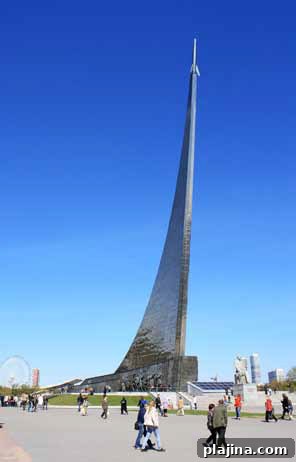
Monument to the
Conquerors of Space © Pavel Kirichenko | Dreamstime.com
The Museum of Cosmonautics chronicles human spaceflight from the Soviet era through modern Russia, beginning with Sputnik’s launch in 1957 and the beginning of the space race. Situated beneath the soaring Monument to the Conquerors of Space, the museum features memorable artifacts: taxidermied space dogs, Yuri Gagarin’s capsule, sections from the Mir space station and even a Soviet lunar rover.
The Pushkin State Museum of Fine Arts is one of Russia’s most important art institutions, with an expansive collection that spans antiquity to the 20th century. Among its vast holdings, the museum’s French Impressionist works are particularly notable, representing some of the finest examples of that movement available in Moscow.
When night falls, Moscow transforms into a city of light. Thousands of LED fixtures illuminate cathedrals, bridges, main streets, squares and monuments in shifting hues—gold, orange, red, pink, violet, blue and green—creating enchanting nightscapes. These nightly illuminations run year-round and are best appreciated from a guided tour that combines a stroll through Red Square, a cruise on the Moskva River and a panoramic bus ride. Local operators and many cruise lines offer evening tours that highlight the city’s glow.
Moscow Info to Go
International flights arrive at Domodedovo or Sheremetyevo airports, both roughly 20 miles from the city center. Taxi fares to central Moscow typically cost under $50, but should be paid in Russian rubles. Visitors need a Russian visa and a passport valid for at least six months beyond the planned departure date, with blank pages for entry stamps. Because obtaining a visa for Russia can be complex, many travelers use specialized visa services to simplify the process.
Where to Stay in Moscow
HILTON MOSCOW LENINGRADSKAYA This former Stalin-era skyscraper features baronial architecture and a lobby designated as a historic monument. The hotel offers 273 guestrooms. Kalanchevskaya St. 21/40 $$$$
HOTEL METROPOL A classic Russian hotel located steps from the GUM Department Store, Red Square and the Bolshoi Theatre. The Metropol provides 365 rooms and suites in a highly desirable central location. Teatralniy Proezd 2 $$$$
THE RITZ-CARLTON, MOSCOW Situated on one of Moscow’s most famous streets, this luxury hotel is popular with business travelers and celebrities. Rooms vary in size and view. Tverskaya St. 3 $$$$$
Restaurants in Moscow
BUONO Known for classic Italian cuisine and spectacular views from the 29th floor, reservations are recommended to secure a window seat. Radisson Royal Hotel, Kutuzovsky Ave. 2/1, Building 1 $$$$$
CAFÉ PUSHKIN Dine in an opulent, pre-Revolutionary setting and sample traditional Russian dishes—blini, black caviar, borscht and pelmeni—alongside a curated vodka selection. Reservations are essential. Tverskoy Blvd. 26a $$$$
STOLOVAYA NO. 57 Located inside GUM, this Soviet-style cafeteria serves hearty, affordable classics and attracts locals and officials alike. A straightforward, nostalgic dining experience. GUM, Red Square 3 $$