
Lisa Bartlett stumbled upon Lisbon by chance after a business trip took her to Spain. “I had taken a night train from Madrid. I didn’t know much about Portugal at all,” she recalled of her first visit in 2002. “I walked out of the train station, and I was in love with it.”
She was captivated by the cafés, the castles and churches, the feel of cobblestones underfoot and the sense that something ancient or remarkable might appear around every corner. When her cousin invited her back five years later, Bartlett happily returned, excited to share Lisbon—the White City—with her cousin’s 10-year-old daughter.
“She had a blast,” Bartlett said. “There’s a lot of exploring you can do just walking around. The castle, for example, isn’t so much a museum as it is just kind of a cool place for kids to explore.”
Lisbon’s charms have attracted visitors for more than 2,000 years, from Phoenicians and Gauls to Romans and Moors. Its seven hills hold winding alleys, secret churches and layers of history. For American visitors, Lisbon is also convenient—closer to the U.S. than many European capitals, about a five-hour flight from Boston or New York—and economical; hotel rates in Portugal are among the lowest in Europe. Beyond value, travelers rave about sensory pleasures: grilled sardines with a glass of Madeira or Port, the gleam of weathered marble on royal tombs and the warm, instant friendliness of Lisbon’s residents.
“That first summer, people were super friendly to me,” Bartlett remembered. “No one had talked to me in Spain, but in Lisbon I would be sitting in a café having coffee, and people would just start conversations.”
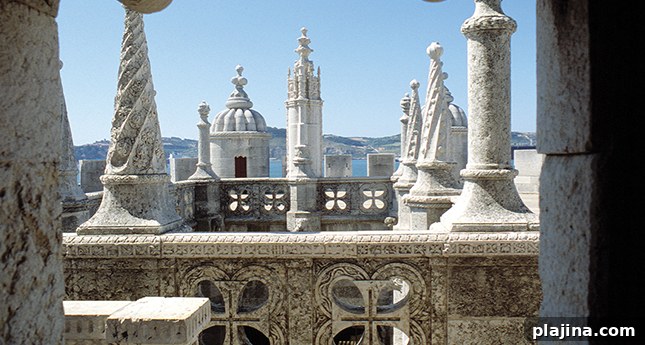
Many visitors begin in Belém, the riverside district where Vasco da Gama departed on July 8, 1497, for his historic voyage to India that helped launch Portugal’s Golden Age of Discovery. King Dom Manuel I commemorated that era with two iconic monuments: the Tower of Belém, dating from around 1515, and the Jerónimos Monastery, started in 1502 and completed at the end of the 16th century. The white monastery—built on the spot where da Gama and his crew prayed—now houses the explorer’s tomb within a vaulted chamber of stained glass and carved stone.
Another wing of the monastery contains the Maritime Museum, which displays model ships, period uniforms and 15th-century navigational instruments that bring the Age of Discovery into perspective. Nearby, the National Coach Museum occupies the former equestrian arena of Belém Palace and exhibits ornate coaches and carriages. Before leaving the district, sample pastéis de Belém, a creamy custard tart created by Jerónimos monks and prepared from a closely guarded recipe for centuries.
When locals refer to “the castle,” they mean the Castle of St. George, the medieval fortress that became the city’s and nation’s stronghold after King Alfonso Henriques reclaimed Lisbon from the Moors in 1147. To reach the castle’s ramparts and dungeons, wander up the steep streets and narrow alleys of the Alfama district, one of the few neighborhoods to survive the earthquake of Nov. 1, 1755. Within Alfama are attractions such as the Military Museum, with antique armor and artillery; the National Tile Museum, which traces the history of azulejos (colored tiles); and the curious 16th-century House of Points, known for its exterior of gleaming metal spikes.
The city’s most popular modern attraction sits in the Park of the Nations, developed along the waterfront for the 1998 World’s Fair. The Lisbon Oceanarium is among the world’s largest aquariums, offering visitors a chance to walk amid kelp forests, explore an Antarctic shelf and watch more than 25,000 creatures—from jellyfish to penguins—swim behind vast acrylic panels. For adventurous families, overnight “sleep with the fishes” programs let children camp near the tanks for a memorable experience.
Two excellent day-trip options are each about a half-hour from central Lisbon. Cascais, on the Portuguese Riviera, is a cliffside town popular with surfers, sailors and sunbathers who flock to Guincho Beach. Sintra, described by Lord Byron as a “glorious Eden,” is a fairy-tale town of palaces and gardens that once served as royal summer retreats: Palácio da Vila, Palácio da Pena and Palácio de Queluz are highlights, along with beaches and the Toy Museum’s extensive collection.
No visit is complete without hearing fado, the soulful Portuguese music of longing, in a small club or tavern where a single guitarist accompanies a singer. It’s a fitting moment to reflect on the journey and, in true Lisbon fashion, to imagine what might have been.
“There’s something called saudade that’s part of Portuguese culture,” said Jayme Simões, a spokesman for the Portuguese National Tourist Office. “It’s not exactly nostalgia, because nostalgia is a desire to return to something you knew, like your childhood or your college days. Saudade is a desire to go back to a time that never was, to fantasize or romanticize something that isn’t real. In a sense, all Portuguese imagine a mythical time of a great, happy nation that never existed. It’s a personal memory for everyone, even though it’s no memory at all.”
Info to Go
Portela de Sacavém International Airport (LIS) lies about 4.4 miles from the city center. Lisbon’s subway, the Metropolitano, is straightforward to use. The Lisboa Card, available from Turismo de Lisboa, provides unlimited travel for 72 hours on the metro, buses, trams and funiculars, plus trains to Sintra and Cascais.
Lodging
Hotel Avenida Palace
Located in Restauradores Square in the heart of Lisbon, Hotel Avenida Palace embodies the city’s charm and elegance. Rua 1 Dezembro, tel 351 213 218 100. $$$$
Hotel Tivoli Lisboa
Known for “experience” packages for families—such as visits to thoroughbred farms or tours following the royal route from Mafra to Queluz. 185 Av. da Liberdade, tel 351 21 319 8900. $$$
Novotel Lisbon
Offers family-friendly packages and convenient access to attractions like the Lisbon Zoo. Children under 16 stay free with parents or grandparents. 1 Av. José Malhoa, tel 351 21 724 4800. $
Dining
Bom Jardim
Famed as the “King of Chickens,” this casual spot serves roasted chicken and fries in a welcoming atmosphere popular with locals and visitors alike. 11 Travessa de Santo Antão, tel 351 21 342 4389. $$$
Restaurante Manifesto
Diners can enjoy Chef Luís Baena’s creative dishes while looking out over the park through a wall of glass. 9C Largo de Santos, tel 351 21 390 3583. $$$$
Restaurante Tavares
Lisbon’s oldest dining establishment, led by Chef José Avillez, earned a Michelin star with refined, French-influenced dishes such as Champagne-covered sole and tender lamb. 37 Rua da Misericórdia, tel 351 21 342 1112. $$$$