
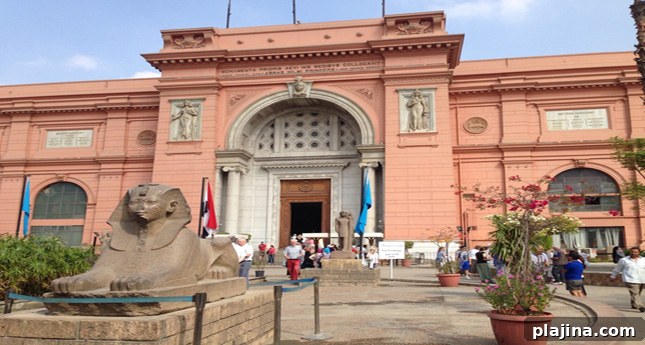
In the Egyptian Museum of Antiquities, a haven for lovers of ancient Egypt, you can explore a vast collection of artifacts that span millennia. Housed in a Neoclassical building completed in 1902, its soft rose-colored façade faces the well-known Tahrir Square. The museum preserves roughly 160,000 objects covering some 5,000 years of Egyptian history, from small amulets and coins to imposing stone statues.
Inside, visitors encounter royal mummies, sarcophagi, funerary urns, jewelry and a wide array of everyday and ceremonial objects that together tell the long, complex story of ancient Egyptian civilization. The displays include examples of finely worked gold, intricate beadwork, and carved stone that demonstrate the skill and artistic sensibility of ancient craftsmen.
Undoubtedly the museum’s most famous exhibit is the gilded funerary mask of the Boy King, Tutankhamun. Visitors come from around the world to see this iconic object: a stunning example of ancient Egyptian luxury, combining beaten gold with inlays of deep blue lapis lazuli. On the day I visited, crowds were light, which gave me the rare chance to spend uninterrupted time before the glass case. I circled the display slowly, captivated by the craftsmanship and the mask’s vivid colors. Photography is not permitted in that gallery, so the memory of the mask remains a personal impression—its gold glinting and the lapis lazuli tones glowing like a jewel recovered from the past.
The museum’s layout guides you through different periods and themes, allowing you to appreciate the continuity and change across thousands of years. Antiquities range from monumental statuary to delicate funerary objects, each with labels that provide historical context. Walking the galleries, you get a clear sense of how religious beliefs, royal power, funerary practice and everyday life shaped material culture in ancient Egypt.
Practical information: the Egyptian Museum of Antiquities is open daily from 9 a.m. to 5 p.m. If you prefer a quieter visit, aim for weekday mornings to avoid peak tourist hours. Allow several hours to explore—the collection is extensive, and there are many highlights beyond Tutankhamun’s mask, including elaborately carved sarcophagi, detailed reliefs and royal portraiture that reward careful attention.
Whether you are an avid student of Egyptology or a first-time visitor curious about ancient civilizations, the museum offers a powerful and tangible connection to Egypt’s past. Its unmatched concentration of artifacts provides a rare opportunity to see original objects that shaped and reflected five thousand years of history.