
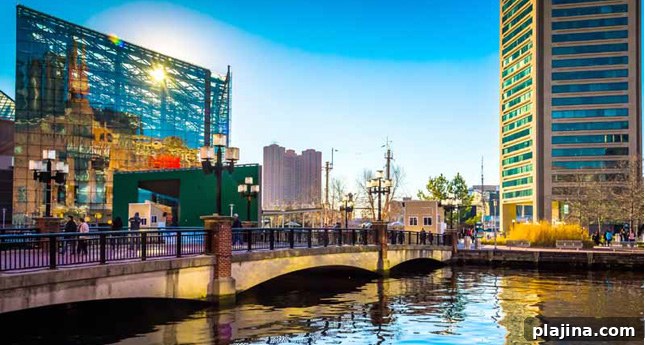
Baltimore is plucky, brash, buoyant and relentlessly full of character. Its past as one of America’s busiest immigration ports and a major manufacturing and transportation center shaped a city of distinct, diverse neighborhoods—many so different they feel like separate towns. That diversity is part of Baltimore’s appeal: a blend of neighborhoods, cultures and histories that give the city its unmistakable attitude.
The Port of Baltimore remains a vital economic engine. As one of the closest Atlantic ports to the Midwest, it supports roughly 150,000 jobs and has grown to accommodate the world’s largest cargo vessels after a $1.3 billion upgrade that allows super post-Panamax ships to call here. Today the port ranks among the top U.S. facilities in total tonnage and value, handling more than $50 billion in annual trade. Baltimore is the leading U.S. port for automobiles and roll-on/roll-off equipment and ranks among the top cruise ports on the East Coast. Its Foreign Trade Zone is one of the largest and most active in the nation.
The USS Constellation © Stillman Rogers Photography
Maritime life has defined Baltimore for centuries. Naval activity played a central role during the War of 1812—when Francis Scott Key, watching Fort McHenry withstand a British bombardment, penned the words that became “The Star-Spangled Banner.” Today, historic ships and naval exhibits connect visitors to that maritime legacy and bring history to life along the waterfront.
For business travelers and visitors alike, the Inner Harbor remains the city’s focal point. What was once an untidy waterfront has been transformed into a dynamic, multiuse district that mixes hotels, residences, dining, retail, offices, museums and attractions. The harbor’s renovated shoreline showcases historic vessels such as the 19th-century sloop USS Constellation, a World War II submarine, a Coast Guard cutter and a lightship—each open for exploration.
Adjacent to the Inner Harbor, Harbor East is a major driver of the waterfront’s revitalization. This mixed-use neighborhood offers a lively combination of locally owned boutiques, national brands, restaurants, hotels and event spaces, all within steps of the Baltimore Convention Center. Harbor East’s tree-lined streets and waterfront views have made it one of the city’s most vibrant hubs for residents and visitors.
The Baltimore Convention Center itself is a substantial meeting venue with 1.2 million square feet of space, including 300,000 square feet of contiguous exhibition area. Meeting planners can take advantage of flexible floor plans and detailed venue information to stage conferences and trade shows. Unique off-site venues surround the Inner Harbor, adding cultural and experiential options: the National Aquarium, science exhibits, the observation level of the World Trade Center and the imaginative collections of the American Visionary Art Museum are all popular choices for receptions and events.
Display at the American Visionary Art Museum © Stillman Rogers Photography
The Inner Harbor and Convention Center district offer roughly 9,000 hotel rooms, making Baltimore an attractive destination for large meetings and conventions. Harbor East includes five hotels ranging from luxury to extended-stay options, such as a Four Seasons, Courtyard by Marriott, Hilton Garden Inn, Homewood Suites and a waterfront Marriott.
Beyond the harbor but still within easy walking distance of convention facilities and corporate headquarters, several boutique and historic hotels enhance Baltimore’s lodging options. Adaptive reuse projects have converted older downtown buildings into distinctive properties: Hotel Indigo Baltimore in Mt. Vernon offers contemporary rooms and flexible meeting space in a renovated urban structure; The Ivy Hotel occupies a restored private mansion and provides an intimate boutique experience in the Mount Vernon Historic District; and Hotel RL blends a lively lobby-lounge-café design with comfortable guest rooms in another historic building closer to the harbor.
Neighborhood revitalization continues to reshape Baltimore’s waterfront. Fell’s Point, once an industrial dockland, has evolved into a lively area of restaurants, shops and market activity. The restoration of the long-vacant Recreation Pier into a new hotel adds to the neighborhood’s momentum, introducing waterfront lodging and amenities that complement the area’s historic streets and maritime heritage. Fell’s Point connects easily to the Inner Harbor and other waterside attractions via frequent water taxi service.
Scenic Drives
For a scenic drive north of the city, Maryland Route 25—known as Falls Road—traces a historic corridor that follows streams and waterfalls that powered early mills. The route passes attractive small towns, parkland and country estates. Beginning near the Prettyboy Reservoir, the road winds through Butler and the Green Spring Valley, where antique shops, grand homes and historic sites sit amid rolling landscapes. Notable stops include The Cloisters, a 1932 Medieval-style castle, and the Rockland Historic District, recognized for its stone buildings and Gothic Revival homes. The Cylburn Arboretum offers gardens, sculptures and peaceful trails. Falls Road descends into Hampden, one of Baltimore’s most distinctive neighborhoods. Stroll 36th Street to experience the quirky, creative spirit that inspired the film Hairspray—and expect to hear locals greet you with, “Welcome to Bal’mer, hon.”