
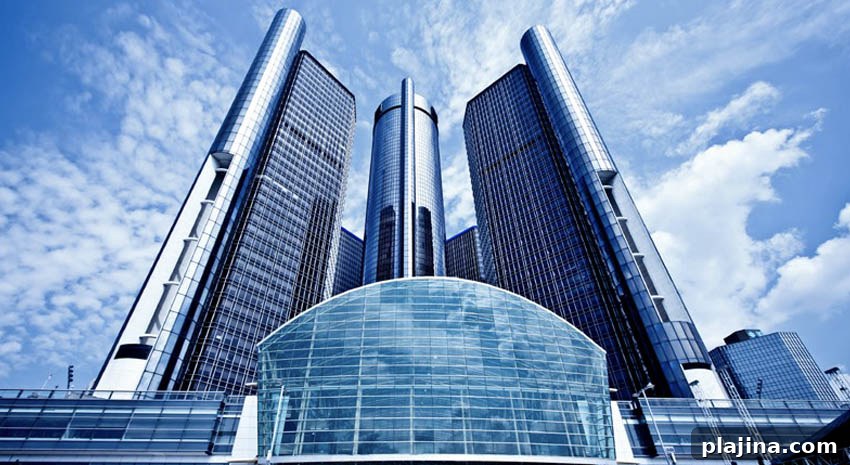
More than $11 billion in development projects continue to reshape Detroit, a city that once declared bankruptcy but is now experiencing a broad and sustained revitalization. New and renovated buildings in downtown Detroit are adding hotels, meeting spaces, dining establishments and entertainment venues, transforming the urban core.
The pace of investment shows no sign of slowing.
“If you swing a hammer in this town, you’re going to be busy for a while,” said Mark Denson, director of business development at the Detroit Economic Growth Corp., a nonprofit that partners with the city and other stakeholders to encourage development. He credits strong planning and continuity of leadership across business, civic and philanthropic sectors for the city’s forward momentum. “We have all the major stakeholders rowing in the same direction,” he added.
Cobo Center, the 17th-largest convention center in the United States, completed nearly a $300 million expansion last year, according to Denson. The upgraded facility is now better positioned to host a wide range of North American conferences and trade shows.
A $627 million arena is set to open this fall, linking downtown with the Midtown neighborhood and business district. Little Caesars Arena, backed by Ilitch Holdings, will seat more than 20,000 for Detroit Red Wings hockey and Detroit Pistons basketball and will host concerts and other events. The broader 50-block District Detroit development will include a 350-room athlete hotel, residential units, retail, restaurants and a large plaza with a below-ground community ice rink.
Developer Dan Gilbert, founder of Quicken Loans, has purchased more than 95 properties across Detroit through his commercial real estate firm. One notable restoration is the Albert Kahn–designed building formerly occupied by the city’s daily newspapers, now reimagined as office space for Quicken employees and the Michigan regional offices of Molina Healthcare. A ground-up mixed-use project called 28Grand brings the micro-loft trend to downtown with 218 furnished apartments in a 13-story building; 85 of those units will be reserved for residents qualifying for low-income tax credits. Gilbert is also developing a 130-room boutique hotel tied to the Detroit-based Shinola brand. Housed in an eight-story building that once was a hardware store, The Shinola Hotel is scheduled to open next year and will connect to an activated alleyway lined with shops and restaurants.
Since the city’s 2013 bankruptcy, more than 100 bars and restaurants have opened in Detroit—averaging about one per week—and hotel occupancy rates have reached record levels.
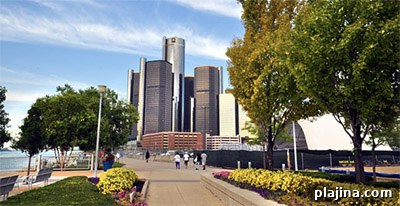
The new Riverwalk winds through Milliken State Park and Harbor, a 31-acre green oasis in downtown Detroit © KATHERINE RODEGHIER
At least five hotels are currently under construction, with more planned, Denson said. Companies ranging from tech startups to Fortune 200 firms are moving downtown, including Ally Financial and Microsoft, which plans to relocate from the suburbs next year.
Demand for downtown living is strong; prospective residents may face waiting lists for condos and apartments. Gilbert’s redevelopment of the former Hudson’s department store site aims to ease some of that pressure by adding 250 residential units. When completed, the tower will stand as Michigan’s tallest building—rising slightly above Detroit’s Renaissance Center, the headquarters of General Motors. The project is envisioned as an architectural landmark befitting Detroit’s designation as a UNESCO City of Design. The residential tower will sit atop a nine-story podium that will include meeting space, offices, technology and cultural space, retail and a public market.
In Brush Park, between Midtown and downtown and not far from Little Caesars Arena, Gilbert’s City Modern development will create low-rise housing in five types. The plan blends restoration and new construction: four renovated Victorian mansions will become seven historic units and will be joined by modern apartments, townhomes, carriage homes and duplettes, totaling 410 residences—54 of which will qualify for low-income credits. Pocket parks and ground-floor retail are intended to create a walkable neighborhood reminiscent, in Denson’s view, of Washington, D.C.’s Georgetown.
The QLINE streetcar began operating in May, connecting downtown with Midtown and improving access to many of the city’s new restaurants and retailers, including Shinola’s flagship store. The 3.3 miles of rail along Woodward Avenue, Detroit’s main thoroughfare, better link key destinations such as the new arena, Comerica Park and Ford Field. The route also passes the Fox Theatre, a 1920s landmark and part of the nation’s largest theater district outside Manhattan.
Denson notes that the seeds of downtown renewal were planted in the 1990s as Detroit prepared to host the 2006 Super Bowl. Although the recession stalled some projects, investment has returned and momentum has picked up. “Detroit is on a positive trajectory,” he said. “There’s a lot planned in the next five to seven years. The goal is to be a better Detroit tomorrow than we are today, and I think we are making great strides.”
SCENIC DRIVES
Belle Isle, the nation’s largest city-owned island park, sits in the Detroit River with views of Windsor, Ontario, on one side and the Detroit skyline on the other. Designed by Frederick Law Olmsted and covering 982 acres, the park is larger than Olmsted’s Central Park in New York City. Visitors reach the island by bridge and can explore a carillon, a historic fountain and an all-marble lighthouse from the 1920s and 1930s. Maritime history is on display at a Great Lakes museum, while a nature zoo, aquarium and conservatory showcase wildlife, fish and tropical plants. The island also offers recreational amenities such as a driving range for golfers.
About 20 miles northwest of downtown, Bloomfield Hills is one of Detroit’s wealthiest suburbs, known for mansions set among rolling hills and winding roads. Cranbrook, founded by philanthropists in 1904, occupies a 319-acre campus that includes museums of art and science, a historic house and gardens, and a preparatory school. The site features work by notable designers and architects including Eliel Saarinen, Albert Kahn and Carl Milles. A few miles southwest, the small town of Franklin preserves 19th-century charm; founded in 1825, it offers historic buildings such as a cider mill that draws fall visitors seeking apple cider and hot doughnuts.