
Sparta’s legendary queen, Helen of Troy, may have have been famed for her beauty, but Christopher Marlowe’s line about “a face that launched a thousand ships” overstates the role of looks in shipbuilding. Constructing a vessel that actually sails requires far more than admiration; it demands engineering, planning, materials and time.
If your idea of shipbuilding comes from historic seafaring movies or maritime novels, you might picture teams of shipwrights shaping oak, pine, acacia or cedar into hull planks and caulking seams with tarred hemp. That traditional craft was once the norm: wooden hulls were joined with ropes, copper or iron rivets, and sealed by skilled hands. Over time, ship construction shifted to metal hulls and engines, and modern methods and materials have steadily transformed the process.
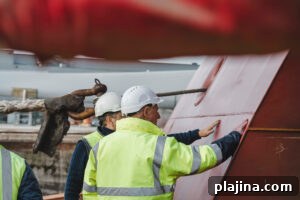
PHOTO: © WINDSTAR
Even with modern manufacturing and automation, building a passenger ship remains a multi-year endeavor. “We start dreaming up ships long before the first piece of steel is cut,” says Keith Lane, Senior Vice President, Hotel Operations at Celebrity Cruises. He explains that the path from initial concept to welcoming the first guests typically spans about five years, reflecting investments in design, dining, entertainment and every detail of the onboard experience.
Design is only the beginning. James Kent, Senior Director New Builds at Princess Cruises, outlines the main stages. Early steps involve welding steel plates, stiffeners and girders into panels that become the hull, bulkheads and decks. Those panels are joined into larger steel sections, then pre-outfitted with elements like ventilation ducts. Sections are welded into blocks, which are lifted into dry dock and assembled during the erection phase.
At that stage the hull visibly takes shape. Heavy machinery such as engines is installed, then the blocks above are set in place, followed by piping and ducting. Electrical cabling is run, technical systems are commissioned, and catering equipment installed. Cabins and public areas are erected and outfitted before final delivery. From the first cut of steel to the ship’s initial floating out typically takes 12 to 16 months, with an additional eight to 12 months of final fitting out before delivery.
Passengers often assume staterooms are built individually on board, but many modern lines build cabins offsite and integrate them later. For example, Celebrity’s new luxury ship Celebrity Xcel—an Edge-class vessel built in partnership with Chantiers de l’Atlantique—uses offsite-built staterooms delivered about 80 percent complete, then finished and audited during integration. This modular approach helps ensure consistent craftsmanship and quality across cabins.
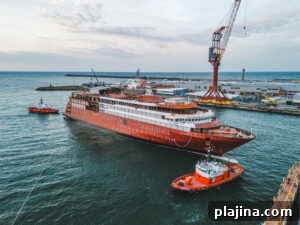
PHOTO: © WINDSTAR
Sail-powered cruise ships follow many of the same construction steps, though with some differences. John Gunner, Vice President of Expansion Projects at Windstar Cruises, explains that hull assembly still uses a block method, with machinery loaded at precise moments so engines and other heavy components can be craned into place. Plumbing, electrical and HVAC systems are installed in the steel hull. On Windstar’s vessels, suites are often constructed inside the ship, with bulkheads and cabinetry set up in place rather than added as modular units.
Modern cruise ships rely primarily on steel for structural elements; aluminum sometimes appears in upper works to reduce weight, while real wood is mostly limited to decorative finishes. Where wood is present, comprehensive fire-protection systems such as HI-FOG are used to safeguard interiors.
Before construction, naval architects run detailed calculations to determine a ship’s weight and balance. John Gunner explains that a vessel’s mass is considered as lightweight and deadweight: lightweight refers to the ship itself with installed parts, while deadweight covers payload—passengers, luggage, provisions and fuel. The ship’s displacement equals the weight of the water it pushes aside when floating, per Archimedes’ principle, and gross registered tonnage (GRT) measures internal volume rather than weight. Throughout building, engineers track and refine these calculations, finally verifying displacement by surveying how much hull sits below the waterline.
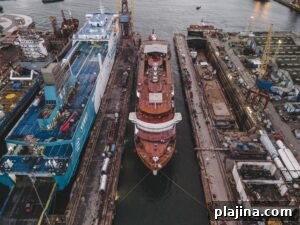
PHOTO: © WINDSTAR
Once afloat, a ship undergoes sea trials—rigorous at-sea testing held one to two months before delivery. Sea trials validate machinery, navigation systems and overall performance under real conditions. “Sea trials are an important milestone,” says Lane. Teams of engineers, crew and maritime specialists run comprehensive tests that cover safety, maneuverability, comfort and fuel efficiency. Trials are especially critical for vessels introducing novel features in guest experience and engineering systems, as with Celebrity Xcel.
After successful trials and final adjustments, the ship is cleared for its maiden voyage, the first sailing with paying guests aboard. For travelers fortunate enough to sail on a brand-new ship, the voyage marks the culmination of years of design, engineering and craftsmanship. Pack your best attire and enjoy the experience—no mythic intervention required.