
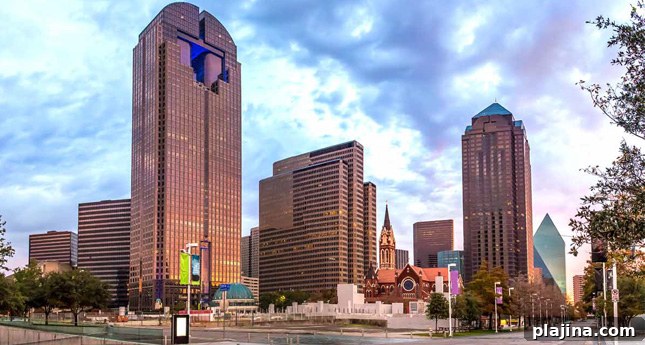
While many oil-dependent cities have faced setbacks since the economic downturn, Dallas continues to grow, attracting both startups and established companies to its metropolitan area. In 2014 the city’s economy surpassed that of Washington, D.C., becoming the fifth-largest in the United States, and in 2015 Dallas topped Texas cities in Forbes’ ranking of “The Best Places for Business and Careers.”
Historically dominated by cotton, stockyards and a 20th-century oil boom, modern Dallas is often called the “Silicon Prairie” for its concentration of telecommunications and technology firms. The northern suburb of Richardson hosts major high-tech employers such as AT&T, Samsung, Sprint, Texas Instruments and Verizon.
“We hear three things over and over again from companies that are looking to relocate to the Dallas region: labor quality and availability, central access, and low cost of living and doing business,” says Duane Dankesreiter, senior vice president of business information and research at the Dallas Regional Chamber. “Companies are relocating and expanding to the Dallas region to draw on that talent, and people are moving to the area to take advantage of the low cost of living, our quality of life and the availability of great jobs.”
Major relocations and expansions illustrate that trend. Toyota is consolidating manufacturing, sales, marketing and corporate offices into a single national headquarters in the Plano suburb, a campus expected to employ more than 4,000 workers when it opens. Nearby in Frisco, the Dallas Cowboys organization is developing a 91-acre site to house its new world headquarters.
Growth isn’t limited to the suburbs. Downtown Dallas is experiencing a revival, with more than 8 million square feet of office development underway. One of the largest projects is the conversion of the former First National Bank Building: a $170 million redevelopment that will transform the 52-story skyscraper into a mixed-use complex occupying an entire city block. Attracted to this live-work-play environment, many young professionals are choosing downtown as their primary residence.
“We expect to see the continuing resurgence of downtown Dallas next year,” Dankesreiter adds. “We have one of the hottest multifamily markets in the country, with over two dozen mid- and high-rise residential towers announced or currently under construction in or near downtown Dallas.”
Formed in 2015 as a public-private partnership, the Dallas Innovation Alliance is developing an Innovation District in the West End of downtown, an area already home to numerous startups and tech companies. The Alliance’s goal is to build the social and technological infrastructure needed to make Dallas a smarter, more sustainable city that fosters collaboration and innovation.
Dallas West End Historic District entrance © Dnaveh | Dreamstime.com
“A major strength of our region is the historical success it’s seen in entrepreneurship — from two founders in a garage to multibillion-dollar exits,” says Michael Sitarzewski, publisher of Launch DFW, a digital news outlet covering Dallas startups and technology.
Dallas’s central U.S. location and two major airports — Dallas/Fort Worth International and Dallas Love Field — make the region vital for manufacturing, distribution and business travel. Dallas is currently one of the top U.S. destinations for business travelers and is investing in infrastructure and convention facilities to attract even more events.
The Kay Bailey Hutchison Convention Center in downtown Dallas offers more than one million square feet of space, including the world’s largest column-free exhibit hall. A recent first phase of a $60 million expansion added multimedia conference rooms and renovated function areas; a second phase, begun in 2015, will add roughly 100,000 square feet.
Dallas/Fort Worth International Airport, among the world’s busiest hubs, is planning an additional terminal and improvements to airfield operations, cargo facilities and parking. At the same time, the proposal by Texas Central Partners to connect Dallas and Houston with a 90-minute high-speed train has continued to gain support in both cities.
Dallas also excels culturally. The city contains the largest arts district in the nation, featuring several buildings by Pritzker Prize-winning architects. The ambitious Trinity River Corridor Project, a multibillion-dollar effort to create thousands of acres of trails and green space, aims to establish one of the largest urban parks in the world.
“If you’re shopping the world for a place to start or grow your company, make sure you spend time getting to know Dallas/Fort Worth,” Sitarzewski says. “It’s what we do.”
SCENIC DRIVES
About 35 miles south of Dallas in Ennis, Texas, bluebonnet blooms blanket the countryside every April. Visitors often drive south on Interstate 45 for the Bluebonnet Trails Festival in late April, which features live music, art and more than 40 miles of scenic country roads lined with blue-hued flowers.
Spring is also a great time to explore the horse country around Denton, where farms raise full-bred horses and visitors can tour facilities to see foals and learn about breeding. Denton sits roughly 39 miles north of Dallas along Interstate 35 and offers a leisurely rural drive past white picket fences and rolling green pastures.
For those who prefer to stay within city limits, Swiss Avenue in Dallas provides a glimpse of turn-of-the-century architecture. Built between 1880 and 1910 as an upscale neighborhood, the 2.5-mile stretch includes Victorian, Italian Renaissance and Spanish Revival homes and is listed on the National Register of Historic Places, making it an enjoyable driving or walking tour.