
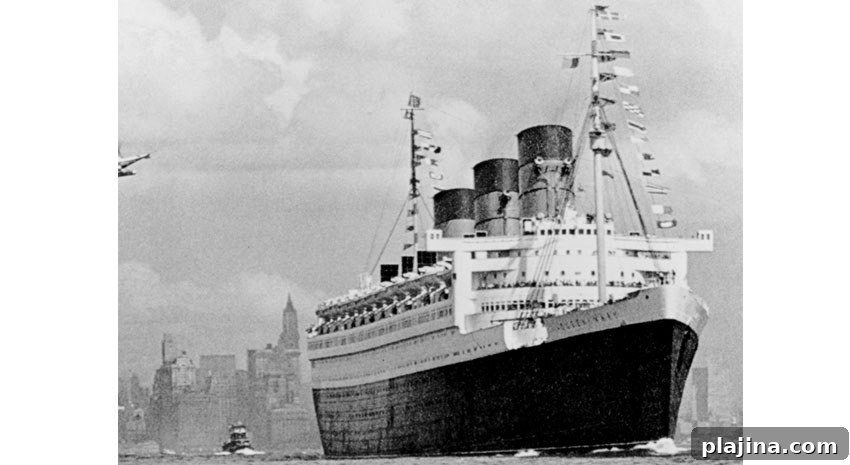
NO MODERN CRUISE LINE can match Cunard Line’s maritime legacy, which stretches back to 1840 and the era of trans-Atlantic steamships. Over more than a century, Cunard introduced many firsts: the first passenger ship illuminated by electric light, the first vessel with an indoor swimming pool, and the first to offer a true around-the-world voyage in 1922. During World War II, Cunard liners transported more than two million service members, an effort Winston Churchill said helped shorten the war by a year. Cunard was the first company to operate regularly scheduled trans-Atlantic passenger service and remains the only cruise line still offering scheduled trans-Atlantic crossings today.
Cunard’s crossings and other itineraries emphasize a distinctly British style of cruising, celebrating the elegance and romance of classic ocean travel. The onboard atmosphere leans toward formal refinement: jackets are expected even on informal evenings, libraries are staffed by professional librarians, and nannies are available to care for children. The line also preserves traditional social roles such as dance hosts and offers period-inspired interiors that reflect Edwardian and Victorian design rather than modern cruise-ship trends. Passengers can expect a program of distinguished lecturers, Shakespearean and West End performers, and signature rituals like a full afternoon tea with scones and clotted cream in the Queens Room, presented with Cunard’s signature White Star service.
Cunard operates three ships — Queen Victoria, Queen Elizabeth and Queen Mary 2 — each carrying a little more than 2,000 guests. Queen Mary 2, the largest of the trio, carries roughly half as many passengers as today’s largest mega-ships while being nearly equal in length and tonnage. That scale provides generous space for facilities tailored to long ocean passages and world cruises: the world’s largest floating bookshop and library, the first full-scale planetarium at sea, and unique pet accommodations staffed by two kennel masters, complete with an exercise area and in-cabin room service.
The line offers a formal yet relaxed luxury experience that has become rare in contemporary cruising. At the same time, Cunard has been broadening its itineraries to appeal to a wider international audience, including more travelers from the United States, Canada and Australia. In a typical season the line maintains numerous scheduled trans-Atlantic sailings; for example, there were 22 seven-night trans-Atlantic cruises planned for 2018. Cunard also rotates ships to new regions: Queen Elizabeth has been deployed for seasons in Australia and Japan to coincide with cherry blossom time and was scheduled to visit Alaska in 2019 after a two-decade absence from that market.
Special-interest sailings complement the traditional crossings. Examples have included a Voyage du Vin aboard Queen Victoria focused on Iberian wine tastings, a Journey of Genealogy crossing on Queen Mary 2 conducted with Ancestry.com, and themed trans-Atlantic crossings featuring guest experts such as The New York Times puzzle editors marking anniversaries of the paper’s crossword. These curated voyages reflect Cunard’s blend of refined onboard programming and destination-led experiences, offering travelers a thoughtful, historically rooted way to cross the ocean or see the world.