
At the start of AmaSiena’s late-August christening cruise, cruise manager Martina Valachova and hotel manager Romeo Luchian used warmth and good humor to set the tone for a COVID-era maiden voyage. Their public announcements explained how AmaWaterways’ updated health and sanitation practices were intended to enhance the guest experience. Announcements about masking, pre-meal temperature checks and pre-departure COVID tests were presented as logical extensions of familiar safety routines from the pre-pandemic era.
“During these unpredictable times, we are confident in our teams’ ability to react quickly to changing conditions and come up with creative solutions to collaboratively implement the measures,” said Kristin Karst, cofounder and CEO of AmaWaterways. “The same attention to detail and willingness to take on new challenges pre-COVID shapes how we’ve moved forward. We have tried to instill in our teams the freedom and confidence to make decisions as long as they are always in the best interest of our guests. This validated that we have done things the right way in Europe and are now fully prepared for the remainder of the 2021, 2022 and 2023 seasons.”
In summer 2020, a year before AmaSiena’s christening, AmaWaterways conducted a dress rehearsal with a German tour company to test safety and health protocols. Those measures were practiced for four months with European passengers and, with no COVID cases reported, the procedures were rolled out more broadly once American travelers returned to Europe. These protocols are being applied across AmaWaterways’ fleet.
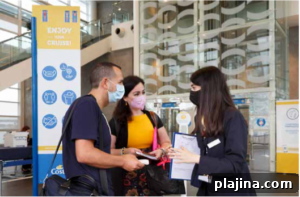
PHOTO: © CARNIVAL CORPORATION
Roger Frizzell, chief communications officer at Carnival Corp., described how the operator first introduced enhanced protocols on its AIDA and Costa brands when those ships resumed limited European sailings in late 2020. Positive passenger feedback and demonstrated effectiveness led Carnival to expand those practices fleetwide through a gradual, phased restart with limited guest occupancy, allowing crew and guests to adapt to a new onboard routine.
Dining aboard ships has changed industry-wide, with a move away from self-service buffets. While this shift partly responds to public health concerns, it also aligns with evolving passenger preferences for more personalized, refined meal service. AmaWaterways president Rudi Schreiner said aboard AmaSiena that he had long favored replacing self-service with menu-driven, attentive dining. Across Carnival’s global brands, the company continued expanding full-service restaurants and varied dining options.
“As an industry, we have dealt with many types of viruses previously and already have effective protocols in place on board our ships, including screening measures, medical centers and enhanced sanitation procedures,” Frizzell said. “Cruise lines have some of the most stringent and effective public health and sanitation practices, with multiple layers of protection encompassing the entirety of the cruise experience. The successful resumption of cruise operations has been a testament to that approach.”
Practices differ between ocean and river cruises and among large and small lines, but the protocols adopted by Cruise Lines International Association (CLIA) members offer a useful overview of how operators are preparing to resume safe operations. Every CLIA-member ocean cruise line maintains policies to monitor, detect and respond to COVID-19. In the relatively rare instances of cases since operations resumed, prearranged onboard response plans have been activated quickly and effectively.
A 2021 CLIA survey found 82 percent of veteran cruise travelers planned to resume cruising, exceeding pre-pandemic levels, while 62 percent of general travelers said they were open to cruising. CLIA president and CEO Kelly Craighead noted these figures reflect rising traveler confidence and the industry’s sustained commitment to enhanced safety measures.
For both experienced and new cruisers, the changes mean allowing more time for planning and preparation before a trip. The trade-off is that cruising can remain a satisfying way to explore the world with reduced risk for guests and crew.
At the time of reporting, CLIA noted 30 countries had reopened to cruise tourism, with additional markets preparing to follow. By aligning with science-backed protocols and coordinating with governments, CLIA member lines and others have helped facilitate a measured resumption of operations, supported jobs and modeled responsible travel — steps that passengers and crews are broadly willing to support.
EXTRA PROTOCOLS
Crystal Cruises, which resumed sailings in July 2021, introduced its Crystal Clean+ program to consolidate health and safety measures. The initiative requires vaccination and negative COVID-19 tests for all guests and crew, reduced capacity, social distancing, adaptable mask policies, rigorous cleaning routines, isolation rooms for suspected illness, contactless options such as QR-code menus, and a health screening questionnaire at embarkation. For Crystal’s river ships, all guests must be fully vaccinated at least 14 days before travel through Dec. 31, 2022.
Princess Cruises implemented crowd-control and social-distancing measures to reduce embarkation congestion. Guests can complete pre-cruise health questionnaires in advance via the MedallionClass app and choose staggered arrival times at the port. The mandatory safety drill can be completed by viewing a safety video on the app or on the stateroom TV on embarkation day. Passengers must provide a negative PCR or antigen test taken within two days of embarkation, with some flexibility for weekend sailings so results arrive in time for check-in.
In line with a Bahamian government emergency order, Bahamas Paradise Cruise Line requires all passengers aged 12 and older to be fully vaccinated at least 14 days before sailing and to present their original CDC vaccination card at embarkation. Passengers must also have a negative rapid antigen or PCR test within 72 hours of sailing. Unvaccinated guests under 12 must provide a negative PCR test taken no more than 72 hours before boarding and also take an antigen test at the terminal.