
We descend the covered steps from the aircraft and step into brilliant sunlight. The sky is a flawless blue and palm trees sway in the sea breeze. From the plane’s final approach we had admired a scatter of beach-fringed islands set in some of the clearest water imaginable. Where are we? The instant answer—“paradise”—comes easily to mind.
Most visitors stop there. Everything they see during their stay reinforces that first impression of the Seychelles.
These jewel-like islands in the Indian Ocean, a thousand miles off the African coast, draw beach connoisseurs from around the world. For decades they have been a favored retreat for celebrities and royalty; in 2011 Prince William and Kate Middleton chose the Seychelles for their honeymoon.
But specialists offer broader perspectives. Geologists, biologists and anthropologists all provide different answers to that simple question: Where are we?
Politically, the Seychelles belong to Africa. The nation is the continent’s smallest by land area (174 square miles) and population (around 84,000).
Geologists note that the main islands are granitic and are remnants of the Mascarene Plateau, which separated from the Indian subcontinent some 65 million years ago.
Biologists point to the islands’ remarkable endemism. Some plants and animals were stranded when the land broke away, while others arrived by wind or sea from Africa and Asia and evolved here into species found nowhere else.
Anthropologists emphasize the human influences. Centuries of French and British rule—until independence in 1976—have left traces in the architecture, language and appearance of the Seychellois people.
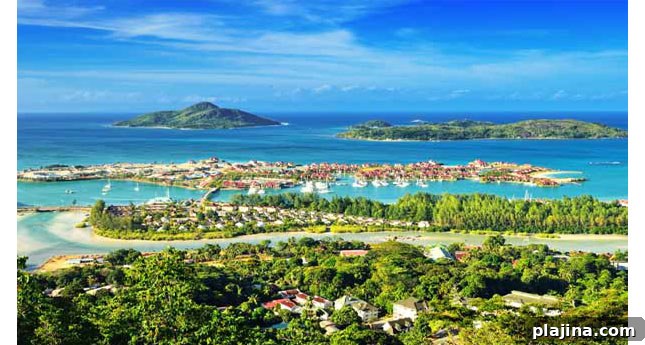
The coastline of Mahé Island © Oleg Znamenskiy | Dreamstime.com
The largest island, Mahé, is home to roughly 90 percent of the country’s population and houses the international airport. For many travelers Mahé is just a gateway to more secluded islands.
Mahé itself remains relatively unspoiled. Civilization’s footprint is light and a major portion of the mountainous interior is protected as a national park.
Before venturing inland we pass through the capital. The 15-minute drive from the airport reveals three reminders of 160 years of British influence: drivers keep left, the capital is named Victoria, and the city’s central roundabout features a small silver replica of London’s famous clock tower.
Victoria feels intimate rather than urban, yet it offers a genuine slice of local culture. Leaving the city, we turn inland and follow a winding road into the green highlands.
This side of the Seychelles is often absent from tourist brochures that favor picture-perfect beaches. With every bend we encounter dramatic tropical vistas that justify packing hiking boots along with swimsuits. For now, only a committed few explore the trails that cross this verdant wilderness.
After crossing the island we descend to the west coast and arrive at our first base, the five-star Constance Ephelia resort. Although the property is the island’s largest, its villas are spread across 296 acres of gardens and mangroves on a peninsula between two white-sand beaches, preserving a sense of privacy.
It’s easy to surrender to the setting: long hours on the sand, dips in the pool and gentle strolls through surf. We indulge for three days, but curiosity about other islands draws us onward. With 115 islands in the archipelago, there is always more to see.
A short flight by 19-seat Twin Otter takes us to Praslin in about 15 minutes. Again, the view from the air is a necklace of idyllic isles in crystalline water.
Praslin, the archipelago’s second-largest island, has a gentler population and a selection of elegant resorts. We stay at Raffles Praslin on the north shore, where golf carts ferry guests among villas that overlook nearby Curieuse Island.
Despite its modest width—three miles at most—Praslin’s interior hides an ancient tropical forest that has often been likened to the Garden of Eden. This fragment of a lost world is protected as the Vallée de Mai Nature Reserve and designated a UNESCO World Heritage site.
Coco de mer, Vallée de Mai Nature Reserve © Richard Semik | Dreamstime.com
The reserve’s entry fee can feel steep, but the three-hour trail through primeval forest quickly makes such complaints seem petty.
On the dirt paths, bizarre palms arch overhead like enormous blades of grass and huge leaves blot out the sun. Birdlife bustles through the undergrowth; soon we spot a Seychelles black parrot, one of 15 bird species unique to these islands.
The forest’s star attraction is the coco de mer. These palms are remarkable: individual trees are male or female, with male trees producing sausage-like flowers and female trees bearing the world’s largest seed. The coco de mer nut can take up to seven years to mature and its distinctive shape has inspired countless legends.
We cap our island-hopping with a trip to La Digue, urged by a local who praised its relaxed pace. A brief ferry crossing brings us to an island that, at first glance, seems to echo the others: smooth granite boulders on quiet beaches, spindly palms and dense interior vegetation.
La Digue sets itself apart by banning motorized watersports to preserve calm, and by embracing slower transport. Instead of taxis or golf carts, we board a wooden cart drawn by oxen. The gentle pace defines our stay.
An ox cart provides transportation on La Digue © Sarah Dreyer | Dreamstime.com
We stay at Le Domaine de L’Orangeraie, a Zen-influenced property of 55 villas focused on relaxation: sunbathing, massages and poolside repose. A brief bicycle ride takes us to Anse Source d’Argent, a beach often called the world’s best. Here all the familiar elements—clear water, soft sand, sculpted granite boulders and gracefully arranged palms—come together in near-perfect harmony.
At the end of our trip we return to Mahé and the international airport, preparing to leave the tranquil rhythms of island life. From the plane we watch the archipelago unfold—Silhouette Island’s green slopes, the small profile of North Island where the royal honeymooners stayed, and the inner granitic islands we’ve explored.
North Island also exemplifies conservation-minded tourism: profits help restore native habitats and remove invasive species. The Seychelles is a leader in ecotourism, with nearly half the country’s land area permanently protected and sizable marine reserves safeguarding the seas.
Further islands tempt us from above: the remote Outer Islands and alluring names like the Amirante group and Aldabra Atoll join our wish list. As we climb above the clouds, we bring home our suntans and a lingering calm, already resolving to return to this special place—truly, paradise.
SEYCHELLES INFO TO GO
International flights arrive at Seychelles International Airport (SEZ) on Mahé Island, about eight miles from Victoria. Since 2012 many international travelers connect via Abu Dhabi following changes in national airline routes. From SEZ, transfers to outlying islands are available by small aircraft or helicopter.
Where to Stay in the Seychelles
Desroches Island Resort: A 20-suite property on a coral island southwest of Mahé, ideal for diving and game fishing. Desroches Island $$$$
Frégate Island Private: A whole-island resort with luxurious residences, abundant wildlife and multiple beaches. Frégate Island $$$$
North Island Resort: An intimate private-island retreat offering seclusion and high-end amenities. North Island $$$$
Restaurants in the Seychelles
Anse Soleil Café: A barefoot, beachside spot serving Creole specialties, including the local favorite bat curry. Anse Soleil Beachcomber, Mahé $$$
Le Château de Feuilles: Candlelit fine dining with ingredients sourced locally from sea and garden. Le Château de Feuilles Hotel, Pointe Cabris, Praslin $$$$
Le Repaire Restaurant: Italian-inspired dishes made with local ingredients—pasta and wood-fired pizzas with a Seychelles twist. Anse Réunion, La Digue $$$