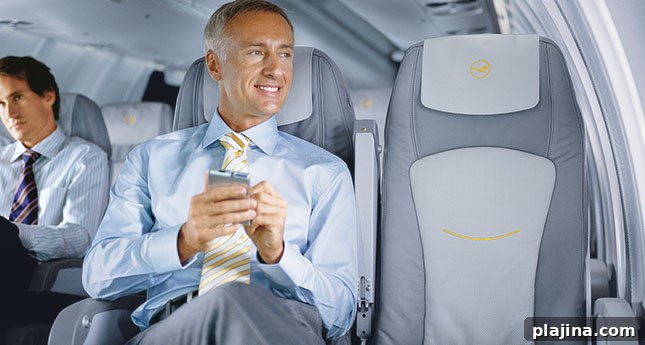
It is no secret that airlines and their first- and business-class cabins have faced significant challenges in today’s difficult economy. Over the past year passengers have encountered new hurdles — from checked-bag fees to reduced routes and lower capacities — yet one priority remains: providing high-quality service and innovative premium products at competitive prices.
At Global Traveler, we understand that many of our readers still travel in first and business class. Entrepreneurs, small business owners and executives know that nothing sustains business in a downturn like face-to-face meetings. As you continue to travel, we continue to deliver the information you need — and want — about premium travel offerings.
For the fifth consecutive year, our staff reviewed extensive information to compile the comprehensive charts featured on these pages. We queried airlines directly and collected details on configuration, entertainment, seat width, seat pitch, recline and onboard amenities.
Each year our research uncovers confusing or surprising data. One recurring source of confusion is seat pitch. Seat pitch is the distance between the back of your headrest and the back of the headrest in front of you when the seats are fully upright. Pitch affects how much room passengers have when sitting upright or reclining to sleep. Generally, a seat pitch of at least 70 inches is required for a true 180-degree lie-flat bed, an estimate based on the average male height of 5 feet 9 inches. Taller travelers might prefer carriers such as British Airways, United Airlines, V Australia, Air India or Hainan Airlines, which offer pitches of 70 inches or more.
There are, however, notable exceptions. Singapore Airlines, with a 51- to 58-inch pitch, delivers a truly flat bed through a unique design that compartmentalizes head and foot areas. When converted to a bed, the seat creates a fully flat 76-inch-long sleeping surface despite the relatively short pitch.
Air Canada’s herringbone configuration is another exception. That layout creates a suite-like atmosphere by angling seats outward so there is no seat directly in front of the seat bottom. Although the headrest-to-headrest pitch measures just 44 inches, the recline reaches a true 180 degrees. Delta Air Lines offers a similar exception with certain products.
This is the year of the consumer. To encourage travel, many airlines introduced sales and lowered first- and business-class fares to historic lows. If the cabin features highlighted in our charts appeal to you, now is an excellent time to sample premium offerings across global carriers. We expect many travelers will return as the economy recovers, drawn by service and product improvements introduced during these challenging times.
North America
North American travelers are discerning, and major carriers have worked to attract them amid strong competition from budget airlines for domestic routes. Skyrocketing fuel costs, the recession, health concerns and safety issues have made the past year particularly difficult for airlines.
In the last year several major U.S. carriers formed strategic partnerships: Delta merged with Northwest, and Continental left SkyTeam to partner with United Airlines and Star Alliance. One clear trend was the expansion of in-flight wireless Internet. American Airlines led the charge, and many other carriers followed. Comparing our 2008 and 2009 surveys shows a marked increase in WiFi availability. Alaska Airlines and Virgin America added onboard WiFi in premium cabins, while AirTran completed a fleetwide installation, becoming the first North American airline to equip its entire fleet.
American Airlines also introduced several new Boeing 737-800s and completed the installation of lie-flat, next-generation business-class seats across its Boeing 777s and 767s. The carrier plans further fleet updates and WiFi rollouts through 2012, aiming to maintain strong products while navigating economic challenges.
“American Airlines remains upbeat and confident in our plans to see our way through this environment,” said Charley Wilson, managing director of external communications and international advertising. “We are focused on two key customer objectives: to be the airline that best delivers what premium customers value and to deliver fair value to all non-premium customers.”
Europe
European carriers experienced a turbulent year. Late 2008 through 2009 saw the exit of several single-class airlines on transatlantic routes. British Airways launched OpenSkies, a two-class operation (Biz Bed and Biz Seat) between Paris (ORY) and New York (JFK/EWR), absorbing L’Avion, and briefly announced routes it later discontinued.
Malév Hungarian Airlines and Czech Airlines ceased service to the United States, Lufthansa became part owner of Brussels Airlines and planned extensive premium-cabin refurbishments, and British Airways and Iberia paused merger talks. Swiss International Airlines introduced a complete first- and business-class redesign in 2009, unveiling an adjustable, lightweight air-cushion business seat designed to improve comfort and fuel efficiency; refitting will continue through at least 2011.
LOT Polish Airlines, one of the Eastern European carriers still serving the United States, focused on product improvements despite the economy. In JulyLOT introduced a new business-class menu developed with a popular Polish chef, reflecting efforts to enhance the passenger experience.
Pacific Rim
Asia remains a growing market as tourism increases and new carriers expand service. In late 2008 Hainan Airlines started Seattle service and Singapore Airlines launched a business-class-only flight. Vietnam Airlines has been in talks to join SkyTeam and broaden its global network.
A wave of low-cost carriers in China increased domestic competition, but legacy carriers emphasize their opportunities. “Although there have been many negative impacts, opportunities parallel as well,” said Zhihang Chi, general manager of Air China. “The Chinese economy’s continued growth supports robust travel demand.” Air China announced an $80 million refresh of its long-haul fleet, with lie-flat first-class beds, new 170-degree business-class recliners and upgraded ground amenities.
Asiana Airlines continued product improvements, removing a business-class row to enhance comfort and upgrading its Boeing 777 business class to 32 seats with 60-inch pitch and 167-degree recline. Its Boeing 747 first class now includes 10 sleeper seats with 86-inch pitch. “Regardless of economic hardships, Asiana passengers’ paid comforts are never compromised, but always improved,” said Steve Koo, advertising director.
Richard Branson’s Virgin Group launched V Australia with service linking Los Angeles (LAX) to Sydney (SYD) and Brisbane (BNE). Qantas remains the largest Pacific carrier and rolled out cosmetic seat updates and a redesigned website to simplify bookings. Qantas also planned to increase A380 frequency between Los Angeles and Sydney to daily service in November. Air Pacific refreshed its 747-400 cabins with upgraded entertainment, lighting, seat covers and updated galleys and lavatories while preparing a new Hong Kong route and a codeshare agreement with Alaska Airlines.
“At all times, Air Pacific does not place any compromises on product, customer convenience or safety,” said Candy Andrus, general manager.
Latin America
TAM’s strong 2008 performance reinforced its leadership in Latin America. The region’s international service from the United States remains served largely by North American carriers, Japan Airlines, Korean Air, Avianca and LAN.
TAM joined Star Alliance in late 2008, with integration continuing into early 2010, expanding the carrier’s global reach. TAM added five international routes, including service from Rio de Janeiro (GIG) to Miami (MIA) and New York (JFK) and new São Paulo (CGH) routes to Orlando (MCO) and Lima (LIM); Brasilia (BSB) to Buenos Aires (AEP) also launched. Global Traveler’s “Date of Last Major Cabin Overhaul” category marks all TAM aircraft as “New,” reflecting the airline’s policy of operating a young fleet and its recent delivery of four Boeing 777-300ERs that provide more spacious cabins and improved fuel efficiency.
Middle East/Africa
Carriers in the Middle East faced competitive pressure but continued to innovate. Etihad Airways added four destinations in 2009 and launched non-stop service from Chicago. Etihad’s new Terminal 3 at Abu Dhabi International (AUH) introduced a concierge-style check-in for premium travelers and unveiled a first-class cabin with individual suites, oversized fully flat seats, built-in massagers, increased storage, iPod connectivity and enhanced privacy.
South African Airways maintained its service standards despite lower demand, introducing non-stop morning service from New York (JFK), boosting onboard entertainment options and offering refreshed menus to attract travelers. “While demand for travel is down, we haven’t slowed our efforts to win new customers, maintain existing ones and encourage travel to South Africa or with South African Airways,” said Marc Cavaliere, executive vice president of the Americas.
Method
To provide thorough information on first- and business-class services, Global Traveler spent months contacting airlines, reviewing independent research and conducting interviews with airline executives. We reached out to each carrier for the data used in our charts. When airlines did not respond, we supplemented entries with verified information from the previous year and independent sources such as airline websites and reputable seat-mapping resources. All survey entries completed through our research are clearly marked, and any information labeled “EST” reflects adjustments made by Global Traveler when discrepancies appeared between reported pitch and recline.
As you plan your next journey, we hope this guide helps you choose the airline and cabin that best suit your needs. Enjoy your first- and business-class experiences — happy travels from one set of global travelers to another.