
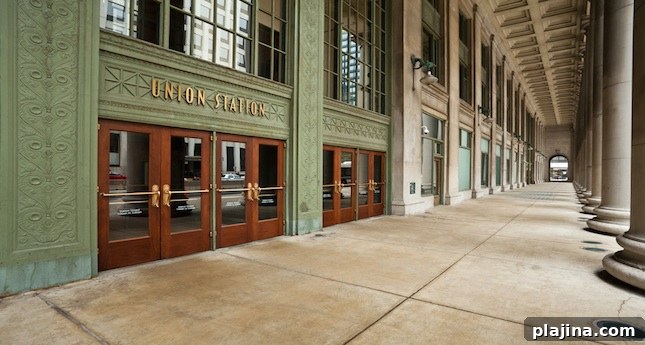
Amtrak last month announced that plans to restore Chicago Union Station are advancing into the next phase, which will include detailed planning, historic review and preliminary engineering. The global design firm Arup has been selected to lead the renovation work. Amtrak and the City of Chicago are jointly funding the station improvements to address passenger capacity, service reliability, safety, accessibility and circulation both inside and around the historic facility.
Under the contract, Arup will develop designs to expand and reconfigure concourses and entrances, widen platforms, and address ADA compliance, pedestrian passageways and ventilation systems. The work in this initial stage, called Phase 1A, is expected to take about 18 months.
“Chicago Union Station is an enormous asset to Amtrak as well as the City of Chicago,” said Stephen Gardner, executive vice president of Amtrak. “We are excited to begin this first phase of efforts to improve this vibrant transportation hub, in collaboration with our partners. These efforts, combined with related work to add new customer amenities and to encourage redevelopment of Amtrak’s historic Station Headhouse and surrounding assets, could restore Union Station’s role as a central anchor of the West Loop neighborhood.”
Mayor Rahm Emanuel added that the project is part of a broader commitment to modernize transportation infrastructure. “We are making Union Station a true transit hub and economic engine by doubling down on transportation investments that create jobs and transform neighborhoods,” he said. “Union Station provides an essential link to economic, cultural and recreational opportunities for Chicago’s residents, visitors and businesses. Modernizing Union Station is one of the ways we are working together to build 21st-century infrastructure to power Chicago’s 21st-century economy.”
The Phase 1A work will focus on improving passenger flow and safety while preserving the station’s historic elements. Planned upgrades aim to reduce congestion during peak travel times by enlarging key concourse areas and streamlining entry points, while platform widening will enhance boarding efficiency and emergency response capability. Accessibility upgrades will include improved path-of-travel routes, upgraded elevators and ramps, and clearer signage to meet current ADA standards.
Environmental and operational systems also are part of the scope: engineers will assess and modernize ventilation systems, lighting and other critical infrastructure to improve air quality, energy efficiency and passenger comfort. Preliminary engineering will identify constraints and opportunities that inform later construction phases and help minimize disruption during implementation.
Coordination with preservation authorities and community stakeholders will guide how historic components of the station are conserved and integrated with new elements. The historic review process will ensure that renovation work respects architectural character while enabling contemporary transit functions and amenities.
Amtrak and city officials say the renovation supports broader economic and neighborhood development goals. By improving connections, capacity and the overall passenger experience, the project seeks to encourage transit use, attract investment, and enhance the role of Union Station as a multimodal gateway to downtown Chicago and the West Loop.