
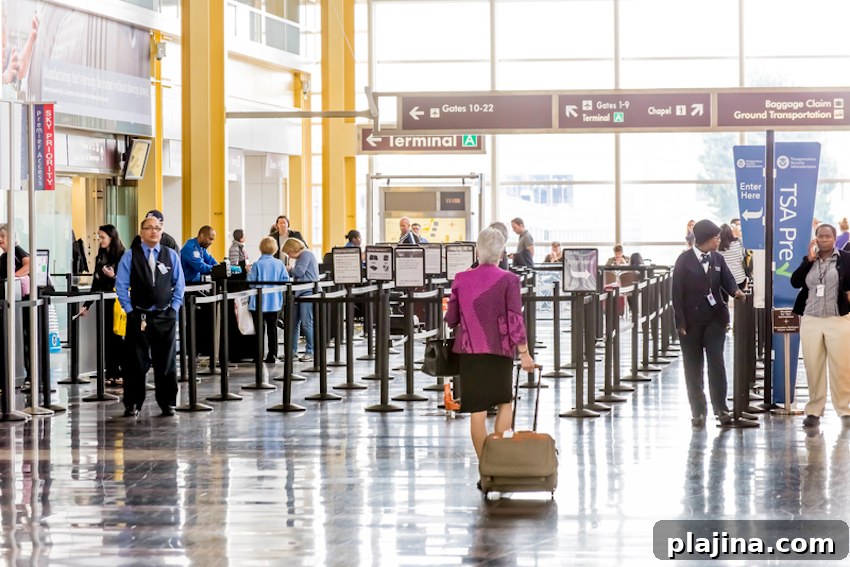
If new screening technology proves reliable after extended trials, passengers could soon be allowed to carry liquids in their hand luggage again.
The new system, called Analogic ConneCT, produces a three-dimensional image of a bag while it moves through the security checkpoint. Based on computed tomography (CT) techniques used in medical imaging, the scanner captures multiple X-ray views of each item from different angles and reconstructs a detailed 3-D picture. Unlike traditional X-ray machines that require close inspection of separate liquid containers, ConneCT pairs imaging with an algorithm that highlights potential threats such as explosives, helping security staff identify suspicious items more quickly and accurately.
Trials for the scanners began in late 2017 and they received approval from the Transportation Security Administration not long after. This year, the technology has been deployed for operational testing at major hubs including London Heathrow and New York’s John F. Kennedy International Airport. If the tests continue to show strong performance, the rollout could expand and simplify the passenger screening process.
Despite the improved detection capabilities, current liquid limits remain in place: travelers are still expected to carry containers no larger than 3.4 ounces (100 milliliters) in their hand luggage. The new scanners aim to reduce the need to remove electronics and liquids for separate screening, speed up checkpoint flow, and lower false alarms, while maintaining high security standards.
Airport security authorities and regulators will continue to evaluate the technology’s consistency, false-positive rate, and integration with existing procedures. Adoption at additional airports will depend on those assessments as well as logistics such as installation costs, staff training, and throughput capacity. If all factors are favorable, passengers may experience a more convenient and streamlined boarding process in the coming years without compromising safety.