
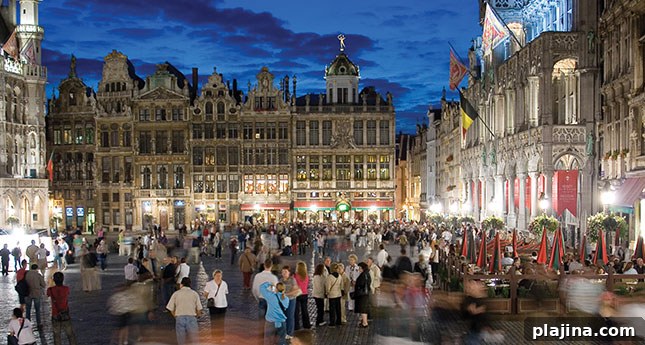
Lovely Brussels, with its soaring spires, charming passageways and landscaped parks, began humbly. Around the year 580, when the Senne still meandered through the region, settlers founded a small village and built a chapel on a modest island in the river, surrounded by marshland. The city’s name, derived from Old Dutch, essentially means “home in the marsh.” Its riverside location near Bruges, Ghent and Cologne helped trade grow steadily, and by the 12th century the marshes were gradually drained to make way for urban expansion.
In the 14th century, defensive walls were erected around the city. By the late 19th century those fortifications had mostly been removed and replaced by roads and boulevards. The historic center, originally laid out as a pentagon, is now ringed by a major road, and only fragments of the medieval walls remain. The most prominent remnant is one of the original seven city gates, the impressive Porte de Hal (Halle Gate) on Boulevard du Midi.
An 1830 performance of Auber’s La Muette de Portici at the Théâtre Royal de la Monnaie is often cited as the spark for the Belgian Revolution. That uprising led to the creation of the Kingdom of Belgium, the accession of Leopold I, and the separation of the predominantly French-speaking Catholic southern provinces from Dutch rule. A few years later, the major European powers formally recognized Belgium’s independence. Today French and Dutch are the official languages and public signage is generally bilingual.
As headquarters for NATO and a key center for the European Union, Brussels sits within the Brussels-Capital Region and is divided into 19 separate municipalities. The city blends art, history, culture and cuisine into a lively urban experience. It is the birthplace of actress Audrey Hepburn and claims a close association with Agatha Christie’s fictional detective Hercule Poirot, who began his career in the city’s police force and famously bristled at being mistaken for a Frenchman.
Brussels designated 2009 as the official Year of the Comic Strip, and the Belgian Comic Strip Center celebrates the country’s rich cartooning heritage with permanent and temporary exhibits. The museum spotlights Hergé’s creation Tintin, the intrepid young reporter whose adventures with his dog Snowy have delighted readers worldwide.
The Musée Magritte Museum honors the surrealist work of René Magritte across five themed floors, exhibiting paintings, photographs, texts and interviews that illuminate the artist’s playful and provocative vision.
Brussels takes food seriously and with style. Belgian waffles come in two main varieties: Brussels and Liège. In pâtisseries and cafés you’ll find rectangular Brussels waffles with a crisp, golden exterior and deep pockets perfect for strawberries, powdered sugar or whipped cream. Liège waffles are denser, sweeter and chewier, and are commonly sold by street vendors. Culinary tours of the city can be arranged through local operators.
Classic Belgian dishes include moules-frites (mussels with fries) and exquisite handmade chocolates from renowned chocolatiers such as Wittamer, Leonidas, Neuhaus and Mary. The city also has a proud beer culture. Lambic, a traditional Brussels-style beer fermented with local yeasts, comes in several varieties. Kriek is one popular Lambic made with sour cherries. Pubs and cafés abound; the pleasant dilemma is choosing which terrace offers the best view of the city’s lively street life.
INFO TO GO
Brussels Airport (BRU) serves the city. Car rentals and taxis are available, but traffic can be heavy and parking limited, so many visitors prefer the frequent train shuttle to the city center. Trains run approximately every 20 minutes and are an economical, convenient option.
LODGING
COMFORT ART HOTEL SIRU
Themed floors and 101 guestrooms decorated with contemporary Belgian art and poetry. Located on a broad pedestrian mall. $$$
COMFORT ART HOTEL SIRU
1 Place Rogier
tel 32 2 203 35 80
LE DIXSEPTIÈME
A luxurious, palatial hotel in the historic district, restored from a 17th-century building with suites named for Belgian artists. $$$
LE DIXSEPTIÈME
25 Rue de la Madeleine
tel 32 2 517 17 17
THE DOMINICAN
Opened in 2008, this eclectic and elegant hotel stands behind the city’s notable theater and opera house. $$$$
THE DOMINICAN
9 Rue Léopold
tel 32 2 203 08 08
DINING
COMME CHEZ SOI
A Brussels institution with two Michelin stars and seasonal menus. Closed Wednesdays for lunch, and closed Sundays and Mondays.
COMME CHEZ SOI
23 Place Rouppe
tel 32 2 512 29 21
LA MARÉE
A relaxed, friendly atmosphere with a wide selection of fresh seafood. Located just behind the fish market at Metro Sainte-Catherine. Closed Sundays and Mondays. $$$
LA MARÉE
99 Rue de Flandre
tel 32 2 511 00 40
ROTISSERIE VINCENT
Kitschy nautical décor and a solid menu of Belgian classics, including generous beef dishes and moules-frites. $$$
ROTISSERIE VINCENT
8–10 Rue des Dominicains
tel 32 2 511 26 07
DIVERSIONS
La Grand-Place (Grote Markt), a UNESCO World Heritage site, is the city’s magnificent central square and showcases a range of architectural styles. Ornate buildings like Le Cornet reflect maritime motifs in an Italian-Flemish style, while Le Cygne (The Swan) bears a carved swan above its entrance and once hosted meetings associated with Karl Marx.
Near La Grand-Place stands the famous bronze fountain Manneken Pis, a small statue of a boy at his fountain that attracts many visitors. The statue’s extensive costume collection—housed in the neo-Gothic La Maison du Roi—features more than 700 outfits created to dress the figure over time. La Maison du Roi sits opposite the Gothic Hotel de Ville, which houses the city’s historical museum.
The Palais Royal overlooks Brussels Park and is open to visitors in summer months. Music lovers should not miss the Musée des Instruments de Musique, with a collection of more than 7,000 instruments. The Musées Royaux des Beaux-Arts displays national treasures including works by Brueghel and Rubens. Many museums and attractions are closed on Mondays, so plan accordingly.
Cathédrale des Saints Michel et Gudule is a golden-hued Gothic cathedral often used for royal ceremonies. For architecture and design enthusiasts, the Musée Horta—once the home of Art Nouveau architect Victor Horta—offers insight into one of Brussels’ most influential creative figures.