
Just after midnight, my brother Sam and I receive a phone call in our Prague hotel room. It’s Martin, my British brother-in-law, calling from the nearby Casino President where he works as night manager. He asks if we’d like a quick look at the casino operations before his contract ends in a few weeks.
Martin has been in Prague almost a year and has given us helpful sightseeing tips; tonight is our last night in the city. If we want a personal tour of Casino President (Nam. Curieovych 100, tel 420 234 614 113), we need to move quickly.
We’ve just returned from a lively dinner where beer, roast pork with sauerkraut, dumplings and jablkový závin (apple strudel) were abundant, and the pub-style restaurant was packed with young Czechs, European tourists and a few American ex-pats. Normally I’d decline a late-night invitation and head to bed, but it’s a warm summer night in Prague — a city I may not visit again soon — and an insider’s tour sounds too tempting to pass up. Within ten minutes we’re in a taxi.
Even at this hour, beer gardens are still serving pilsner and couples stroll along the Vltava River. A full moon washes Prague’s medieval skyline in a soft, unreal light. Martin meets us at the casino entrance, ushers us through the smoky, noisy gaming floor to a reserved table in the restaurant, and orders two steaks and beers before slipping away to an emergency meeting with his supervisors. We watch him head into the bright chaos of the casino, chain-smoking and delivering a witty line in his English accent that lingers in our minds. Slot machines chime constantly outside the restaurant; an Italian man argues with a woman beside him, and somewhere nearby a woman is singing “New York, New York” on karaoke. For a moment I think, “I could be in bed right now.”
Sam and I aren’t really hungry, but the steaks and beers have arrived, so we settle in and talk about how much we’ve grown attached to Prague during our visit.
During the first few days we explored the city center, beginning at Wenceslas Square, a long rectangular plaza laid out 600 years ago as a horse market. Today it’s lined with shops, hotels and restaurants, and it remains a focal point for political gatherings and public demonstrations. It was here that student Jan Palach set himself on fire in protest of the 1968 Soviet invasion, and where crowds returned in 1989 during the Velvet Revolution to mark the end of communist rule.
Overlooking Wenceslas Square is the 19th-century National Museum (Vaclavske namesti 68, tel 420 224 497 111), one of the city’s major historic institutions. Nearby, the Prague State Opera Theatre (Legerova 75, tel 420 296 117 211), a beautifully restored late-19th-century building, presents opera and ballet performances.
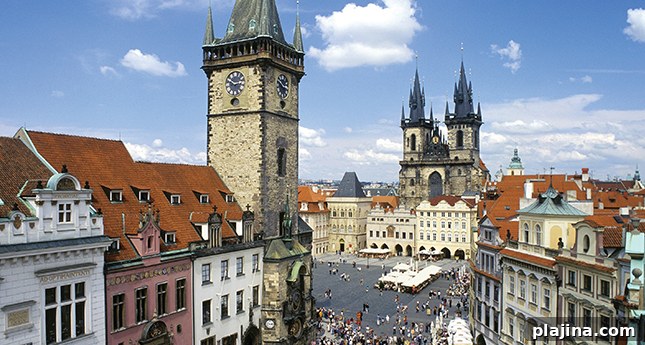
From Wenceslas we walked north to Old Town Square, the city’s historic heart since the 10th century and the site of many dramatic events, from Hussite executions in the 15th century to Nazi attempts to destroy the Old Town Hall in 1945. The square is usually filled with tourists taking photographs of the Tyn Church and the 15th-century Astronomical Clock on the Old Town Hall Tower.
A short walk north of the square brought us to the river and the former Jewish quarter of Josefov. Despite centuries of oppression, including the Holocaust, Jewish life in Prague is experiencing a revival. Several historic synagogues remain, such as the Old-New Synagogue, Europe’s oldest active synagogue completed in 1270, and the 15th-century High Synagogue. The Old Jewish Cemetery, used from the 15th century until 1787, is a somber site where visitors still linger among its layered tombstones and shaded trees.
Today Prague’s Jewish community includes residents from Europe, Israel and the United States, many of whom contribute to the city’s cultural and economic life as entrepreneurs, artists and restaurateurs. A kosher grocery and deli has reopened in recent years; King Solomon’s Kosher Bakery and Deli (Siroka 8, tel 420 224 818 752) sells matzo, gefilte fish, kosher meats and wine.
We crossed the Vltava River frequently, using either the Josef Manes Bridge or the more famous Charles Bridge. The Charles Bridge is especially magical late at night, when the crowds thin and Prague Castle glows across the water. In winter the bridge can be harsh and windy, but the snow-covered castle creates its own dramatic beauty.
Much of Prague is part of a UNESCO World Heritage site, and Malá Strana (Lesser Town) is one area you can easily wander into and take for granted. It begins at one end of the Charles Bridge and climbs toward the castle complex. We spent a day exploring its narrow streets, which date back to the 8th century. Many Renaissance and Baroque houses still serve as residences, while their ground floors often house pubs, galleries and small shops that thrive on tourist traffic.
The constant flow of visitors and location shoots must be challenging for residents, but the neighborhood benefits from dozens of small hotels, numerous restaurants and steady local business. There are quiet corners, too: the 18th-century St. Nicholas Church with its large green dome is one of Central Europe’s finest Baroque structures, and Petrin Hill offers a peaceful walk and sweeping views from its 1891 observation tower, a charming Eiffel Tower look-alike accessible by funicular.
About two hours after we arrived, Martin returns to the restaurant while we finish our coffee. Despite his insistence that we take his personal casino tour, Sam and I decide to leave the bustling casino and walk back to the hotel. The streets are empty, historic facades are softly lit, and the private tour we had hoped for unfolds naturally as we wander through a nearly empty city, savoring Prague to ourselves.
Info To Go
Prague-Ruzyne International Airport (PRG) is about nine miles from the city center; taxi rides typically take 25–40 minutes (airport licensed taxis recommended). The Airport Express bus connects to the main rail station and metro (fare around $2.40). Although the Czech Republic is in the European Union, it still uses the koruna (crown) as its currency.
Lodging
Hotel Josef
Modern boutique hotel with 109 rooms featuring designer furnishings, Philippe Starck bathroom fittings and complimentary high-speed Internet. Interior by Czech designer Eva Jiricna. Rybna 20, tel 420 221 700 711, $$$
Mandarin Oriental Prague
Located in Malá Strana in a former Dominican monastery, this elegant hotel was named Czech “Building of the Year” in 2007. Home to the atmospheric Essensia restaurant. Nebovidská 1, tel 420 233 088 888, $$$$
Radisson Blu Alcron Hotel
Restored 1930s Art Deco property near Wenceslas Square offering rooms with castle views, two notable restaurants, business services and a health spa. Stepanska 40, tel 420 222 820 000, $$$
Dining
Allegro
The first restaurant in a post-communist country to earn a Michelin star (2008, retained in 2009). Known for slow-roasted veal with Alba truffles. Four Seasons Hotel, Veleslavinova 2a, tel 420 221 427 000, $$$$
La Degustation Boheme Bourgeoise
Restaurant focused on local producers and organic ingredients. Midweek two-course tasting lunches offer good value. Hastalska 18, tel 420 222 311 234, $$$
Riegrovy Sady Beer Garden
Large park beer garden in the Vinohrady district with an extensive menu and excellent beer; open April–October. Riegrovy Sady, tel 420 222 717 247, $