
We may not have the “beam-me-up, Scotty” teleportation Gene Roddenberry imagined when he created Star Trek in the 1960s, but modern travel is closer to science fiction than many realize.
Some innovations that feel routine today were once the stuff of speculation. As Global Traveler enters its ninth year of publication, it’s worth looking back at the technologies and service improvements that have reshaped travel since our first issue in February 2004.
“Probably the greatest innovations over the past several years have been the way we communicate with our customers and the flying experience itself,” says John Jackson, vice president, marketing and sales for Korean Air. “Internet and mobile access have definitely shifted the paradigm. Constant IT improvements make it possible to interface with passengers with a timeliness like never before.”
Jürgen Seibenrock, vice president, the Americas, Lufthansa, echoes that view. “Innovation and technology both play a much greater part in the overall travel experience,” he says. “In today’s lifestyle, people want to stay connected wherever they go. Technology has also increased the self-service aspect of travel and has made it easier to connect with the airline via text message services, Facebook or Twitter.”
From a practical perspective, technology has delivered clear benefits. Global Traveler reader and frequent traveler Frank Reilly highlights Global Entry, the U.S. Customs and Border Protection program that allows expedited clearance for pre-approved, low-risk travelers, as a major convenience. Qualified travelers can use automated kiosks at select airports to enter the United States.
“Global Entry, the new kiosk immigration service, has been the biggest help to me,” Reilly says. “Since enrolling a number of years ago, I have never spent more than five minutes in immigration or, after retrieving my bags, in the customs line.”
Reilly also cites kiosk check-in and smartphone boarding passes among the top travel innovations of recent years. Airline industry veteran Bill Noonan agrees.
“The concept of ticketless travel and advance boarding passes was actually talked about as early as the 1970s,” says Noonan, general manager of sales, the Americas, for Asiana Airlines. “However, it wasn’t until 1995 that the process finally started to become a reality. Today, virtually all airlines provide their customers with ticketless travel based on a PNR — passenger name record.”
“Estimates suggest the cost savings associated with changing from a paper ticket to a passenger record designator is 15-fold,” Noonan adds. “The real benefit to passengers, though, is being able to avoid check-in lines by having their boarding passes and seat assignments confirmed and in hand 24 hours prior to departure.”
Advances in technology have also made communicating with airlines easier. While many travelers still find automated phone menus frustrating, the internet has made it simple to find and book flights, change schedules, claim frequent-flyer miles and share feedback when service falls short. Social media and review platforms give travelers a direct voice and provide service providers with immediate customer feedback.
“The most important and powerful development for the traveler in the past decade has been the access to information we now have via the Internet,” says Global Traveler reader Frank Brightwell. “Whether through vendor sites or via blogs and Twitter, the information I can gather before I leave the house is incredible — and communication goes both ways. Service providers also have immediate access to feedback from their customers.”
Customer feedback has influenced many improvements in comfort and convenience across the industry.
“Many international airlines are offering passengers a more relaxed flying experience designed around lounges, shops and social areas,” observes Korean Air’s Jackson. “There’s definitely a race among the top airlines for comfort, spaciousness and service.”
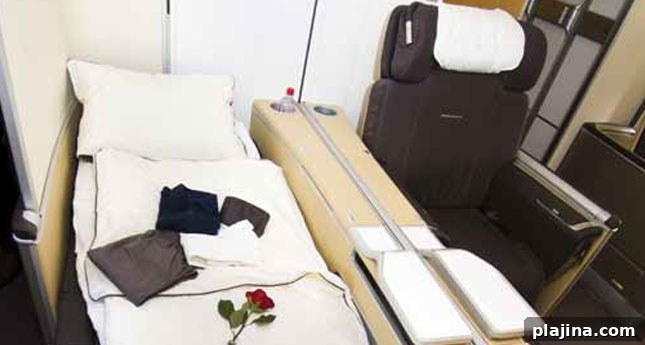
“Over the past nine years we’ve witnessed three significant innovations in commercial air travel,” says Ken Bright, vice president, Singapore Airlines. “First among them is an industry-wide trend toward improved passenger comfort in all classes of service, often to levels never dreamed of in the past. While private first-class suites and lie-flat business-class beds are the most obvious examples, greatly improved economy-class seat ergonomics and 1,000-plus personal entertainment options at every seat mean that all travelers have benefited from this trend.”
Qantas has pursued improvements across every cabin. “Our Airbus A380 showcases how far our product and services have come,” says Wally Mariani, Qantas senior vice president, the Americas. “Our first-class suites and business-class beds ensure you sleep as soundly as you would in your own bed, while our economy-seat ergonomics and spacious premium-economy seats are designed to maximize comfort.
“We have revolutionized in-flight dining, and we offer 5-star restaurant-quality meals,” Mariani adds. “Plus, passengers have abundant options to amuse themselves during flights with our ever-improving array of in-flight entertainment options.”
Innovations tied to the Airbus A380 have generated particular buzz. Korean Air’s in-flight business-class lounge and Emirates’ first-class onboard shower are high-profile examples of how cabin design has evolved to provide social spaces and distinctive amenities for premium travelers.
“The best innovation yet is Emirates’ onboard shower,” says Global Traveler reader Daniel Green. “The A380 cabin design has opened up a new world for premium travelers. Korean Air’s in-flight lounge gives business travelers the ability to move around instead of feeling trapped on a long-haul flight.”
Technology also plays an invisible but important role by preventing and resolving travel disruptions. Mobile check-in and boarding passes are standard, and many airlines offer real-time upgrade status on departure monitors. Automated systems can rebook passengers after cancellations or missed connections, and travelers can retrieve new itineraries on their smartphones without needing agent assistance.
“In addition to services like mobile check-in and mobile boarding passes, upgrade-eligible customers can now routinely check their status on departure monitors to see where they fall on the upgrade list,” says United Continental spokesman Rahsaan Johnson. “We also have systems to automatically rebook passengers if their flights are canceled or if they miss a connection due to inbound delays. Travelers can pull up their new itineraries on their smartphones, so they have much more control and can rely less on agent assistance if they don’t need it.”
To recap: since February 2004 the premium air travel experience has advanced markedly in comfort, convenience and accessibility. Travelers confirm reservations, select seats and access boarding passes on mobile devices the size of a wallet. Onboard, passengers enjoy enhanced dining, broad entertainment libraries, and the ability to recline into fully flat beds with linens and pillows. At arrival, easy-to-scan passports or Global Entry kiosks speed the immigration process for eligible travelers.
All of this comes alongside faster, more direct routes. “The advent of ultra-long-range aircraft means that nearly any two points on Earth can be connected with a non-stop flight, shortening overall travel times and improving convenience for global travelers,” says Singapore Airlines’ Ken Bright.
With a nod to the past and an eye on the future, it’s clear that many innovations once imagined in science fiction have become real improvements to how we travel today.