
Prepare to be breathless when you step off the plane in Bogotá. Colombia’s cosmopolitan capital sits along a high Andean plateau at roughly 8,530 feet, spread east to west with cool, thin air that greets every visitor.
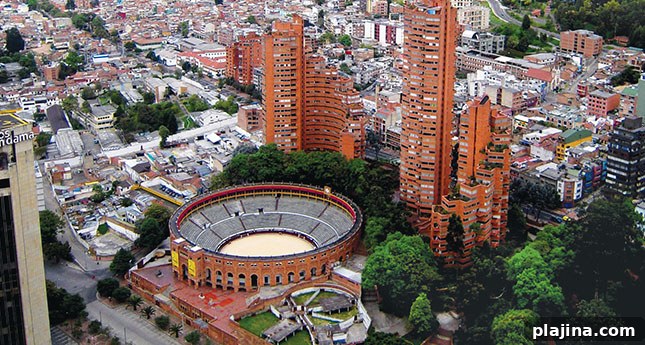
Even before you land, the city announces itself. On final descent you pass over the páramo of the Andean highlands, a largely agricultural area dotted with grazing dairy cattle and greenhouses that glint in the sun — producers of roses and carnations exported worldwide. Then the urban fabric suddenly emerges: a sprawling, industrialized city of brick buildings stacked in varied heights and densities, a testament to Bogotanos’ enduring affinity for the warm, ruddy material.
Rogelio Salmona, a prominent Colombian architect, helped shape that brick aesthetic across Bogotá. His last project, the Gabriel García Márquez Cultural Center, completed shortly before his death in 2007, offers smooth, curving forms that contrast with the angular colonial blocks of La Candelaria. Salmona also worked to humanize neglected central areas — notably Avenida Jiménez and its Environmental Axis (Eje Ambiental), which integrates the city’s old river courses into shady, pedestrian-friendly promenades. His Torres del Parque residential complex remains an iconic part of Bogotá’s skyline: two towers that reach upward alongside the eastern mountains, symbols of rebirth after turbulent chapters in the city’s past, including the Bogotazo of 1948.
While many businesses and offices have migrated north to upscale neighborhoods like Quinta Camacho and Rosales, Torres del Parque stands in La Macarena, a barrio that has reinvented itself from edgy and bohemian to a lively cultural and dining district. Where once a foreigner’s walk through La Macarena might have raised eyebrows, today independent restaurants, shops and boutiques make it a destination distinct from the major draws of the Museo del Oro and the austere Plaza de Bolívar.
This mix of contemporary and colonial architecture, vibrant cultural life and civic pride explains the affection residents show for their city. Bogotá hosts major cultural events — for example, the Bogotá International Book Fair draws hundreds of thousands of visitors and the Ibero-American Theater Festival brings international attention — but security remains a frequent topic in international coverage.
To attract visitors and investment, Bogotá continually reinvents itself. Gastronomy is now a clear selling point, organized into culinary zones: Zona G in Rosales for gourmet dining, Zona C around La Candelaria, and Zona T for nightlife. International hotel brands have returned, with chains reestablishing a presence and many new options for travelers. Yet rapid growth brings transport challenges.
The city’s bus fleet is notorious: rickety buses speed through narrow streets, often without regard for lanes and emitting heavy exhaust. Taxis are not always a comfortable alternative, and debates about a metro system continue alongside criticism of the existing TransMilenio bus rapid transit. A modern metro could ease congestion and, ideally, inspire commuters to care for shared transit infrastructure.
Bogotá markets itself as bike-friendly and has miles of separated bike lanes thanks to initiatives by former mayor Antanas Mockus. For visitors, two practical ways to cycle safely are recommended: rent a bike and join the Sunday ciclovía, when main arteries close to cars and open to cyclists, joggers and pedestrians; or take a guided tour such as the locally run Bogotá Bike Tours for an informed, candid overview of the city.
Despite its challenges, Bogotá continues to bloom culturally. Well-used libraries, respected universities and growing international business presence combine with local comforts like ajiaco soup to create a city that is both industrious and inviting. Bogotá is fast becoming a destination that balances business and tourism, offering elegant hotels, inventive dining and a compelling, sometimes turbulent, history.
Diversions
There are countless ways to spend an evening in Bogotá. One lively option in Zona Rosa is Andres Carne de Res (Calle 82 No. 12-21), a colorful, theatrical steakhouse that transforms into a nightclub after dinner — a quintessentially Colombian night out. For a calmer scene, visit Parque de la 93 (Calles 93A–93B between Carreras 11A and 13), a pleasant plaza framed by quality restaurants and cafés.
Bogotá’s museums are essential for understanding the region’s past. The Museo del Oro in La Candelaria houses the world’s largest collection of pre-Hispanic gold objects, offering an unparalleled look at indigenous craftsmanship and cosmology. The Museo Arqueológico presents pre-Columbian ceramics and artifacts, while the Museo de Arte Colonial features works from the colonial period. Also in La Candelaria, the Gabriel García Márquez Cultural Center showcases fluid modern architecture alongside galleries, cafés, shops and a substantial Spanish-language library.
Lodging
Charleston Casa Medina
Set in leafy Rosales within walking distance of many top restaurants, Casa Medina combines modern guestrooms with an atmospheric setting. Carrera 7 No. 69 A-22, tel 57 1 217 0288
Hotel Casa de la Botica
A restored colonial house near Plaza de Bolívar offering a small collection of elegant, modern suites surrounded by gardens and courtyards. Calle 9 No. 6-45, La Candelaria, tel 57 1 281 0811
Hotel de La Ópera
Located among La Candelaria’s cultural landmarks, this hotel provides stylish rooms along with a notable spa and dining experience. Calle 10 No. 5-72, La Candelaria, tel 57 1 336 2066
Dining
Criterión
Run by the Rausch brothers, Criterión is widely regarded as one of Colombia’s finest French-influenced restaurants. Consider the tasting menu paired with wines. Calle 69A No. 5-75, Zona G, tel 57 1 310 1377
La Esquina
An unpretentious spot celebrated for Colombia’s coastal seafood traditions, offering fresh, flavorful dishes. Carrera 4A No. 26 A-04, La Macarena, tel 57 1 283 8685
Leo Cocina y Cava
Chef Leonor Espinosa highlights regional Colombian ingredients in a refined setting; notable dishes include sea bass wrapped in plantain leaves. Calle 27B No. 6-75, La Macarena, tel 57 1 286 7091