
The great city of İstanbul sits at a crucial crossroads of trade and culture. Most people focus on the familiar east–west axis that links Asia and Europe, but there is also a south–north corridor that connects the Mediterranean with the Black Sea. This second axis shapes a very different side of Turkey’s geography and history.
Though the Black Sea region is often overlooked by visitors to Turkey, dramatic changes are underway just 22 miles northwest of İstanbul, along the Black Sea shore. Forested hills and wetlands are being reshaped to form a vast, flat expanse of more than 17,000 acres—the site of İstanbul’s new airport. With six runways and one of the world’s largest single-roof terminals, the $36 billion project, scheduled to begin operations in 2018, will shift İstanbul’s—and Turkey’s—center of gravity and bring the Black Sea coast into sharper global focus.
Turkey’s Black Sea coastline stretches from the Bulgarian border to the Georgian frontier, tracing hundreds of miles of beaches and coves, pine-clad promontories and sheer cliffs. In contrast to the sun-drenched resorts of the Mediterranean, the Black Sea coast resembles the U.S. Pacific Northwest, with lush green hills and cooler, wetter weather.
Samsun, roughly midway along the coast, makes a useful gateway. Modern and sprawling, Samsun offers few tourist sights in its contemporary center, but it holds a central place in Turkish history: Mustafa Kemal Atatürk launched the War of Independence here in 1919. The Gazi Museum documents that pivotal moment and is worth a stop.
Samsun’s strategic position that aided Atatürk’s campaign also makes it a logical base for travelers exploring the region. From Samsun you can head west along milder, sunnier stretches of coastline or travel east toward cooler, wetter terrain.
Heading west, the coastal city of Sinop sits on a narrow isthmus protected by imposing medieval walls. The city’s layered past is well represented at the Sinop Archaeological Museum. From Sinop a scenic 200-mile drive along mostly coastal roads leads to Amasra. The route winds through attractive red-roofed villages and offers continual views of the sea.
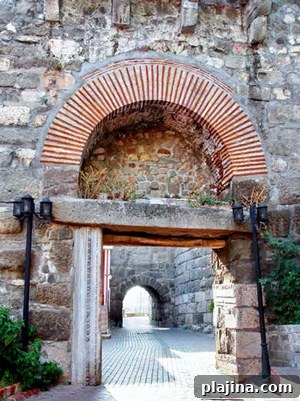
Ancient Amasra Castle gate © AHMET IHSAN ARITURK | DREAMSTIME.COM
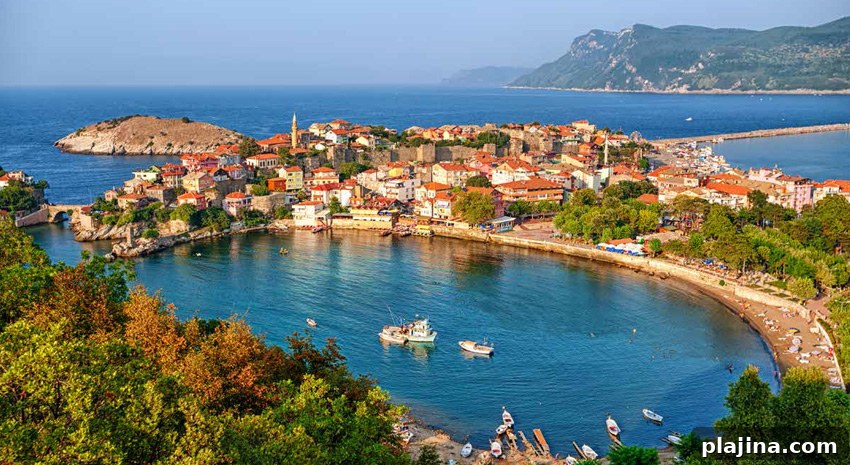
The old port of Amasra sits huddled on a headland and has been noted since Homer’s time. Romans, Byzantines and Genoese all left their marks; Amasra Castle reflects this layered history. More than its monuments, the town’s charm lies in its narrow streets, a lovely sandy beach and a working fishing port. Colorful wooden boats rest beneath the old battlements, and bustling fish restaurants serve fresh, local catches—an authentic, low-key seaside experience.
East of Samsun, roughly halfway to the Georgian border, lies Trabzon. Once known as Trebizond, it was the center of a medieval empire and an important Silk Road port. Although modern Trabzon can feel provincial, the old town’s winding alleys still convey echoes of that exotic past.
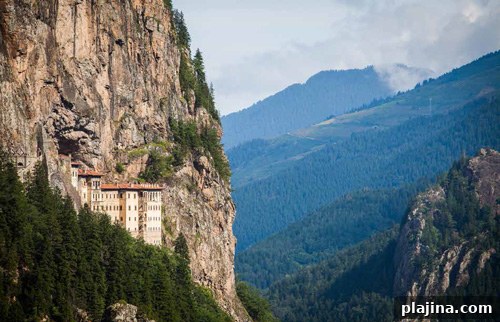
Sumela Monastery hugging the hillside in Trabzon © BIZOON | DREAMSTIME.COM
One of Trabzon’s most notable buildings is its 13th-century Hagia Sophia. Over centuries it has served as an Orthodox church, a mosque, a prison and, during World War I, a Russian military hospital. Recently the building’s status has been debated, and for now it remains a museum and a must-see when visiting the city.
An hour’s drive inland from Trabzon, clinging to a sheer cliff face, is the remarkable Sumela Monastery. Founded in AD 386, the monastery has survived earthquakes and centuries of change and remains an important pilgrimage site. Restoration work began in September 2015 and at times has required scaffolding; the monastery has been periodically closed for conservation, with reopenings timed to key dates.
The coming together of the modern İstanbul airport project and ancient monuments like Sumela highlights Turkey’s role as both a geographic and historical crossroads. A journey along the Black Sea coast brings that heritage to life—lush landscapes, layered histories and vibrant coastal towns connected by a distinct culture and cuisine.
Black Sea Coast Info to Go
The main regional hub remains İstanbul’s Atatürk International Airport (IST), which has long been cramped and crowded. Plans called for operations to shift to the new airport beside the Black Sea in 2018. Travellers often fly into key coastal airports instead: Samsun Airport (SZF) offers regular connections from İstanbul and seasonal flights from several European cities, while Trabzon Airport (TZX) provides domestic connections and year-round service from Germany.
Restaurants in the Black Sea Coast
CEMILUSTA TRABZON — Located on Trabzon’s main square, this local favorite, part of the Cemilusta franchise, serves reliable Turkish dishes with prompt service. Atatürk Alani, Trabzon $$
MUSTAFA AMCA’NIN YERI — A family-run fish restaurant that has been an Amasra institution since 1945. The terrace offers lovely sunset views. Küçük Liman Caddesi 8, Amasra $$
PAMUK KARDEŞLER — With three branches in Samsun, the most popular sits beside a small marina at Batı Park. Known for fresh fish and casual waterfront dining. Batı Park, Samsun $$
Where to Stay in the Black Sea Coast
ANEMON SAMSUN HOTEL — Stylish seafront rooms, adjacent shopping and close proximity to downtown make this one of the better hotel options in Samsun. Yeni Mahalle Çarşamba Caddesi 52, Canik, Samsun $$$
HILTON GARDEN INN TRABZON — Located just outside the city, the Hilton offers spacious rooms and suites; a sea-view room is recommended. Barbaros Hayrettin Pasa Sokak 35, Akçaabat, Trabzon $$$
NORTHDOOR HOTEL AMASRA — Convenient waterfront location close to town and beach, with attractive rooms and solid service. Turgut Işik Caddesi 78, Amasra $$