
Strawberry lemon meringue pie. That was my first impression upon tasting Champagne Billecart-Salmon Brut Rosé — an immediate love for its remarkable balance of freshness and structure, red fruit and citrus, drinkability and complexity.
© Kelly Magyarics
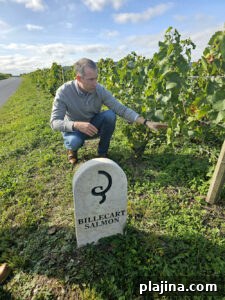
Last summer I walked the vineyards of Aÿ-Champagne with seventh-generation winemaker Mathieu Billecart. Family-run for more than a century, the house relies primarily on fruit grown on estate and leased land — a notable distinction in a region where many producers buy grapes. Long before the current craze for grower Champagnes, Billecart-Salmon was already committed to estate fruit and terroir-driven wines.
Of the 740 acres under vine, 92 percent are within a 12-mile radius of the property. Pinot Noir is sourced from the chalkiest villages in Montagne de Reims, Pinot Meunier from clay soils in four communes of the Vallée de la Marne, and Chardonnay from top sites in the Côte des Blancs. “We treat the vines like our children,” Mathieu said, an ethic visible in every parcel.
Among those parcels, Le Clos Saint-Hilaire stands out. This single-parcel plot has dedicated winemaking facilities for vintage expressions and a strong commitment to biodiversity and natural practices: beehives sit in barrels and a shed stores biodynamic equipment. The house uses only the highest-quality first-press juice for all its Champagnes and controls fermentation temperature to preserve aromatics and maintain a bright, acidic backbone. Most fermentations take place in stainless steel; select lots are aged in used wooden barrels to encourage gentle micro-oxygenation, add body, and impart subtle woody nuance. Two million bottles rest in 1.5 miles of chalk caves, aging from five to 14 years or longer for the prestige cuvées.
© Kelly Magyarics
Billecart-Salmon has a precise and thoughtful approach to dosage — the final addition of reserve wine and sugar that defines a Champagne’s sweetness. “Dosage is the last chance to manipulate the wine,” Mathieu noted. “But it needs to be very precise.” They devote as much attention to dosage as to blending, drawing from a palette of up to 51 small tanks rather than a single house liqueur. This method preserves the house style while allowing nuance and diversity between cuvées.
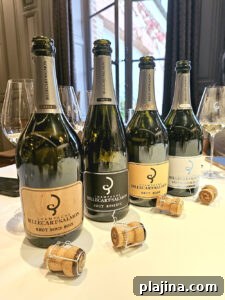
The results range from taut, terroir-driven bottlings to richer, aged expressions. The non-vintage Blanc de Blancs is made exclusively from Grand Cru Chardonnay in the Côte des Blancs, vinified in stainless steel to highlight terroir and freshness, then aged long on the lees for added weight and elegance. The Brut Réserve features a low dosage and the highest share of reserve wines (55 percent), sourced from vintages 2006 to 2018; it’s lifted, layered, and remarkably food-friendly.
Brut sous Bois honors the long tradition of barrel-fermented Champagne. Crafted through a fractional blending method akin to sherry solera systems, it incorporates mature wines (2006–2015) that contribute depth and softened tannins. The result evokes cozy evenings by the fire and pairs beautifully with veal, mushroom risotto, and other umami-rich dishes.
Just a short trip from Paris, Billecart-Salmon opens a new visitors’ center this summer. Tastings are available by appointment and often booked months in advance, but a visit offers a rare look into the philosophy and meticulous practices behind a house that consistently produces expressive, elegant Champagne.