
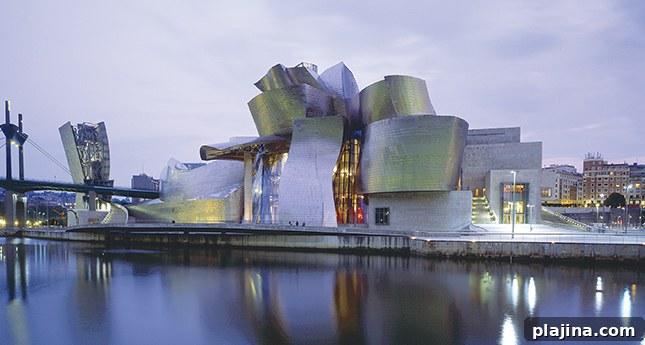
In the 1989 film Field of Dreams, Kevin Costner hears a whisper: “If you build it, he will come.” He builds a baseball diamond in the middle of his vast Iowa cornfield, and gradually it draws curious visitors and the ghosts of baseball players from the past. Decades later, an echo of that line seemed to inspire a very different project across the Atlantic.
In Bilbao, a Basque city in northern Spain, local officials convinced the Solomon R. Guggenheim Foundation to place a museum on a disused, industrial stretch of the Nervión River. No one could have predicted how profoundly Frank Gehry’s shimmering, titanium-clad building would transform this 700-year-old city.
When the Guggenheim Museum Bilbao opened in 1997 at a cost of roughly $100 million, it instantly became a global sensation. Gehry’s daring, organic forms—shimmering panels of titanium and unconventional angles—stood like a gleaming spacecraft beside a landscape of rusting factories, derelict shipyards and historic stone buildings. Jeff Koons’ giant Puppy sculpture, covered in flowers, welcomed visitors at the entrance.
Before the museum, Bilbao was a traditional industrial center of some 350,000 people, founded around 1300. Its economy centered on steel, shipbuilding and fishing, and many residents devoted their spare time to supporting Athletic Bilbao, the city’s beloved soccer team. The Guggenheim’s bold modernity initially felt out of step with Basque traditions and stood physically isolated on the city’s western bank, surrounded by cranes and shipping containers.
Like the baseball diamond in Field of Dreams, the Guggenheim began to attract visitors. At first they arrived in small numbers—art patrons and backpackers—then increasingly in groups on coach tours and in rental cars, and soon major media, architects, urban planners and photographers made the museum a must-see destination. Even skeptical Bilbaínos came to appreciate their city’s new landmark.
Gehry’s success helped usher in a wave of “architecture tourism,” with travelers seeking out signature buildings by landmark architects—Foster, Hadid, Libeskind, Piano, Calatrava, Koolhaas and others. Cities large and small began commissioning bold, high-profile cultural projects in hopes of triggering the so-called “Bilbao effect”: a surge of visitors, international attention and investment following construction.
The Guggenheim continues to draw visitors and inspires other notable architects who appreciate Bilbao’s dramatic terrain and distinctive light. In sunlight and at dusk, the museum’s 33,000 titanium shingles catch color and glow in tones that shift from gold to purple and pink. While Bilbao has faced broader economic challenges, its unemployment has fallen considerably since the museum opened. Local officials point to the museum’s roughly 950,000 visitors and the 4,000 jobs generated in 2008, estimating that the museum’s activities produced about $347 million in direct spending in the region that year, including over $40 million in taxes that were reinvested in technology parks, housing and public amenities such as modern transit and parks.
Bilbao’s economic and cultural revitalization has involved multiple actors, including longstanding institutions like the Bolsa de Bilbao (the local stock exchange) and banks such as Banco Bilbao Vizcaya. New architecture and infrastructure projects have further reshaped the city. The Bilbao Metro, designed by Sir Norman Foster, is notable for its innovative glass entrances. Santiago Calatrava’s Zubizuri footbridge and his airport terminal—nicknamed La Paloma, the Dove—introduced striking white concrete and glass forms to the riverfront and the city’s skyline.
Nearby, the Euskalduna Conference Centre and Concert Hall, completed in 1999 and designed to resemble a ship, occupies the former Euskalduna shipyard and houses a 2,164-seat performance theater, home to the Bilbao Symphony Orchestra and one of the largest stages in Europe. The Abandoibarra redevelopment, where the Guggenheim sits, also includes the Iberdrola Tower by César Pelli, a 40-story office tower that became one of the city’s tallest landmarks when it opened.
Bigger projects were also planned. The Zorrotzaurre redevelopment, envisioned as an innovation district with retail and more than 5,000 homes, was designed by Zaha Hadid and aimed to convert another former industrial spit into a mixed-use neighborhood. Mayor Iñaki Azkuna predicted that within a decade these initiatives would yield new stadium facilities, research centers and improved transport connections, possibly including high-speed rail to Madrid and enhanced links to the airport.
Plans announced in late 2009 for a potential second Guggenheim, this time combining art and nature in the Urdaibai Biosphere Reserve about 24 miles from Bilbao, surprised many. Discussions between the provincial government and the Guggenheim Foundation were at an early stage, and regional authorities had set aside funds to explore the idea, though no final decisions had been made.
Diversions
Begin with the Guggenheim Museum Bilbao (2 Abandoibarra), whose spectacular exterior and rotating exhibitions reward even seasoned visitors. The Bilbao Fine Arts Museum nearby presents classical, contemporary and Basque art in a modern setting. To learn more about local history and identity, visit the Basque Museum and explore Athletic Bilbao’s home at San Mamés Stadium—the emotional core of the city and Spain’s oldest soccer stadium, originally built in 1913; a new stadium was scheduled to open adjacent to the old site in 2014. Athletic Bilbao’s team store is open daily for scarves and shirts.
Cultural venues include the historic Arriaga Theatre for opera and ballet and the Euskalduna Concert Hall for symphonic performances and fine dining. Wander Casco Viejo, the Old Town, where the Mercado de la Ribera showcases fresh regional produce and Plaza Nueva’s Neoclassical arcades host pintxo bars and lively evening social life—locals follow the long-standing tradition of moving from bar to bar, sampling small dishes and drinks.
The Basque countryside and Atlantic coast lie just beyond the city. The metro reaches the sea in about 30 minutes, and nearby Getxo offers seaside dining and shopping. Further afield, the mountains and valleys of Vizcaya province contain wineries and historic villages for day trips off the beaten path.
Info to Go
Bilbao Airport (BIO) is about seven miles north of the city. Taxi fare to downtown runs around $30; an airport bus provides a cheaper option, taking roughly 15 minutes and costing about $1.80. Multiple car rental agencies operate from the terminal.
Just the Facts
Time Zone: GMT +1 (GMT+2 April–Oct.) Phone Code: 34 Spain; 94 Bilbao
Currency: Euro
Entry/Exit Requirements: U.S. citizens may enter Spain for up to 90 days for tourist or business purposes without a visa. Passports must be valid for at least three months beyond the period of stay.
Official Languages: As part of the Basque Autonomous Community, Bilbao recognizes both Euskera and Spanish; street signs and public information commonly appear in both languages. English is widely spoken in hotels, restaurants, museums and shops.
Key Industries: Financial services, technology, tourism, chemicals, metallurgy
Lodging
The Hotel Carlton
A historic 1919 hotel located in the city center, offering 142 renovated rooms, a restaurant and public spaces that retain classic charm. 2 Plaza Federico Moyúa, tel 34 94 416 22 00.
Miró Hotel Bilbao
Situated between the Guggenheim and the Fine Arts Museum, this boutique hotel’s 50 rooms were conceived by fashion designer Antonio Miró. 77 Alameda de Mazarredo, tel 34 946 611 880.
Silken Gran Hotel Domine Bilbao
A contemporary, design-forward 5-star hotel opposite the Guggenheim, notable for Philippe Starck–inspired details and 135 rooms. 61 Alameda de Mazarredo, tel 34 944 253 300.
Dining
El Perro Chico
An intimate restaurant above the Nervión River near Casco Viejo, serving Basque specialties such as tuna with black squid ink sauce. 2 Aretxaga, San Francisco, tel 34 94 415 05 19.
Restaurante Atlanta
A small, family-run spot known for fresh Basque fish and seafood; try the torrija de brioche with homemade coconut ice cream. 63 Gran Vía, tel 34 94 442 26 45.
Restaurante Etxanobe
Chef Fernando Canales’ acclaimed restaurant atop the Euskalduna center, awarded a Michelin star and recognized among Spain’s top dining venues. 4 Avda. Abandoibarra, tel 34 94 442 10 71.
Checking in with Marga Meoro
Associate Director of Guggenheim Museum Bilbao
Why did the Basque government petition the Guggenheim Foundation to locate a museum in Bilbao?
During the 1980s, Bilbao faced economic decline as traditional industries such as iron, steel and shipbuilding contracted. Authorities launched a redevelopment plan in 1991 to clean up the river, remove obsolete factories, create green spaces and build cultural and high-technology facilities to change the city’s image from industrial to service- and culture-oriented.
Does the museum attract more foreign or domestic visitors?
About 60 percent of visitors are from abroad, but domestic and Basque visitors have increased. The museum programs exhibitions that appeal to a broad audience—examples include popular shows like Armani and Art of the Motorcycle—which draw day-trippers and school groups in addition to traditional art patrons.
Is it true that the Basque government is working with Guggenheim directors to establish a second museum just outside of Bilbao?
Conversations have taken place but remain preliminary. The regional government is assessing strategic priorities and whether a second, environment-focused Guggenheim outside the city would be financially and culturally viable. While Bilbao’s current museum averages close to one million visitors annually, any new project will require detailed planning and time before a formal proposal is presented.