
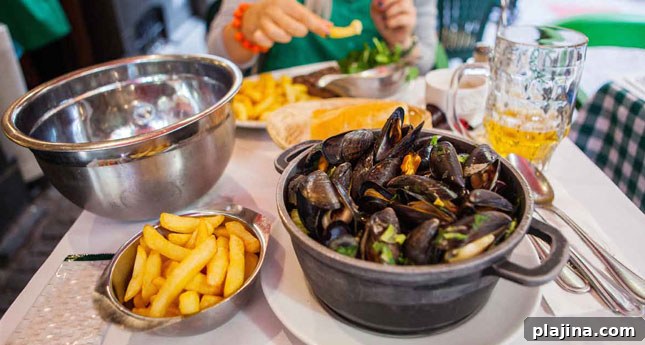
Although their name suggests otherwise, French fries likely began in Belgium rather than France. A Flemish manuscript from 1781 contains the earliest known mention of fried potatoes. Today, frites are paired with another Belgian favorite, mussels, to make the national comfort dish moules-frites — a beloved meal across Belgium and popular in neighboring countries, especially France.
Historically, mussels were an inexpensive winter food in Belgium, eaten when other seafood was scarce. Potatoes were also a common staple in cold months. Moules-frites gained wider popularity after World War I, when numerous friteries began selling the combination cheaply and in large quantities.
In modern Belgium, moules-frites remains omnipresent and social — people gather around tables to share steaming bowls of mussels and crisp, hot frites served separately so the fries stay crunchy instead of becoming soggy. Mussels are usually presented in the pot or pan in which they were cooked, resting in their flavorful broth. The Scheldt river, a shallow waterway linking western Belgium and the Netherlands, is known for producing some of the best mussels. During cooking, mussels are often shaken to ensure even heat distribution.
For frites, the bintjes potato is commonly preferred because of its higher starch content. Traditional preparation calls for double-frying the cut potatoes to achieve a crisp exterior and fluffy interior, often finished with a touch of cayenne for subtle heat. Although many sauces may accompany the dish, mayonnaise remains the classic condiment served alongside.
Moules-frites can vary widely depending on regional or personal preferences. Several classic mussel preparations are widely enjoyed. Marinières is perhaps the most popular: mussels simmered with white wine, shallots, parsley and butter. Au vin blanc is a straightforward style where mussels are cooked in white wine. Natures refers to a simple preparation with celery, leeks and butter. À la crème resembles marinières but adds flour and cream to create a richer, thicker sauce. À l’ail highlights garlic, with sliced or minced cloves infusing the broth.
Contemporary takes on moules-frites experiment with different flavor profiles in the steaming liquid, introducing elements such as smoky chili, curry spices, or beer — the latter resulting in moules à la bière. Another growing trend is moules parquées, which presents mussels raw on the half-shell accompanied by a lemon-mustard sauce.
Whether served in a traditional marinières broth or a modern, spiced liquid, moules-frites remains a versatile dish rooted in Belgian culinary culture. Its enduring popularity reflects both the simplicity of its ingredients and the communal pleasure of sharing piping-hot mussels and perfectly fried frites at the table.