
Flying into China’s vast capital is a memorable experience. Beijing stretches across some 6,300 square miles, offering compelling views from the air. On the ground, those vistas give way to Beijing Capital International Airport, China’s largest aviation hub and one of the world’s busiest airports.
Passenger traffic at Beijing Capital has been growing rapidly. In one recent month, passenger numbers rose by 9 percent, serving more than 8.1 million travelers. This increase is part of a longer trend: during the 2004–2010 period the airport’s annual passenger volume doubled, averaging roughly 8.6 percent growth each year.
Despite strong demand, capacity constraints have limited further expansion at Beijing Capital, prompting plans for a second major airport. Located in the Daxing District and scheduled to open in 2019, the new facility is planned to handle 45 million passengers in its first phase and expand to accommodate 100 million. Several major carriers, including China Eastern and China Southern, will shift operations to the new airport, which is expected to relieve congestion and improve the overall travel experience as China’s tourism market continues to expand.
To address operational pressure while the aviation network evolves, Beijing Capital is implementing a series of upgrades focused on efficiency and safety. As flight numbers grow and airlines begin transitioning to Daxing, the airport is modernizing traffic management and ground operations. A joint venture between Thales and Beijing EasySky Technology will introduce automation across terminal maneuvering space, area control, and airport operations to streamline workflows, reduce delays, and enhance passenger throughput.
Competition among airlines serving Beijing is increasing as well. For example, Qantas resumed flights between Sydney (SYD) and Beijing (PEK) after a multi-year pause, reestablishing service that had previously been operated by other carriers. Beijing Capital has also pursued international partnerships to boost connectivity, signing a memorandum to explore expanded services between Beijing and major European hubs.
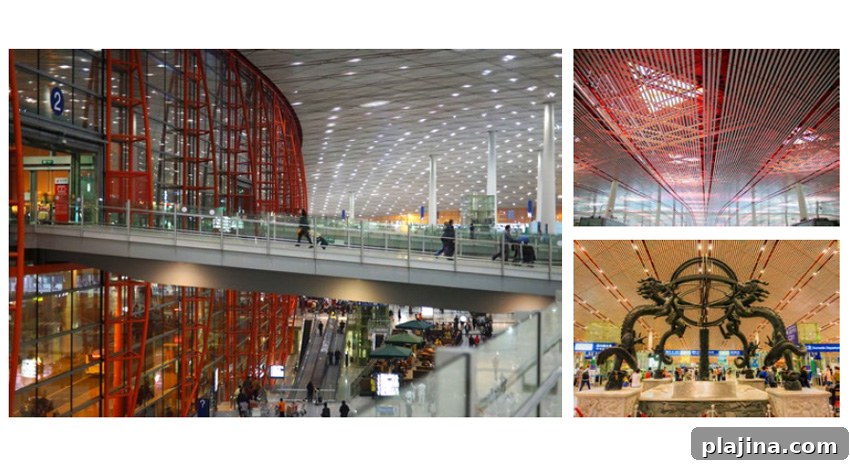
Beijing Capital comprises three terminals, highlighted by the expansive Terminal 3—one of the largest airport terminals globally. Built for the 2008 Summer Olympics, Terminal 3 has since been upgraded and expanded. The terminal emphasizes convenience and comfort, with a large service area that includes business and internet centers, banking services, and an advanced baggage transfer system that improves tracking and speeds retrieval. Architectural and aesthetic touches, such as indoor imperial-style gardens and a distinctive red roof inspired by cultural symbolism, contribute to a pleasant passenger environment. A diverse dining and retail offering in the terminal’s “global kitchen” provides travelers with dozens of food and shopping choices.
Over the coming years Beijing’s aviation landscape will continue to shift as capacity grows and operations modernize. The planned new airport and ongoing improvements at Beijing Capital aim to reduce congestion, enhance safety and efficiency, and support the region’s expanding travel demand.