
When Marco Polo arrived in Beijing, which he called Cambaluc (“The City of the Khan”), he admitted he could not describe it adequately. “You must know,” he wrote, “that the city of Cambaluc has such a multitude of houses, and such a vast population inside the walls and outside, that it seems quite past all possibility.”
If even the world’s most famous travel writer found words insufficient, I wondered how I would manage on a two-day visit to this sprawling metropolis of roughly 20 million people. My husband and I found an answer during the morning rush as we cycled toward a massive intersection near Tiananmen Square.
To our right and left hundreds of commuters sat on bicycles—some in business clothes, others balancing towering stacks of goods—waiting for the traffic light. When it turned green we surged forward together in a buzz of thousands of spokes.
Beijing has changed dramatically since the Mongol emperor Kublai Khan established his winter palace here, yet the city still feels immense: the 9,999-room Forbidden City, expansive Soviet-style avenues, and the $40 billion urban facelift after the Olympics all contribute to its scale. Today, glass-and-steel towers by world-famous architects rub shoulders with narrow hutong alleys, and entire skylines can transform nearly overnight. On a blustery November morning we set out by bike to explore the historic neighborhoods at the city’s core before they vanish.
Not long after passing the Forbidden City, one of my husband’s pedals snapped. We steered the damaged bike to a small garage where three elderly men sat among spare parts. They chuckled as we approached; one held up a calculator showing a fee of 50 yuan—about a quarter of the bike’s retail price. My husband protested, but the mechanic merely grinned and got to work.
With the bike repaired, we pedaled past a series of ponds lined with ornate homes, boutique shops and courtyard cafés. When we stopped to warm our numb fingers, we watched several stocky men in Speedos hammer through the icy water, dog-paddling toward the center of a frozen lake.
Deciding against tempting but pricier pizzerias and wine bars, we chose a lively family-style Chinese restaurant for lunch. The English menu included curious translations—“steamed leather jacket,” “gastronomy frog,” and “fried bloody noun”—so we opted for familiar comforts: sautéed string beans, peppered bacon and thin pumpkin slices fried in egg batter.
Afterward my husband spent an hour searching the maze of streets for the famed scorpion-on-a-stick stalls, but with no luck. We turned back toward Chairman Mao’s mausoleum on the south side of Tiananmen Square, hoping to catch a glimpse of the leader’s embalmed body before the line grew too long.
Although the Communist Party officially concedes Mao was “30 percent wrong” in some policies, viewing his body remains a solemn pilgrimage for many Chinese. The line of bouquet-bearing visitors can stretch for hours. Inside the mausoleum, guards shepherd people quickly past the glass case, making it hard to judge whether the figure is the genuine corpse or a replica. Historians note that the preservation process was intense—Mao’s doctors used so much formaldehyde his face briefly swelled.
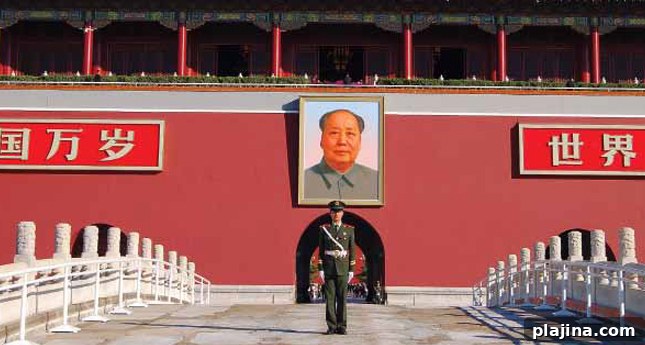
Across the windswept, stadium-sized plaza, tour groups in matching hats posed beneath Mao’s massive portrait affixed to the Forbidden City’s south gate. Sunburned vendors from distant provinces sold trinkets among the tourists, and children tugged on strangers’ sleeves. The square is most widely known abroad for the 1989 pro-democracy protests, but in official displays at Tiananmen Gate that episode is omitted; photographs instead show citizens celebrating with fireworks. Plainclothes police patrol the area today, watching for dissenters.
The next morning we left before dawn for a Great Wall tour at Simatai, about two hours from the city. We scavenged a quick breakfast—steamed dumplings and milk tea—from a single restaurant open in the dark, then boarded a tour bus at the hotel. Our group split: some traveled from Jinshanling ten kilometers away, while we were dropped closer to Simatai.
We set off with Barbara, an elderly woman whose daughter stayed on the bus to visit a man she’d recently met. Barbara laughed about lagging behind, but the path soon proved too steep and rocky for her to continue. I felt guilty leaving her when the route turned rougher.
A dusting of snow made the wall’s steep ramps treacherous; in some stretches we slid down while sitting to avoid twisting an ankle. The wall snaked along a leafless ridge for miles, a ribbon of stone across hills dusted in cinnamon-brown grass. From a distance our fellow hikers approached like a well-ordered band of marauders making steady progress down the ridge toward us.
We returned to Beijing just before sunset famished and headed straight for a cozy hutong restaurant we’d noticed earlier. Inside, heavy wooden tables and black-and-white photographs set the mood; we warmed our toes by a heater and ate cashew chicken, spicy eggplant and Tsingtao beer. “It’s not exactly scorpions,” my husband observed, and I was relieved.
While we finished fried bread with sweetened condensed milk for dessert, the restaurant owner approached with a broad smile. Spotting my SLR, he produced an old Holga camera and snapped a picture across the table. In halting English he introduced himself as Jia Yong and invited us upstairs for an improvised tour of his photography studio.
Perhaps aware that the hutong life he grew up in is fading, Yong began documenting neighborhood life as a teenager. He now devotes his spare time to photographing and exhibiting local scenes. His work—stacks of prints showing crumbling courtyards, dumpling shops and everyday faces—lined the walls above shelves of vintage and digital cameras.
As he revealed glossy portraits—a boy with his grandfather, a bicycle repairman—his enthusiasm for the neighborhood was contagious. His round, smiling face and lively eyes gave him an unexpected resemblance to Kublai Khan, whose era inspired Marco Polo’s rapturous but inadequate description.
Info To GoBeijing International Airport (PEK) lies about 16 miles north of the city center. A taxi to downtown takes 45 minutes to an hour; if you travel light, the subway to Dongzhimen Station costs roughly 3.50 USD and takes about 20 minutes to the Second Ring Road. Beijing’s subway system—more than a dozen lines—offers fares starting at 2 yuan (about 30 cents) to most destinations. Many hotels rent bicycles by the hour; for safer cycling, stick to the parks and quieter streets around the Back Lakes area. |
LodgingAman at Summer Palace, Beijing: An escape from the urban rush beside the tranquil Summer Palace grounds. 1 Gongmenqian St. $$$$ Grand Hyatt Beijing: Convenient for the Forbidden City with excellent onsite dining. 1 E. Chang An Ave. $$$$ The Westin Beijing Financial Street: High-quality amenities, a poolside bar and a kids’ center in the financial district. 9B Financial St., Xicheng District $$$$ |
DiningMade in China: Frequently cited among Beijing’s best, known for innovative takes on traditional dishes like Peking duck. Grand Hyatt Beijing, 1 E. Chang An Ave. $$$$ Maison Boulud: Housed in the former American embassy, Chef Daniel Boulud’s restaurant offers refined French cuisine. 23 Qian Men Dong Da Jie $$$$ Tian Hai Restaurant: Local photographer-restaurateur Jia Yong serves Northern Chinese comfort dishes in an authentic hutong setting. 37 W. Dazhalan St., Xuanwu District $ |
Aman at Summer Palace, Beijing
China National Tourist Office
Grand Hyatt Beijing
Made in China
Maison Boulud
The Westin Beijing Financial Street