
It sat inside a flat, glossy black plastic sleeve that reflected my eager face when I opened it. Folded into quarters, the chessboard unfolded to its full size and revealed flat magnetic pieces already in place: two ranks of pawns, kings and queens, rooks, knights and bishops. The set felt high-tech and precise, a compact vision of a distant world.
To my young mind, that chess set represented a world beyond my immediate surroundings — a world of polished goods, clever design and new materials. It suggested that the future was being made elsewhere, out of reach and full of sophistication.
Over the next few days my grandfather taught me how to play. Chess, with its strict rules and elegant strategy, came across as a refined, complex pastime associated with European customs and study. It felt like a symbol of another culture’s order and discipline.
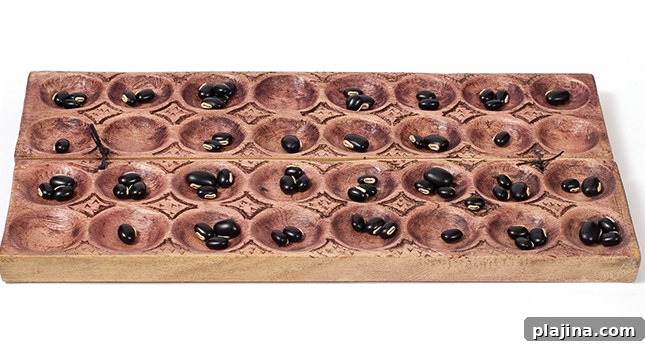
Only years later did I begin to think about the board games I had long seen people playing in village shade or on shop verandas. When I was introduced to bao, I discovered a game that matched chess for strategic depth and cultural weight. Even more striking: portable versions of bao have existed for centuries.
Bao is part of the mancala family, a wide group of traditional board games played across Africa and Asia. Its boards are made up of pits into which players sow and redistribute seeds or stones, and the object is usually to capture or control the opponent’s pieces. Rules and board layouts vary by region; in East Africa, for example, a typical bao board has 32 pits in four rows of eight.
One charming aspect of bao is how social it is. When a game begins in a public space, passersby often stop to watch, cheer and offer advice. The play is fast, subtle and interactive: players move pieces in fluid, sweeping patterns that look like choreography, while spectators supply running commentary that decodes the shifting fortunes on the board.
When I inherited my grandfather’s travel chess set in my twenties, its neat design proved less important than its fragility. A couple of pawns were already missing, and later I lost a queen. Without its full complement of pieces the set quickly became unusable. It was a reminder that clever packaging cannot fully replace durability.
By contrast, the travel bao I observed out in the field was endlessly adaptable. On a walking safari in Zambia, porters and guides would gather seeds, pebbles or other found objects to use as playing pieces. They made boards on the ground by pressing pits into the earth and then played with astonishing speed and concentration. The materials were simple, the game resilient and entirely functional.
I would wander over and watch whenever I could. Although I knew the basic principles, I struggled to follow the rapid maneuvers. The players moved seeds in and out of pits with lightning speed, and the spectators’ commentary revealed a communal literacy about strategy and timing that I lacked.
Those moments taught me that what we often call “sophistication” can be only surface deep. The travel chess set was a cleverly marketed object, but it did not make the game more meaningful or enduring. Bao, meanwhile, has been played for generations with minimal tools, yet it carries deep cultural knowledge and strategic subtlety.
I think of this contrast every time I leave Africa on a flight. In the luggage hold or overhead bins there are tourists wrestling with bulky, bubble-wrapped souvenirs: carved wooden boards, large and flat, ornate and conspicuous. Under that protective covering is often the unmistakable shape of a bao board — a reminder that some of the most enduring inventions are simple, communal and portable, and that elegance can live outside any single culture’s idea of progress.