
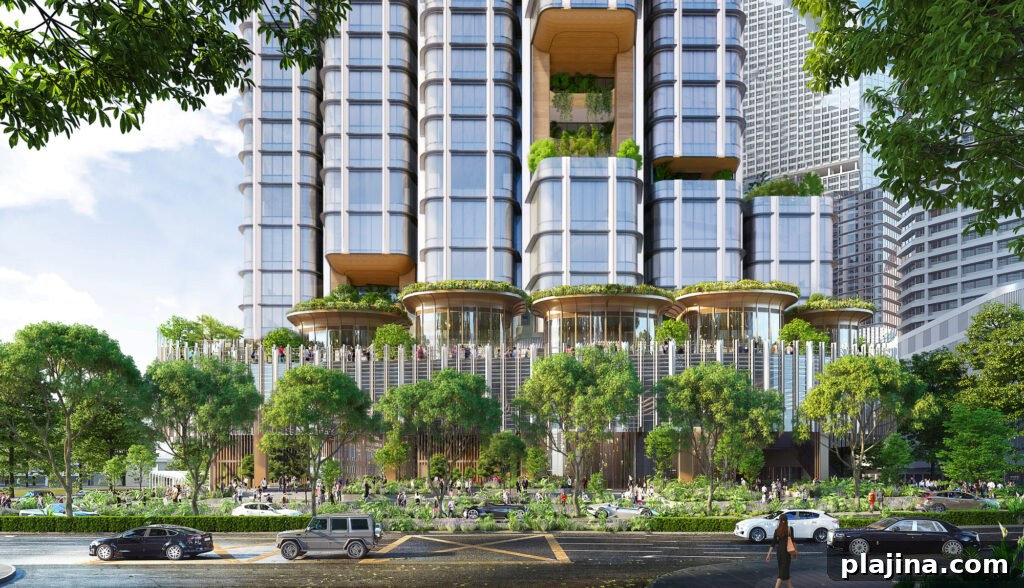
Envisioned as one of Asia’s most sustainable skyscrapers, a proposed 63-story mixed-use development at 8 Shenton Way in Singapore draws inspiration from bamboo forests to create a vertical indoor-outdoor community. The design integrates public spaces, offices, retail, a hotel, event venues and luxury residences into a single cohesive tower that brings the city’s tropical landscape upward from street level into the sky.
Designed by Skidmore, Owings & Merrill, 8 Shenton Way will anchor the junction of Singapore’s Central Business District and Marina Bay, connect to the historic Tanjong Pagar neighborhood and face the emerging Greater Southern Waterfront. Scheduled for completion in 2028, the 63-story tower will become Singapore’s tallest building and a new landmark on the city skyline.
© SOM
With expansive public realms, office floors, retail outlets, a hotel and luxury residences offering sweeping views of the South China Sea, the development is planned as a vibrant 24/7 hub for residents, workers and visitors. Its walkable proximity—about 15 minutes—to Tanjong Pagar’s dining scene and to nearby heritage districts will add to its appeal for both locals and travelers.
“8 Shenton Way will be the newest landmark on the Singapore skyline—a next‑generation tower for the city,” said Mustafa Abadan, partner at SOM. “Designed with Singapore’s tropical climate in mind, this building is one of the first post‑pandemic mixed‑use towers with health and wellness as primary design drivers. By pursuing the city’s most rigorous sustainability standards, the project aims to set a new benchmark for resilient and elegant high‑rise design in Singapore and beyond.”
© SOM
The tower’s biophilic approach echoes the vertical rhythm of bamboo. Materials have been selected to reduce both embodied and operational carbon, including zero‑waste terracotta manufacturing and engineered bamboo elements. The project seeks top sustainability certification in the region and is the first under the Urban Redevelopment Authority of Singapore’s Central Business District Incentive Scheme to combine such a wide range of program elements.
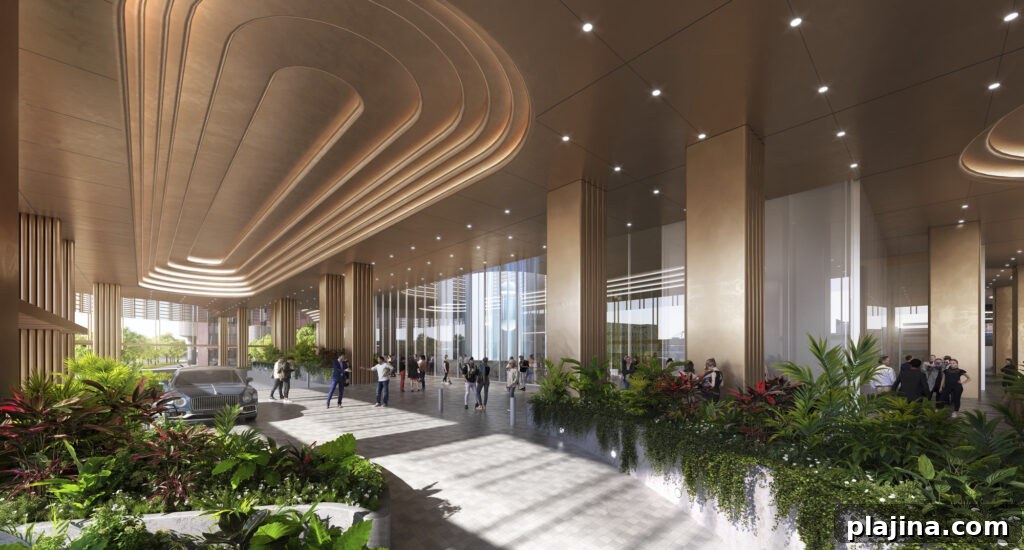
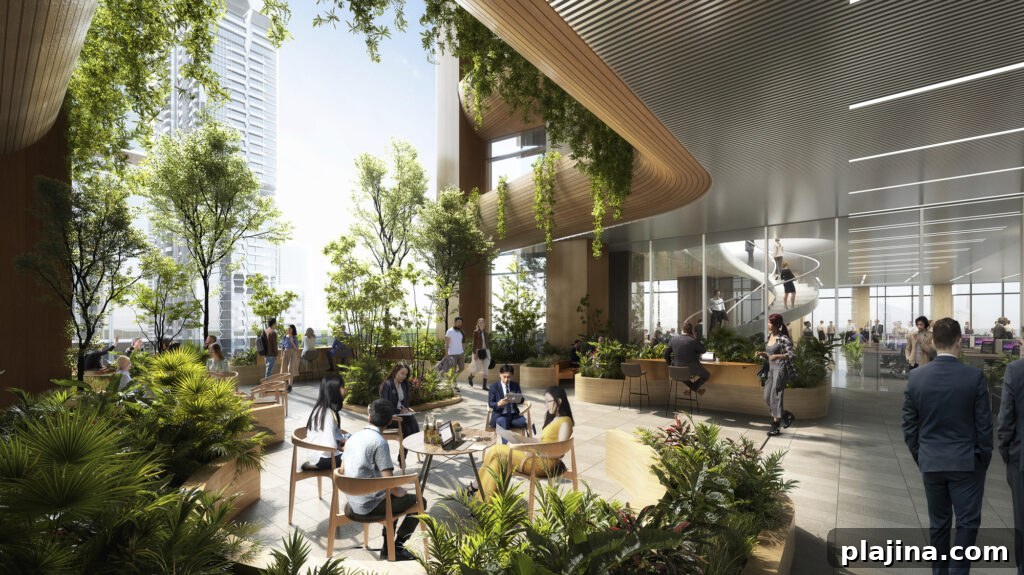
A public performance and events area with retail, seating and bike racks will activate the streetscape, while landscaping flows from the pavement into the building to form a continuous green corridor for pedestrians. The ground floor opens onto a public plaza, and the second floor features restaurants that overlook planted spaces designed to attract birds and butterflies. In total, the scheme provides more than 106,000 square feet of elevated public green space, creating generous outdoor amenity across multiple levels.
© SOM
The façade pairs champagne‑colored terracotta with bamboo-lined sky gardens. Gentle curves create bay windows on almost every level to maximize views of the city and the sea. The lobby features wood, stone and terracotta finishes flanking artwork and a reflecting pool, with a multi‑floor atrium above. Landscaped gardens are interspersed throughout the tower’s height, offering occupants multiple outdoor retreats in the sky. There are seven major terraces—one dedicated to hotel guests and three serving residential levels—carved into the building every five to six floors to introduce daylight, fresh air and natural ventilation that support wellbeing.
Across more than 1.6 million square feet of floor area, 8 Shenton Way incorporates post‑pandemic design measures that prioritize health. Contactless technologies, antimicrobial materials, enhanced airflow and filtration, adaptable interiors and extensive landscaped outdoor spaces combine to create a healthier, wellness‑focused environment for tenants and visitors.
To promote sustainable transportation, the development will link to Singapore’s underground pedestrian network with direct connectivity to Tanjong Pagar MRT station. It will also be within a five‑minute walk of two other stations: Maxwell MRT, serving the Thomson‑East Coast Line, which has already opened, and Prince Edward MRT Station, which will complete the connection between Harborfront and Marina Bay stations by 2026.