
Much like the Formula 1 cars that roared into town last November, Austin’s economy is accelerating past the recession. In 2010 the city posted the second-largest gross domestic product growth among the nation’s 50 largest metropolitan areas. In 2011 it vied with New Orleans as one of the fastest-growing major U.S. cities by population. And last year Austin claimed first place in Forbes’ annual ranking of the best big cities for jobs.
“Few cities — if any — in America could rival the connectivity of all the key elements needed for hosting a Formula 1 event as well as Austin,” says Tavo Hellmund, managing partner of Full Throttle Productions, LP, the promoter of the Formula 1 United States Grand Prix.
That combination of infrastructure, hospitality and regional appeal made Austin the natural choice to host the U.S. Grand Prix — an event that has only amplified the city’s growth. More than 300,000 visitors came to Austin in November for the inaugural Grand Prix at the Circuit of the Americas, the new Formula 1 racetrack located just east of Austin Bergstrom International Airport.
As the first U.S. facility built specifically for Formula 1 racing, the Circuit of the Americas will host the U.S. Grand Prix through 2021 and a wide range of motorsports, entertainment and business events each year. The Greater Austin Chamber of Commerce estimates the Grand Prix’s annual economic impact at $400–500 million, more than double the estimated economic contribution of the South by Southwest film and music festival.
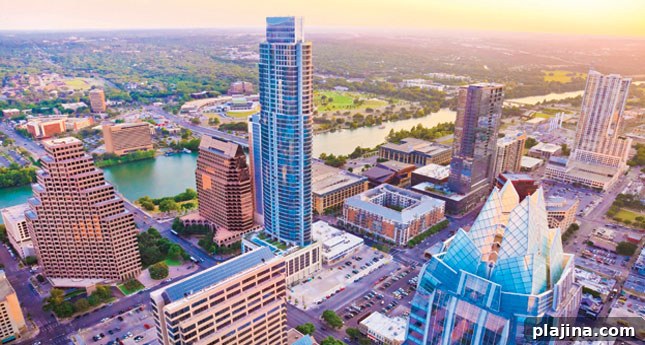
To meet the influx of out-of-state visitors, downtown Austin has seen a surge of development, with new hotels, condominiums, office towers and entertainment venues underway.
Last summer JW Marriott broke ground on a 1,000-room hotel two blocks from the Austin Convention Center. Scheduled to open in 2015, the property will offer roughly 110,000 square feet of meeting space and compete for convention business with the Hilton Austin. Nearby, a 50-story Fairmont Austin with about 1,000 rooms is also planned for completion in the same year.
City incentives have encouraged residential construction in the Central Business District as part of a plan to house 25,000 residents downtown. Recent residential skyscrapers include The Austonian and 360 Condominiums — Austin’s two tallest buildings — along with Four Seasons Residences and The Residences at W Austin.
Austin’s commercial real estate market is thriving as well: downtown office occupancy rates have climbed to around 86 percent. While much of the region’s tech industry historically clustered in North Austin and Round Rock—home to major employers such as Dell—several high-tech companies have opened prominent downtown offices. Facebook, for example, established its first office outside California on lively Sixth Street.
The city’s rapid economic momentum reflects the work of a diverse community of entrepreneurs, musicians, technology professionals, government employees and students. With roughly 800,000 residents, Austin’s independent spirit is summed up in its unofficial slogan, “Keep Austin Weird.”
“Austin is a world-renowned technology hub developed from an entrepreneurial culture, outstanding university-based research, a great mix of venture funding and a rich pool of intellectual talent and leadership,” says Dave Porter, senior vice president of economic development at the Greater Austin Chamber of Commerce. In his words, Austin is “the youngest, smartest, safest, fastest-growing city in the country.”
Stroll South Congress Avenue and you’ll find sushi bars, curio shops and costume stores that reflect the city’s strong support for local, independent businesses. Explore the Barton Creek Greenbelt trails or watch the nightly emergence of Mexican free-tailed bats beneath the Congress Avenue Bridge, and it’s easy to see why Austin consistently ranks among America’s greenest cities.
Austinites embrace both clever wordplay, showcased every May at the O. Henry Pun-Off, and quirky community traditions, such as Eeyore’s Birthday Party each April in Pease Park. The city’s vibrant music scene produced artists like Willie Nelson and Stevie Ray Vaughan and helped earn Austin the nickname “Live Music Capital of the World.”
Even if Austin placed eighth on Bloomberg Businessweek’s 2012 list of America’s 50 Best Cities, its distinctive culture, entrepreneurial energy and ongoing investments in infrastructure and development make it clear the city will continue climbing higher.