
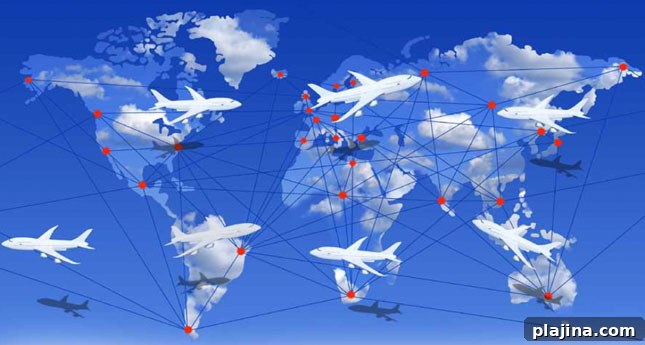
From its earliest days, aviation has connected people and goods across continents, long before the modern global economy took shape. While powerful seafaring nations dominated trade for centuries, the advent of flight opened access to the wider world for virtually every country. That reality inspired the mid-20th-century notion that a nation needed both a flag and a national airline to announce itself to the world.
Governments therefore created and protected flag carriers—airlines designated to represent their countries abroad and to project national identity. Even as the United States began airline deregulation in 1978, many countries kept strict rules on airline ownership and control. Unlike most industries—banking, manufacturing, petrochemicals, and technology—airlines have remained closely regulated, with limits on foreign ownership that restrict access to global capital.
Faced with rising operational costs and the increasing importance of global networks, airlines sought ways to cooperate internationally without violating ownership rules. The solution was the airline alliance: an arrangement that allowed carriers to coordinate schedules, share benefits and extend each other’s reach while keeping national control intact.
BEFORE 1997, attempts at cooperative airline groupings were common but rarely durable. A notable early success was the 1993 partnership between Northwest and KLM, which leveraged synergies and secured antitrust immunity to protect its operations. The modern alliance era began in earnest in May 1997 when Star Alliance launched with five founding members: United, Air Canada, Lufthansa, Scandinavian Airlines and Thai Airways, soon joined by Varig.
Within two years, oneworld formed from a group that included American Airlines, British Airways, Cathay Pacific and Canadian Airlines, later adding Finnair and Iberia. SkyTeam followed in June 2000, founded by Delta Air Lines, Air France, Aeromexico and Korean Air, with Czech Airlines joining soon after. These alliances shared a primary goal: extend frequent-flyer benefits and premium services across a broader network so customers of one carrier could use lounges, priority check-in and other privileges on partner airlines.
At the time alliances took hold, air travel standards were higher across the board—corporate travel budgets were robust, and low-cost carriers had not yet reshaped the market outside of a few exceptions like Southwest in the U.S. Alliances initially grew by adding full-service carriers with strong international networks, bringing established frequent flyers that enhanced the collective value.
AS THEY EXPANDED, each alliance adopted different strategic approaches. Star Alliance emphasized broad network reach and accepted carriers that extended coverage even when they competed in similar markets. That approach led to alliances of former competitors—such as Lufthansa, Swiss, Austrian and SAS—working together while remaining rivals. Star also developed a centralized administrative structure to manage marketing and member services, even encouraging some aircraft to wear Star-branded liveries to strengthen the brand.
Oneworld positioned itself as a group of premium carriers with more regional exclusivity, generally avoiding overlapping dominant market positions among members. SkyTeam struck a middle ground and introduced affiliated or subsidiary memberships that the other alliances handled differently. Joining any alliance requires substantial investment, particularly to integrate IT systems, train staff and upgrade facilities to serve a larger pool of privileged passengers.
THE INDUSTRY’S LANDSCAPE changed dramatically after September 2001. The shock accelerated financial pressures on many legacy carriers, triggered bankruptcies and restructured business models, and opened space for a new wave of low-cost airlines that emphasized simplicity and lower fares. Through the next decade, alliance members faced volatility as partners merged, folded or reinvented themselves and as service expectations—especially in economy class—shifted.
How will alliances continue to evolve? Several trends point to possible directions. First, alliances have deepened cooperation among members: many major routes now operate under joint-venture agreements with revenue-sharing arrangements that are “metal neutral,” meaning partners share revenue regardless of which carrier operates the flight. Service levels on individual flights, however, can still differ significantly.
Second, alliances actively seek to fill geographic “white spaces”—regions where their networks lack depth. For example, India’s international market offers limited partner choices, leaving at least one alliance with weak coverage in that market at any given time.
Third, long-term membership is no longer guaranteed. Airlines have switched alliances, merged into competitors, or ceased operations altogether—shifts that have become more frequent than originally expected. Fourth, some carriers choose multiple partnerships instead of exclusive alliance membership. Airlines such as WestJet, JetBlue and Alaska Airlines have pursued broad codeshare relationships with numerous partners rather than full alliance alignment, while carriers like Brazil’s GOL maintain ties across different alliance members and partners.
Fifth, the emergence of major Gulf carriers—Emirates, Etihad and Qatar Airways—challenged the alliance model, sparking disputes over competition and market access. Yet surprising developments have occurred, such as Qatar joining oneworld, illustrating how strategic priorities can quickly change.
Finally, alliances remain transitional structures on the path toward fuller cross-border ownership and truly global airlines. Europe has seen ownership patterns mirror alliance relationships: Lufthansa’s acquisitions of Swiss, Austrian and Brussels reflect Star Alliance closeness; British Airways and Iberia united to form IAG within oneworld; and Air France–KLM align in SkyTeam. Still, such consolidation has not followed a single global pattern—South America’s LAN and TAM merger cut across alliance boundaries, for example.
In summary, alliances were created to expand networks and market presence when traditional full-service airline models dominated. Over time, changing economics, consumer expectations and competitive pressures have forced alliances and their members to adapt. They will continue to evolve until regulatory barriers to cross-border ownership fall and truly global airlines can emerge—until then, the industry will keep surprising observers.
At a Glance
| Star Alliance | oneworld | SkyTeam | |
| Members | 28 | 13 | 20 |
| Aircraft | 4,701 | 2,488 | 2,963 |
| Passengers (millions) | 727.42 | 353.53 | 588 |
| Daily Departures | 21,900 | 10,117 | 15,723 |
| Countries Served | 195 | 151 | 178 |
| Headquarters | Frankfurt | New York | Amsterdam |
| Future | + AI, -US, JJ | +US, JJ, UL | – |