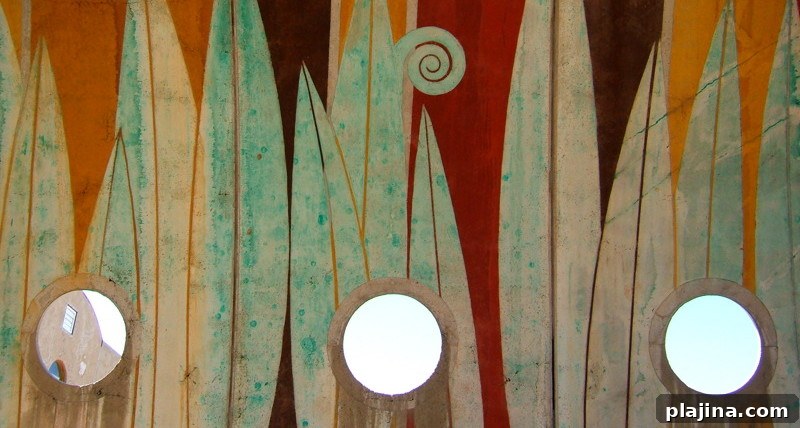
Arcosanti, situated in Yavapai County, Arizona, is an experimental urban laboratory developed by Italian-American architect Paolo Soleri. Conceived in the late 1960s, the project represents Soleri’s vision of “arcology” — a fusion of architecture and ecology intended to demonstrate how urban density and thoughtful design can reduce environmental impact while enhancing social life.
Built into the high desert landscape north of Phoenix, Arcosanti was designed as a workshop-laboratory where designers, builders, students, and artisans live and work together on ongoing construction, research, and craft production. The site’s built environment emphasizes compact, sculptural forms, terraces, and integrated systems that aim to minimize resource consumption, preserve open land, and foster close-knit community interactions.
Over decades, Arcosanti has attracted visitors, volunteers, and scholars interested in sustainable design, urban theory, and hands-on building experience. The community hosts workshops, educational programs, and public events that explore topics such as passive solar strategies, water conservation, energy efficiency, and material reuse. These activities are intended to demonstrate practical, scalable approaches to creating more sustainable urban environments.
One of Arcosanti’s distinctive features is its emphasis on craft and small-scale industry. The site became well known for the production of hand-cast bronze bells, a practice that combined traditional craft techniques with the philosophy of integrating art and daily life. These artisan activities help support the site financially while reinforcing the project’s ethos: design, making, and living should be interconnected.
Architecturally, Arcosanti showcases Soleri’s interest in sculptural form and spatial compression — grouping functions and housing to reduce sprawl and create shared public spaces. Buildings are organized around a sequence of terraces, courtyards, and circulation routes that respond to the desert topography and climate. Passive cooling strategies, strategic shading, and thermal mass are used alongside modern construction methods to create comfortable interior environments with lower energy demands.
Although the original grand vision for Arcosanti — a city for thousands — was never fully realized, the project endures as a provocative, instructive experiment in alternative urbanism. Its incremental construction and long-term evolution provide a rare, real-world case study in how architectural ideals translate into daily life and community practice. Visitors and researchers often find the process of ongoing construction and adaptation itself to be a valuable lesson in sustainable design and social organization.
Arcosanti’s location in the Arizona desert frames both its opportunities and constraints. The arid climate demands careful water management and design that responds to intense sun and temperature swings. At the same time, the dramatic landscape and panoramic views inform the project’s aesthetic and reinforce the relationship between built form and site.
Beyond architecture and environmental concerns, Arcosanti functions as a social experiment. Residents and participants live in close proximity, sharing responsibilities for maintenance, construction, and community programs. This cooperative approach aims to foster stronger social bonds and to test new models for governance, resource sharing, and everyday life in compact settlements.
Over the years Arcosanti has been both praised and critiqued. Supporters highlight its pioneering ideas, educational value, and enduring commitment to sustainable experimentation. Critics point to the gap between Soleri’s ambitious plan and the smaller-scale reality achieved so far, questioning whether arcology can scale effectively in contemporary contexts. Regardless, Arcosanti remains influential in conversations about urban density, sustainable design, and the relationship between architecture and ecology.
Today, Arcosanti continues to welcome visitors, students, and volunteers who want hands-on experience in construction, design workshops, or simply to learn more about an alternative approach to building and living. The site stands as a living archive of a 20th-century architectural experiment that still sparks debate about how cities should grow, how communities can live lightly on the land, and how design can shape social life.