
It’s a question I’ve been asked throughout my career as a travel writer: “What’s your favorite hotel?” After years of searching, I finally have a clear answer.
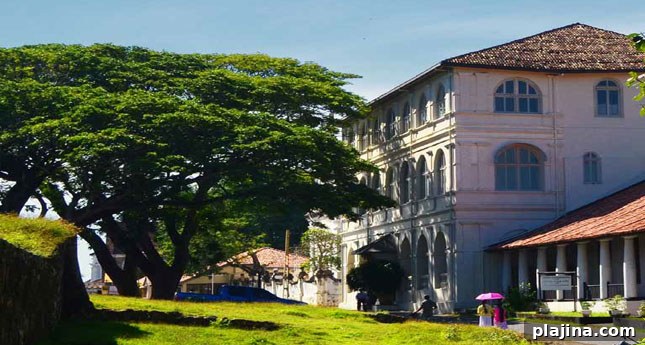
Tucked inside a three-story Dutch colonial building within the walls of Galle Fort in southern Sri Lanka, it sits without a conspicuous sign or a flashy facade. Most passersby never notice it. My wife and I climb the steps to the wide veranda. Immaculately uniformed staff appear from the shaded corridor, greeting us with warm smiles and cool face towels. “Welcome to Amangalla.”
Amangalla is part of Aman Resorts, a discreet collection of boutique hotels known to experienced travelers who value privacy, understated luxury, and exceptional service. At an Aman property you encounter a consistent atmosphere: refined, intimate and quietly elegant. Service is attentive yet unobtrusive, and guests tend to share a sense of calm and respectful conversation.
We are led from the veranda into the zaal, the hotel’s great hall. The room is airy with polished wooden floors, solid colonial furniture and a high ceiling from which ceiling fans stir a gentle breeze. Chandeliers hang, catching the light. The combination of classic architecture and careful restoration instantly charms me. Having grown up in a colonial-style house in the tropics, I have long been partial to the grand old hotels of that era, especially when they have been preserved with taste and care.
The building’s history reaches back to 1863, when Sri Lanka was British Ceylon and the property operated as the Oriental Hotel, later the New Oriental Hotel. Nesta Brohier, born in Room 25 in 1905, managed the hotel for decades and remained a distinctive presence there well into her nineties. After her passing, Aman Resorts acquired and completely refurbished the property, reopening it as Amangalla in 2005. The restoration kept the colonial character intact while introducing modern comforts and service standards that make the stay effortless and luxurious.
I could happily sit for hours in one of the teak chairs in the zaal, sipping a gin and tonic and imagining the history embedded in these walls. But on my first afternoon there’s an appointment at The Baths, Amangalla’s acclaimed spa, so I follow a path through the verdant hotel garden toward the treatment rooms.
I’ve always been slightly awkward about spas—the formality, the idleness and the intimacy of having another person work directly on my body. My apprehension rises when I learn my treatment will be a four-hand massage: two therapists working in synchrony. In the spa waiting area I sip fresh lime juice and try to relax.
The therapists, Sanath and Raju, greet me and explain that my treatment will draw on Ayurvedic principles, tailored to my physical condition. They assess me with professional straightforwardness and determine I have dry skin and some tension. Sri Lanka is one of the strongholds of Ayurvedic medicine, and the spa uses time-honored techniques and local plant-based oils in its rituals.
Laid face-down on the table, I feel the therapists warm and apply vathaviduranga, a richly aromatic oil blending more than fifty indigenous plants. They find tight knots around my shoulder blades and begin to work them out. Within moments a deep release ripples through my upper back and my whole body eases into relaxation. The initial awkwardness evaporates as I surrender to the rhythm of two pairs of hands moving in unison. The fragrance of the oil, the measured pressure and the gentle, synchronous strokes shift me toward a state between wakefulness and sleep.
After about forty-five minutes the massage concludes. I rest briefly, then the therapists guide me to the steam room where heat and steam open my pores. A cold shower finishes the cleansing ritual. Refreshed and light, I return to our suite and join my wife on our private veranda overlooking the garden. Exotic birds flit through the foliage and occasionally one of us says what we both feel: “I could live here.”
The next evening we book The Baths’ private spa area and spend an hour using a steam room, sauna, icy plunge pool and Jacuzzi—amenities offered to guests that elevate the sense of being cared for and cosseted. Again we look at each other and think the same thing: “I could get used to this.”
On our final morning I treat myself to a traditional wet shave at Amangalla’s old-fashioned Barber Shop and Salon. Roshan, who continues a family tradition of serving guests here, handles the razor with calm, practiced skill. Clean-shaven and refreshed, I return to the zaal to savor the remaining moments in this elegant time capsule.
Across the street, Galle Fort’s Groote Kerk stands watch over the 36-acre precinct of narrow lanes and colonial buildings, protected by sturdy ramparts. A gentle breeze off the Indian Ocean stirs the air, and we sit quietly with our drinks, content in the knowledge that Amangalla is, for me, the archetype of a perfect hotel: historically rich, impeccably restored and quietly luxurious.
Amangalla
10 Church St.
Galle Fort, Sri Lanka
tel 94 91 223 3388