
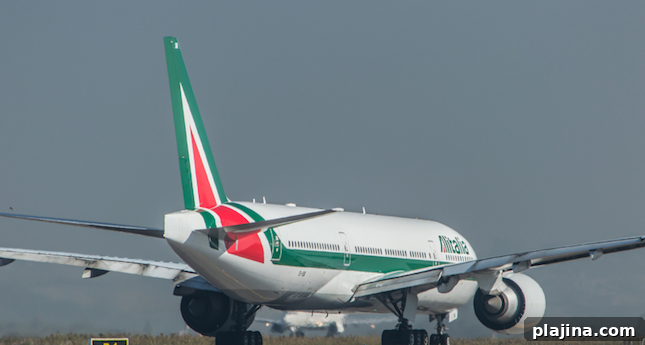
Alitalia’s recent strategic shift toward a partnership with Etihad Airways has led the Italian carrier to prioritize that relationship over its previous ties with Air France-KLM. As a result, Alitalia has decided not to renew its cooperation agreements with Air France-KLM when the current contracts expire at the end of 2016.
The agreements in question were originally negotiated in 2009 and 2010 and cover selected cargo operations and passenger services involving the three airlines. They established cooperative arrangements intended to coordinate routes, capacity and commercial practices across those segments.
Silvano Cassano, Alitalia’s CEO, explained the decision by noting that the legacy agreements no longer align with the airline’s commercial interests or strategic objectives. “These agreements are no longer beneficial, either commercially or strategically, to the new Alitalia and its ambitious turnaround plan,” Cassano said. “They were negotiated when Alitalia was in a very different position, with the result that the agreements in their current forms favor the other party.”
By choosing not to renew, Alitalia is positioning itself to pursue a renewed business model built around its partnership with Etihad Airways. That alliance offers new opportunities for network connectivity, fleet planning and revenue management that Alitalia’s leadership views as better aligned with the company’s restructuring and long-term recovery efforts.
The move reflects a broader trend in the airline industry in which carriers reassess legacy commercial arrangements to ensure they support current financial goals and competitive strategies. Alitalia’s management concluded that the prior contracts, while suitable in an earlier context, could constrain flexibility and limit the benefits the company needs as it executes cost-reduction measures, redefines its route portfolio and seeks to improve profitability.
Rather than extending the old agreements, Alitalia is focusing on negotiating cooperative structures that deliver clearer value and shared incentives. Aligning commercial terms with strategic objectives is intended to create a partnership framework that supports capacity optimization, improved schedule coordination and more effective use of cargo and passenger resources.
The decision is also a signal to stakeholders—employees, customers and investors—that Alitalia is actively reshaping its alliances to back its turnaround plan. Management expects that consolidating around a partnership with Etihad will help the airline modernize operations, enhance network connectivity to key markets and leverage joint commercial opportunities in a way the previous arrangements no longer permitted.
Airline partnerships and joint agreements are complex and often reflect the relative negotiating positions of the parties at the time they were established. Alitalia’s leadership emphasized that the contracts negotiated in 2009 and 2010 were crafted under very different circumstances, and that retaining those terms would not be consistent with the carrier’s current priorities. Exiting the agreements at their natural expiration allows Alitalia to avoid costly renegotiation and to pursue new alliances on a timetable that matches its recovery strategy.
As the industry continues to evolve, carriers frequently re-evaluate codeshare arrangements, cargo partnerships and joint venture elements to ensure they remain commercially viable. Alitalia’s choice to forego renewal with Air France-KLM illustrates the airline’s intent to focus resources on partnerships that provide measurable benefits in the near and long term, while steering away from legacy commitments that could impede progress.
Going forward, Alitalia will concentrate on building collaborative initiatives that are mutually advantageous and that help support its efforts to stabilize finances, improve customer experience and expand competitive reach. The company’s emphasis on constructive partnerships is intended to complement internal reforms and contribute to a sustainable operating model for the future.