
Who doesn’t enjoy a golf road trip that pairs compelling courses with fresh seafood, scenic coastal drives and friendly locals? Last summer I finally made a long-awaited journey to Canada’s eastern tip — the Maritime provinces of Nova Scotia and New Brunswick. I’d heard a lot about Rod Whitman, Canada’s most talked-about golf designer, who has reshaped parts of the Maritimes. His Cabot Links course on Nova Scotia’s Cape Breton Highlands received high praise, and for good reason. Inspired by classic links of England and Scotland, Whitman converted a former coastal coal mine into a genuine links layout with views of the restless Gulf of St. Lawrence from nearly every hole. He then teamed with Bill Coore and Ben Crenshaw on the adjacent Cabot Cliffs, which Golf Digest ranked No. 1 in Canada (2017–18). Cabot Links placed No. 5, and both courses appear in the world’s top 100.
We worked our way down Nova Scotia’s western coast, stopping to play several courses before reaching Digby and the historic Digby Pines Golf Resort and Spa, the Stanley Thompson design. From Digby we took the ferry across the Bay of Fundy — known for the world’s highest tides — into New Brunswick and continued south to St. Andrews. How could anyone resist a storybook village called St. Andrews-by-the-Sea? I fell in love with it on my first visit a decade earlier, and it felt just as charming this time: brightly painted shops and inns along the main street, outdoor tables piled with fresh lobster, and a welcoming, relaxed atmosphere.
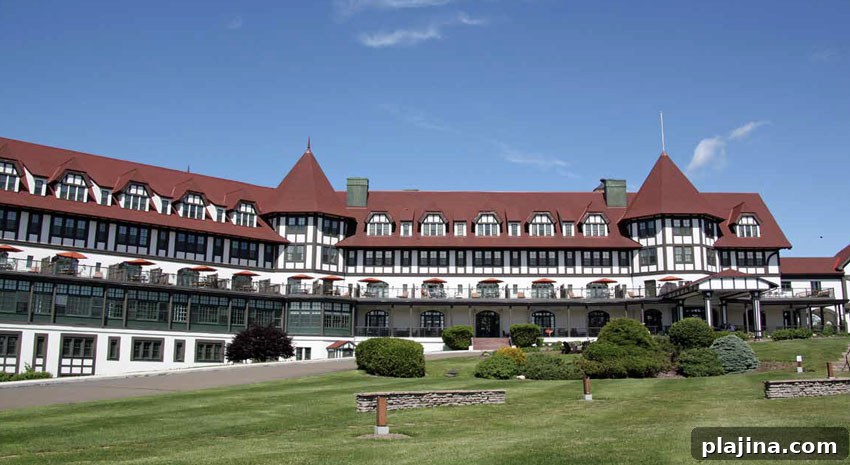
Dominating the town’s hill is the Algonquin Resort, a 233-room Tudor-style “castle by the sea” built by the Canadian Pacific Railway in 1889. The hotel has long hosted royalty and heads of state. It still presents the same bright-white façade and deep-red roofs beneath the porte-cochère, though a $50 million renovation added many modern touches behind the scenes.
From the moment we arrived, the hotel’s character was apparent: kilted porters handling bags and cars, a warm lobby where a friendly black Labrador named Sydney greeted guests, and gracious service that blended formality with ease. The hotel is steeped in history — in the artwork, the fireplaces, the furnishings — and in its golf tradition. The course dates to 1894 and the clubhouse is one of the country’s oldest.
The Algonquin course measures 7,108 yards and plays as a par 72. The front nine winds through woodlands before opening up on the back nine to reveal Passamaquoddy Bay, including several bayside holes. Donald Ross laid out the original route in the 1920s; Thomas McBroom updated it in 2000. The most dramatic transformations came in 2017 when Rod Whitman and associate Keith Cutten refined bunkers, greens and fairway lines on the front nine and moved several back-nine holes closer to the sea to maximize views and natural hazards. The result feels both bold and natural — hard to imagine the course any other way.
“Although the back nine is breathtaking, the front will offer a very good test for all golfers,” said Jason Porter, director of golf and head professional. “Whitman’s pot bunkers are strategically positioned and will definitely make a golfer think. The greens on holes one, four and seven are much larger now, and the breaks will cause a lot of head scratching. The seventh hole has great new tees and a pot bunker in front of the green that will scare even the best golfers.”
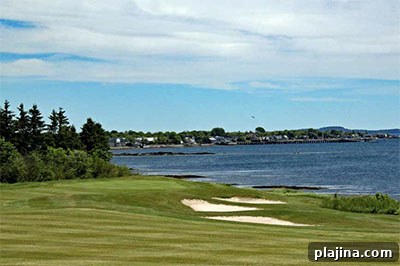
Algonquin green © DONNELLE OXLEY
HOLE 7 | 432 yards, par 4
This clever par 4 poses a demanding second-shot question: the fairway falls away on the brow of a steep drop to a green set in a hollow. Unless your drive lands well forward, you’ll face a blind approach with a long wood into a relatively shallow putting surface.
HOLE 10 | 225 yards, par 3
With trees thinned along the shore, this hole now opens to sweeping bay views and anchors one of Canada’s best four-hole stretches. The green is wide but shallow and protected by well-placed bunkers.
HOLE 11 | 572 yards, par 5
Lengthening the hole and adding sculpted mounding and bunkering created multiple approach strategies. The hole features an “infinity green,” a technique associated with Whitman’s mentor Pete Dye: from about 200 yards out, only sky and sea are visible beyond the green.
HOLE 12 | 170 yards, par 3
This cliffside par 3 has long been one of Canada’s prettiest, but it used to feel cramped and obscured by trees. Whitman opened sightlines by thinning trees, carved a 170-yard back tee and accented the green with artistic bunkers. Wind off the bay makes club selection tricky.
HOLE 13 | 491 yards, par 5
A new tee site discovered from a high vantage allowed Whitman to bring the hole down along the water’s edge. From tee to green it hugs the shore, delivering spectacular views of the bay and the town beyond. The wind amplifies the challenge, making it play tougher than the scorecard suggests.
The Algonquin Resort St.-Andrews-by-the-Sea, Autograph Collection
184 Adolphus St.
St. Andrews, New Brunswick
Canada E5B 1T7
tel 506 529 8823
marriott.com