
Premium travelers understand that first- and business-class tickets offer far more than lie-flat seats, elevated dining and top-shelf beverages. Enhanced baggage allowances and priority check-in, security, boarding and baggage handling certainly improve the journey, but one of the most valued perks is lounge access—quiet, comfortable spaces to work, relax and prepare for the next leg of travel.
Airport lounges began as airline-exclusive spaces. The first example dates to 1939, when American Airlines opened the Flagship Club at New York’s LaGuardia Airport (later renamed the Admirals Club). For decades thereafter, individual carriers hosted lounges for their premium passengers and select partners. That model changed in the 1990s with the arrival of third-party operators such as Priority Pass, and later with credit card–affiliated and public lounges like the American Express Centurion Lounges. The result is a broader array of lounge options available to travelers today.
When airline alliances formed in the late 1990s—Star Alliance in 1997, oneworld in 1999 and SkyTeam in 2000—a new concept followed: alliance-branded lounges. Star Alliance opened the first of these lounges in Zürich in 2001, and today its member carriers and eligible customers can access multiple alliance lounges around the world. According to Star Alliance’s director of marketing and communications, alliance-branded lounges deliver a “win/win/win” outcome: passengers gain a higher-quality facility, member airlines save costs compared with operating separate lounges, and airports benefit from a premium offering that enhances the travel experience.
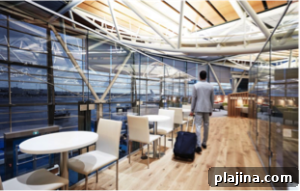
PHOTO: © SKYTEAM
SkyTeam opened its first alliance lounge at London Heathrow in 2009 to serve the alliance’s member airlines. SkyTeam’s vice president of marketing and commercial highlights the cost efficiencies and the importance of maintaining or improving lounge quality and customer satisfaction. For an alliance, branded lounges also strengthen its identity by creating a physical touchpoint that reflects the alliance’s standards and values.
Airports hosting alliance-branded lounges benefit beyond rental income and retail sales. The global reputation of an alliance can bolster an airport’s brand, and positive lounge experiences tend to improve travelers’ impressions of the airport overall.
Building an alliance-branded lounge is a significant undertaking that often takes a year or more. The process includes identifying suitable locations, consulting member airlines and passengers, creating a concept and progressing through design and construction. Location is among the most important decisions. Oneworld, planning to open its first branded lounge in Moscow Domodedovo, evaluates network presence of member carriers, existing lounges, airport real estate availability and collaboration with airport partners. Moscow Domodedovo was chosen because it serves several oneworld members, including local carrier S7 Airlines, and presents an opportunity to consolidate resources and improve passenger facilities.
Both Star Alliance and SkyTeam typically favor non-hub cities that nonetheless play an important role in their networks and are served by multiple member airlines. SkyTeam’s selection criteria also include “fit”—how well a physical space can meet members’ operational needs and deliver a high-quality experience—and the presence of an adequate number of Elite Plus, first- and business-class passengers. The competitive environment, meaning existing lounge options at the airport, is also taken into account.
Alliances continuously research what travelers and member airlines want in lounge amenities, service and atmosphere. SkyTeam consults industrial designers and customer-experience specialists and gathers direct passenger feedback. Over the past decade, technology has driven the biggest changes: travelers now expect seamless, personalized experiences, fast and reliable WiFi, abundant charging points, contactless payment and smart ordering. Food service has evolved too, with more emphasis on locally sourced and sustainably produced offerings.
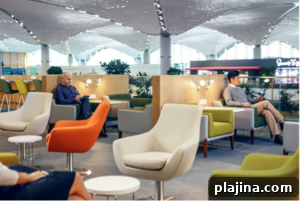
PHOTO: © SKYTEAM
Ambience is another priority. SkyTeam aims for each lounge to convey a distinct sense of place while remaining clearly identified as a SkyTeam facility. Design elements, furnishings and artwork often draw on local materials and cultural references—for example, turquoise-blue tiles in the Istanbul lounge reflect regional aesthetics. Food and beverage offerings follow the same approach, from noodle bars in Hong Kong to made-to-order pide (Turkish pizza) in Istanbul.
Star Alliance likewise emphasizes curated spaces that reflect the host city and country. Local architects and established designers collaborate to deliver interiors that immerse passengers in the destination. Regional cuisine and drinks feature prominently, whether that’s barista-made coffee and pizzas in Rome or fine wines, cheeses and desserts in Paris.
Travelers notice and appreciate these details. Industry observers praise well-executed alliance lounges for their extensive buffets, hot entrees, shower facilities, outdoor terraces and ample seating. Frequent flyers report that alliance-branded lounges often surpass domestic carrier lounges in food and beverage variety and overall comfort, though experiences can vary by location—some lounges receive consistently high marks while others occasionally fall short in ambience or capacity.
During the COVID-19 pandemic, many alliance lounges temporarily closed or reduced services. As lounges have reopened, alliances and airports have followed health guidelines and implemented enhanced protocols. Guests may encounter limited food and beverage options, mandatory face coverings, physical distancing requirements and closures of certain amenities such as showers until conditions allow their safe return.
A look at alliances
ONEWORLD
Member airlines: 13
First lounge: Announced for Moscow Domodedovo
Alliance-affiliated lounges: 650
In the pipeline: Potential future sites include São Paulo, Beijing Daxing, Frankfurt and JFK
Highlights: The LAX International Terminal lounge—co-managed by Qantas, British Airways and Cathay Pacific—features showers, self-serve wines, a juice bar and a children’s play area.
SKYTEAM
Member airlines: 19
First lounge: 2009, LHR Terminal 4
Alliance-branded lounges: 6
Locations: Dubai, Hong Kong, Istanbul, London, Sydney, Vancouver
In the pipeline: Santiago (estimated opening 2021)
Highlights: The two-level London lounge offers spa treatments, an oxygen bar, showers, a living wall, a wine bar and relaxation rooms.
STAR ALLIANCE
Member airlines: 26
First lounge: 2001, Zürich
Alliance-branded lounges: 8
Locations: Amsterdam, Buenos Aires, Los Angeles (LAX), Nagoya, Paris (CDG), Rio de Janeiro, Rome (FCO), São Paulo
In the pipeline: Guangzhou, planned as the first alliance-branded lounge in China
Highlights: The LAX lounge, spanning over 17,000 square feet, includes a First Class Lounge, showers, an extensive buffet and an outdoor terrace with a fire pit and water features.