
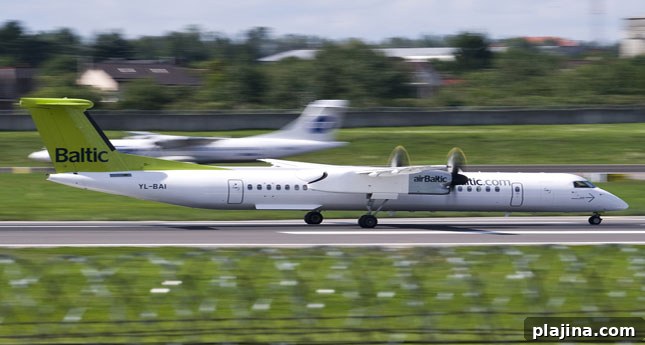
airBaltic announced last week that its daily service between Riga and Istanbul will switch airports starting March 31. Flights that previously used Istanbul Atatürk Airport (IST) will instead operate to and from Istanbul Sabiha Gökçen International Airport (SAW). The change applies to the carrier’s Riga (RIX)–Istanbul service, which will continue to be flown daily on Boeing 737-300 aircraft.
Michael Grimme, airBaltic’s chief commercial officer, explained the rationale: moving the route to Sabiha Gökçen allows for improved scheduling and better connections through Riga for passengers traveling to and from the Baltics, Scandinavia, Russia and the Commonwealth of Independent States. The shift is also expected to reduce total travel time for many customers.
In addition to the Istanbul change, airBaltic plans to add six new destinations for the upcoming summer season. The new routes will link Riga with Prague (PRG) in the Czech Republic, Heviz-Balaton (SOB) in Hungary, Olbia (OLB) in Italy, Rijeka (RJK) in Croatia, Larnaca (LCA) in Cyprus, and Malta (MLA). These additions expand the airline’s network from its Riga hub, which already serves 60 destinations.
The move to Sabiha Gökçen and the planned summer expansions reflect airBaltic’s broader strategy to strengthen connectivity across Northern and Eastern Europe and the Mediterranean. By optimizing airport choices and opening new routes, the airline aims to offer more convenient schedules and reduced transfer times for both leisure and business travelers using Riga as a hub.
Passengers booked on the Riga–Istanbul service should check their itineraries for the updated airport information and allow sufficient time for ground transfers, as Sabiha Gökçen is located on the Asian side of Istanbul, which may affect access times depending on connecting transport. Travelers are advised to confirm terminal and check-in details directly with the airline ahead of travel.
With these adjustments and route additions, airBaltic continues to develop its network while focusing on efficient connections and shorter travel times for its customers across the region.