
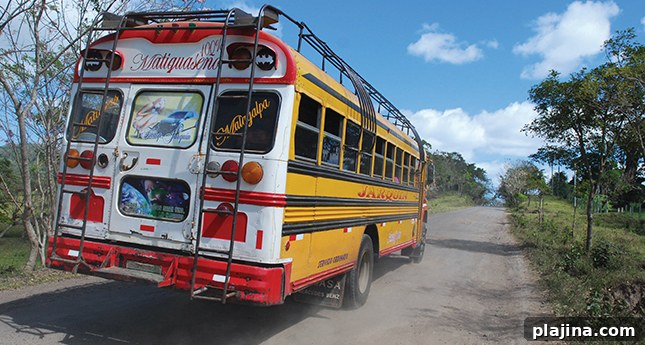
I wake before dawn to the familiar sounds of my barrio — the everyday soundtrack that has greeted me for two years in a northern Nicaraguan village. A neighbor’s hands slap the morning tortillas into shape; across the puddle-rutted dirt street, Eudelia’s teenage daughter flips on a boombox and sings along to a loud Mexican pop band; roosters and dogs add their calls; and from the direction of the highway comes Doña Vicenta, shouting her wares while balancing a wide, shallow basket on her head. “¡Llevo cebolla — zanahoria — ajo — cebollita!”
Fresh onion, carrot, garlic — ready to be fried in oil and tossed into scrambled eggs, eaten with a warm corn tortilla in one hand and a mound of gallo pinto (rice and beans) to soak up the grease. Perhaps I’ll catch breakfast at the bus stop in San Isidro, I think, as I prepare for a day of travel.
Standing barefoot on my tiled porch with a mug of strong backyard coffee, I watch a few low clouds melt from pink to white. I savor the post-dawn coolness; it will be gone soon.
This is the calm before the journey, and I take a moment to enjoy it. Living here has taught me that adventure is never far — you only need to step outside.
I take a final gritty gulp, dump the grounds in the garden, grab my daypack and guitar, and step into the street. I’m heading to Chinandega, a low, sun-baked city about half a day west. I have errands, and if time allows (and in Nicaragua it often does), friends to visit.
I salute my neighbors with a wave and an “¡Adiós!” Seeing my pack, they call out, “¡Que le vaya bien!” — go well.
At the highway I raise my hand and smile at the first vehicle. A teetering white box truck crunches to a stop. I climb in and shake the driver’s hand.
“Para servirle,” he says with a smile — at your service. He has short, thick hair and deep crow’s feet around his eyes. The radio blasts merengue, so we ride in companionable silence, admiring the shifting scenery as we descend from the Segovia foothills into Sebaco Valley and San Isidro. At a speed bump I clap once and nod west; he understands and lets me out at the edge of town.
Within 10 minutes a red pickup stops. I’m running to the window, licking greasy egg from my fingers and brushing bits of tortilla from my beard.
“¿Dame un ride?” I ask — give me a lift?
“¡Como no!” he answers, and I hop over the tailgate, bang the side of the truck, and we’re off.
“Ride” is how Nicas refer to hitchhiking, borrowed from English but given a local pronunciation. I sit facing backward, my back against the cab next to a man with a wide mustache, a thin neck and a battered red cap stamped with a political acronym: PLN.
The wind is already warm. We shake hands and begin to talk. He speaks quickly and softens some final syllables, so I ask him to repeat himself now and then.
“Were you born in these hills?” I ask.
“No, man,” he says. “I’m from Rivas. After the war I came to Estelí to play baseball.”
“And now you’re pure norteño?” I probe, knowing how much Nicaraguans enjoy their regional pride.
“Yes, man,” he smiles. “I’ve got my norteña now.”
When I ask what position he played, his face brightens. “Center field,” he says. “Sometimes catcher. You know we Nicas love baseball! And we love poetry, too. Rubén Darío! His best is Prosas Profanas. Have you read it?”
I knew Darío’s name — Nicaragua’s celebrated writer — though I hadn’t read that book. My companion’s mustache lifts as he prepares to recite, and the moment is quietly remarkable: a campesino who might look uneducated is reciting poetry while the dry countryside slides by.
Juventud divino tesoro / Te vas para no volver, / Cuando quiero llorar no lloro, / Y a veces lloro sin querer.
Divine treasure of youth — you leave to never return; when I want to cry I do not cry, and at times I cry without meaning to.
We travel west into Nicaragua’s volcanic lowlands. By noon the first smoking cone, Volcán Telica, appears; later the Maribio chain rises out of the heat: Momotombo, San Cristóbal, Cerro Negro. Having pierced the ring of fire, the air becomes blast-furnace hot as we slow at the empalme for Chinandega.
I hop out, thank the driver, and walk to the gas station as the pickup heads off toward León. How long will I wait in this heat? Who will I meet next? Much of my time in Nicaragua felt like this: a dance between seeking excitement and letting it find me.
On this day, I don’t wait long. A yellow school bus is parked at the lone pump, passengers’ arms drooping from windows like wilted plants. As I approach the door I ask the driver, “¿A dónde van?”
“Chinandega,” says a man near the door. He is tall, clearly from the Atlantic coast, and when he adds in perfect English, “Where are you going, man?” I realize the whole team is in uniform. “Matagalpa” is scripted across their chests.
He introduces himself: “Marvin Benard.”
At the time, Marvin Benard was one of only a few Nicaraguans in the U.S. major leagues. He’s from Bluefields and played outfield for the San Francisco Giants. He’s spending the off-season here to stay in shape. He turns and calls to his teammates in Creole-accented Spanish, “Make room for the gringo; maybe he’ll play us some music!”
“Play a ranchera, you son of a b#*%@!” jokes one player, and soon we’re all singing along as the bus pulls onto the road. Northern Nicaraguans adore rancheras — Mexican country songs that play everywhere in the region — and I join in: “Clavado en este rincón/ como tu clavaste a mi corazón.”
Less than an hour later we arrive at the stadium in Chinandega. My new friends invite me to the game that evening. I thank them, wave goodbye, and head off to find a taxi into town, the day’s encounters still fresh in my mind.
Info to Go
Augusto C. Sandino International Airport (MGA) sits on the Pan-American Highway leaving Managua heading north. From there you can catch buses to points north and into the interior. Head for the cigar-making city of Estelí — about two to three hours north of Managua — to explore much of the country described here.