
Gleaming acres of glass and marble can look impressive yet interchangeable. Although international airports are the gateways to their cities, many lack a distinct sense of place and blend into a homogenized global “transitland.”
That perception is changing. Governments increasingly see airport terminals as more than transport hubs: they are a country’s public face and the first point of contact for visitors. A terminal shapes a traveler’s initial impression of a destination and can showcase national identity through architecture, art and services.
Beijing Capital International Airport © Tea | Dreamstime.com
One of the most striking recent examples is Terminal 2 at Mumbai’s Chhatrapati Shivaji International Airport, which opened in February. The $2 billion terminal embraces Indian design, with references to the palaces of the rajas. Ornate white columns evoke peacock feathers and elaborate chandeliers hang in the departure lounge, reinforcing a distinctly local atmosphere.
The Loyalty Lounge for premium passengers offers a complimentary bar, gourmet snacks and comprehensive business amenities. T2’s cultural vision extends to more than 7,000 artworks displayed along a nearly two-mile art walk called Jaya He, transforming the terminal into something approaching India’s largest public museum.
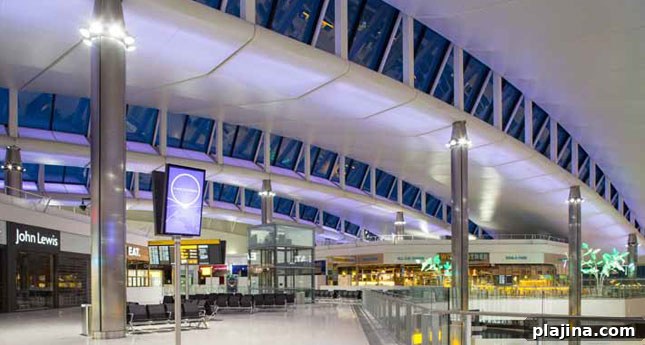
Art also plays a central role at the new Terminal 2 at London’s Heathrow, which reopened in June after the old terminal was demolished. Dedicated to Star Alliance carriers, the Queen’s Terminal features Richard Wilson’s sinuous 230-foot aluminum sculpture Slipstream suspended over the entrance court, capturing the path of a stunt plane.
Heathrow’s Terminal 2 prioritizes operational efficiency over a strong sense of place. Its design follows a functional model suited to modern travel: less space for check-in (reflecting widespread online and self-service check-in) and more capacity for security processing. Premium travelers benefit from dedicated security lanes and plush lounges, but the terminal also showcases British character in its shops, a pub serving a local Fuller’s ale and The Perfectionists’ Café by chef Heston Blumenthal.
In São Paulo, the new Terminal 3 at Guarulhos International Airport opened in May ahead of the FIFA World Cup, easing pressure on Latin America’s busiest airport. The bright, airy terminal contrasts sharply with the older concrete structures and, with a projected annual capacity of 12 million passengers, offers a quieter, more pleasant experience for premium and business travelers. Unusually for large infrastructure projects in the region, Terminal 3 arrived on time and on budget.
Doha’s Hamad International Airport © Edmondlamcw | Dreamstime.com
Not all projects run smoothly. Doha’s Hamad International Airport, serving as Qatar Airways’ global hub, opened in April six years behind schedule and with a $16 billion price tag. Qatar Airways’ CEO argues the facilities justify the cost, and the airport offers an array of amenities for transit passengers, including a shopping mall, short-stay hotel, gym and swimming pool.
Premium travelers benefit most from Hamad’s design: first- and business-class passengers have a dedicated entrance and streamlined access from check-in through security to lounges and aircraft. Arrival facilities include a Pre-Arrival Lounge to freshen up before immigration, which typically takes around 30 minutes; Qatar residents can apply for e-gates to bypass queues.
Other projects have faced long delays. Dakar’s Aéroport International Blaise Diagne missed its intended 2011 opening and was pushed back by years; the currently targeted date is December 2014. Travelers should expect disruption when the new, Saudi-built airport finally opens, while the aging Léopold Sédar Senghor International Airport continues to decline.
Berlin offers another cautionary tale. After reunification the city planned Berlin Brandenburg Airport to consolidate operations from several sites. Originally scheduled for 2010, repeated construction problems have pushed back the opening repeatedly; the airport is unlikely to open before the end of 2016. Once operational, it should transform the city into a major hub and improve services for premium travelers. Meanwhile, other German airports have used the delay to upgrade: Munich Airport plans a satellite terminal linked by automated rail, adding 52 gates and multiple Lufthansa lounges.
The global center of gravity has shifted east in recent years, with China unveiling major new terminals at pace. Shenzhen Bao’an’s futuristic new terminal, which opened in November 2013, provides high-end lounges and an alternative hub to Hong Kong. Beijing Capital became the world’s busiest airport in March after Terminal 3 increased capacity in 2008, and plans are already underway for an even larger Beijing Daxing International Airport, which could become the world’s biggest when it opens.
Shenzhen Bao’an International Airport © Hkctsang | Dreamstime.com
These developments show airports cannot rest on past achievements. The aviation industry keeps evolving: terminals once built for prestige are now necessities to support growing passenger volumes and changing travel behaviors.
Smaller markets are catching up. Edinburgh Airport is due to complete a major terminal upgrade this year, improving the passenger experience in Scotland as the country asserts its identity. The airport already offers airline lounges and pay-per-use options such as the Servisair Aspire Lounge on domestic routes.
In the United States, San Francisco International Airport has been renovating to remain competitive. Its latest expansion, Terminal 3 East, added 10 gates and improved facilities at a cost of $138 million, enhancing the experience for United’s West Coast operations.
“Terminal” may imply an ending, but for modern travelers airports are staging posts — places to pass through as efficiently and comfortably as possible. Successful terminals combine operational efficiency with design, art and services that reflect a place and leave a lasting positive impression.