
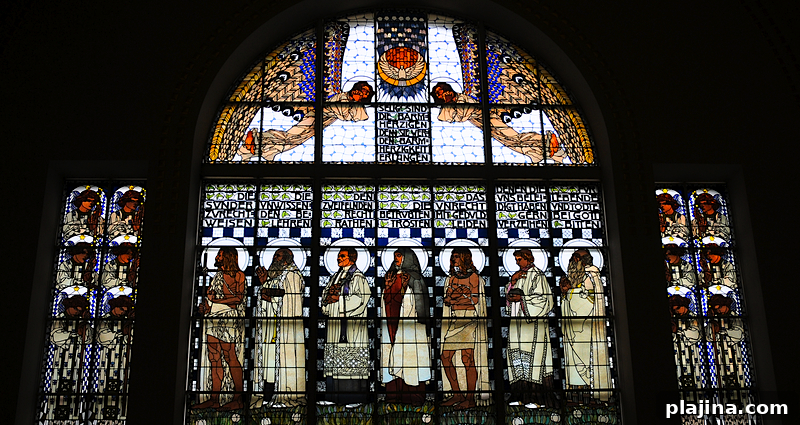
The distinctive work of artist and designer Koloman Moser is highlighted in a new retrospective opening today at the Museum of Fine Arts, Houston. An influential Austrian creator, Moser produced two- and three-dimensional works across many media — metalwork and jewelry, furniture, prints, textiles, glass, and ceramics. His pieces are often recognizable for their bold geometric patterns, strong black-and-white grids, and references to classical Greek and Roman motifs.
Moser co-founded the Wiener Werkstätte (Vienna Workshops) with Josef Hoffmann and became a central figure in the Vienna Secession movement. His portfolio Die Quelle (The Source) presented designs for wallpaper, fabric, prints, and textiles, reflecting a cohesive, modern decorative vision. He also contributed designs for the prominent Austrian art journal Ver Sacrum alongside contemporaries such as Gustav Klimt. The exhibition Koloman Moser: Designing Modern Vienna, 1897–1907 premiered at the Neue Galerie in New York and is now on view in Houston through Jan. 12, 2014.
This retrospective offers a comprehensive look at Moser’s range and influence, tracing how his disciplined use of geometry and classical references helped shape early modern design in Vienna. Visitors can expect to see examples that illustrate both the craftsmanship and the conceptual rigor behind his work, from everyday objects to ambitious interior schemes. The display emphasizes Moser’s role in blurring boundaries between fine art and applied arts, a hallmark of the Wiener Werkstätte’s mission to integrate art into daily life.
Organized with attention to chronology and medium, the exhibition places Moser’s designs in the context of the broader artistic currents of the time, including the Secession’s pursuit of innovation and ornamentation rooted in formal harmony. The selection highlights key works that demonstrate his experimentation with pattern, proportion, and material — qualities that made his designs adaptable to a wide range of domestic and public settings.
For those interested in Vienna’s cultural scene at the turn of the 20th century, the show provides an instructive perspective on how designers like Moser collaborated with artisans and publishers to disseminate modern aesthetics. By combining meticulous technique with an emphasis on unified design, Moser and his peers influenced graphic design, interior decoration, and the development of modern decorative arts across Europe.
You may also like:
Vienna: Coffee, Cake And Culture
Vienna: Double Vision