
Before there was Wall Street in New York or the Square Mile in London, there was Petra.
Set in the heart of Jordan’s Shara Mountains, between the Dead Sea and the Gulf of Aqaba, Petra was once a vital trade center and crossroads connecting Arabia, Egypt and ancient Syria. From the first century B.C. through the third century A.D., wealthy merchants prospered here, turning the city into one of the most influential commercial hubs of antiquity.
Carved and developed by the early Nabateans, the caravan city and the luxury incense routes it served eventually faded. Yet after Petra was named one of the New7Wonders of the World in 2007, travelers, guides and local Bedouin communities helped revive interest in the City of Stone, and it now draws visitors from around the globe.
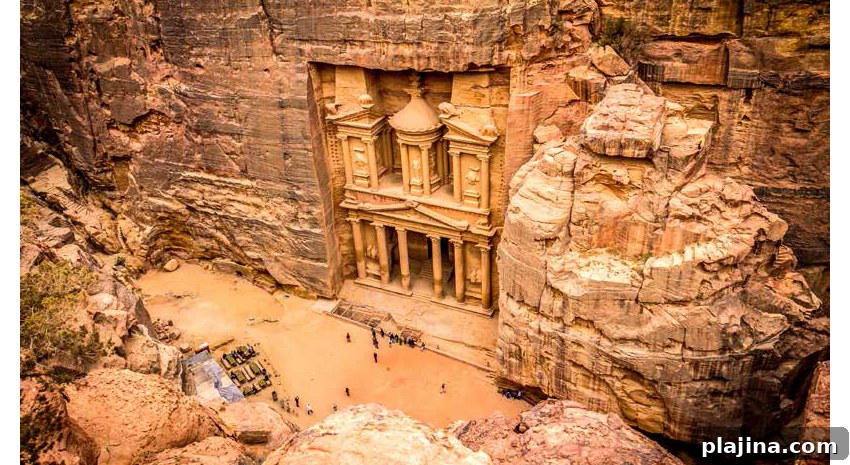
Visitors enter Petra through the Siq, a narrow, twisting gorge cut through sandstone. This towering passage—its cliffs rising hundreds of feet—unfolds along a roughly one-mile route and culminates in the dramatic reveal of the Treasury (al-Khazneh). The Treasury’s rose-colored façade and ornate carving brought it global fame when it featured in the film Indiana Jones and the Last Crusade. Local legends add to the intrigue, including tales of hidden pharaonic treasure housed in the urn that crowns the façade.
Arriving at sunrise often rewards visitors with quieter scenes before the day’s crowds fill the site. Beyond the Treasury, Petra offers several other highlights: the Roman amphitheater, which once seated about 7,000 spectators and attests to the city’s public life; the Royal Tombs, an impressive series of rock-cut burial chambers; and the Monastery (ad-Deir), one of Petra’s largest and most impressive monuments.
Reaching the Monastery requires a climb of roughly 900 stone steps and about an hour’s hike, but the effort is rewarded. The massive carved façade—weathered and pockmarked by time—commands the landscape, while the interior narrows into darker, more intimate chambers where only the occasional flutter of bats breaks the silence.
After a day exploring the ruins, return to Wadi Musa, the town that serves as Petra’s living neighborhood. Hotels, small shops and eateries line the town’s dusty streets, catering to visitors and locals alike. One nearby option is the Mövenpick Resort Petra, which features a Bedouin-inspired souk, the Zara Souk, offering local handicrafts and a chance to browse traditional wares.
For an evening out, consider the Cave Bar, a distinctive venue said to occupy an ancient Nabatean tomb. Set amid carved stonework that dates back centuries, the bar hosts lively performances of traditional dance in an atmospheric setting near the Petra Visitor Center.
Evening activities can include hands-on cooking at the Petra Kitchen, where local chefs teach authentic Arabic dishes, or attending a candlelit viewing of the Treasury for a more reflective experience. If you prefer a low-key decision, relax by the resort pool and let the day’s impressions—whether culinary or cultural—decide your night.