Beyond ocean and river voyages there is a third form of maritime travel: lake cruising. The Great Lakes of North America offer the largest freshwater ecosystem on Earth for that experience. Bordering the Canadian province of Ontario and eight U.S. states from Minnesota to New York, the interconnected system of five enormous, land-encased lakes holds more than one-fifth of the world’s fresh surface water. The shoreline stretches roughly 10,000 miles and is dotted with outstanding natural, cultural, historic and urban attractions. Despite its size and variety, the Great Lakes host far fewer major cruise lines than other North American waterways such as the Mississippi River or the Alaskan coast.
A small number of operators now sail these waters, and each deserves consideration. Most launched operations here recently with modern expedition-style ships. Although comfortable and well-equipped, these vessels are relatively small, carrying a few hundred passengers rather than thousands. The cruising season is short, running from May through September. July typically offers the warmest, sunniest weather, while late August into early September is the best time for leaf-peeping.
© VLAD GHIEA | DREAMSTIME.COM
Viking Expeditions, one of the newer lines in the region, operates one of the Lakes’ larger ships, the 378-passenger Viking Octantis. This recent exploration vessel is outfitted with Zodiacs, kayaks and onboard labs that support research activities. Viking scheduled more than 20 eight-day sailings for a full season. Its Milwaukee-to-Thunder Bay itinerary highlights three major attractions: Mackinac Island on Lake Michigan, a well-preserved Victorian-era resort community; Georgian Bay on Lake Huron, a UNESCO Biosphere Reserve studded with roughly 30,000 islands; and the Soo Locks at Sault Ste. Marie, an impressive engineering complex that links Lake Michigan and Lake Superior and accommodates thousands of freighters each year. Viking’s Toronto-to-Milwaukee sailings include Niagara Falls (Canadian side), Point Pelee National Park, Detroit and Traverse City with access to Sleeping Bear Dunes.
Victory Cruise Lines is another recent entrant to Great Lakes cruising, offering premium exploration-style service. Now part of the American Queen Steamboat Company family, Victory benefits from that company’s river-cruise experience while bringing Great Lakes itineraries to travelers eager to explore North America’s inland sea. Victory operates two 202-passenger ships, Victory I and Victory II, that emphasize relaxed pacing, informative enrichment and a complimentary shore excursion in every port. Sample itineraries include an 11-day Detroit-to-Montréal voyage with stops at Niagara Falls, the Thousand Islands in the St. Lawrence Seaway, Cleveland and Detroit’s automotive museums. Other sailings from Chicago to Toronto or Montréal add Mackinac Island and Georgian Bay—including Little Current and Manitoulin Island, the world’s largest freshwater island. A 16-day Chicago roundtrip explores Lake Michigan and Lake Superior with calls at Marquette, Mackinac Island, Duluth, Green Bay and Milwaukee.
French expedition line Ponant partnered with the Smithsonian for a Great Lakes voyage aboard the 184-passenger Le Bellot. This Toronto-to-Milwaukee cruise featured onboard Smithsonian experts and covered Niagara Falls, Georgian Bay (from Parry Sound to Little Current), Mackinac Island, stretches of Lake Superior and extensive cruising on Lake Michigan. Ponant’s voyages typically include complimentary shore excursions at each port and place a strong emphasis on expert-led enrichment.
If you want to see highlights across all five lakes, Hapag-Lloyd Cruises offers an option with its 230-guest Hanseatic Inspiration, an expedition ship equipped with multiple dining venues, expert lecturers, an English-speaking crew, spa services and well-appointed cabins. The ship operated several interconnected voyages in late spring and early summer that link Boston, Toronto, Chicago and Windsor (Detroit), culminating in a longer cruise that visits every Great Lake on its route.
A SIXTH GREAT LAKE
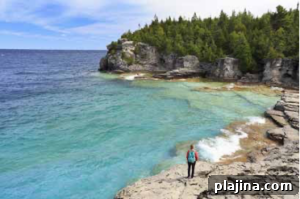
Georgian Bay, a broad, lighthouse-studded expanse on Lake Huron’s northeastern flank, is often called the Sixth Great Lake. Measuring roughly 120 miles long and 50 miles wide and containing about 30,000 islands, Georgian Bay forms the world’s largest freshwater archipelago and includes Manitoulin, the planet’s largest freshwater island. The area is part of a UNESCO Biosphere Reserve and contains extensive freshwater shoreline and beaches.
Outdoor activities such as hiking and horseback riding abound, but many visitors find the bay’s dramatic granite shorelines and wind-sculpted eastern pines to be the most memorable features. The clear, deep blue of the water has even inspired paint manufacturers to name shades after the bay. For lake cruisers, Georgian Bay offers a powerful combination of geological drama, ecological richness and cultural history that rewards slow, attentive exploration.