
As travelers, we often find ourselves peering out airplane windows at the patchwork of land below while cruising at 30,000 feet. On the ground, we watch aircraft take off, land and taxi in what appears to be a carefully choreographed sequence—precise, coordinated and fluid. At night, airports become strings of lights as planes line up for approach, one after another.
Keeping those aircraft moving on time and in the right direction — and ensuring the safety of the thousands of passengers on board — requires intense coordination, precision and expertise. That responsibility falls to air traffic controllers.
According to the Bureau of Labor Statistics, there are about 24,500 air traffic controller jobs in the United States, with employment projected to grow by 4 percent through 2030. The bureau defines an air traffic controller as a professional who coordinates aircraft movement to maintain safe distances between planes.
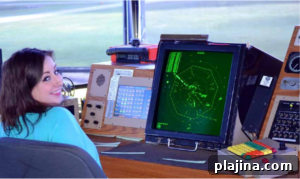
PHOTO: © TARA SAMADIFARD
To understand what a typical day looks like in air traffic control, Global Traveler spoke with Tara Samadifard, an operations supervisor with the Federal Aviation Administration at the Milwaukee Air Traffic Control Tower and Terminal Radar Approach Control facility. Samadifard studied aviation management with concentrations in airport management and air traffic control at Purdue University, though her interest in aviation began long before college.
“I’ve always been interested in aviation, since I was a kid,” Samadifard said. Her father worked as an engineer on planes and helicopters, and she remembers going to the airport to watch landings and takeoffs, especially at night when the lights made everything look magical. “I thought it was the coolest thing ever.”
When she entered college she explored different paths in aviation and discovered air traffic control through coursework. “I stumbled across air traffic control and took a few classes,” she recalled. “I completely fell in love with it.”
After graduating from Purdue, Samadifard began her career as an operations supervisor for a contract airline cargo company before training to become an air traffic controller. At an academy in Oklahoma she learned tower operations and fundamental air traffic control skills to prepare for the role.
Samadifard joined the FAA in December 2014 as an air traffic control specialist at Bismarck Tower and Terminal Radar Approach Control in North Dakota, and she moved to Milwaukee in 2018.
In Milwaukee, her role as operations supervisor involves maintaining close communication with the tower team. Typically three to four people staff the tower at any given time, and each has a specific role.
“There is usually someone who’s the ‘secretary’ of the tower, collecting flight plan information and confirming routes,” Samadifard explained. Other positions include clearance delivery, ground control—which manages taxiing to and from runways—and local control, which clears takeoffs and landings. As operations supervisor, she makes sure everyone and everything operates smoothly and according to plan.
“We’re the eyes and ears of everything,” Samadifard said. “When we work together as a tower team, it’s ‘see something, say something.’ Nothing is a secret in air traffic control. Everyone needs to work together.”
Beyond the tower, Samadifard coordinates with multiple airport departments to maintain safe, efficient operations—handling issues such as maintenance, winter snow procedures and VIP movements.
“My position oversees a little bit of everything,” she said. “That’s my favorite part of the job—every day is different. You may think you know what you’re walking into, but it’s never the same.”
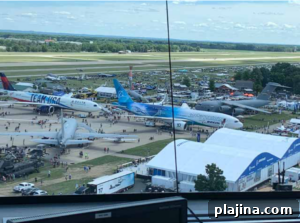
PHOTO: © FEDERAL AVIATION ADMINISTRATION
Samadifard also oversees air traffic control planning for major events like AirVenture Oshkosh, one of the largest fly-in gatherings in the United States. The event attracts a wide variety of aircraft, from antique and restored planes to experimental and eco-friendly designs.
“It’s a really fun event and very different,” Samadifard said of AirVenture. “We make sure everyone is safe because there are so many planes in the air at the same time.”
As one of relatively few women in air traffic control, Samadifard notes that Milwaukee’s tower often includes several female colleagues. “Some shifts, the entire tower is full of women,” she said. “There’s a different perspective when it’s all women, but we all work together.”
While at Purdue she participated in Women in Aviation and continues outreach work through her local safety council. “We do a lot of outreach with young people and communities of color who are interested in aviation,” she said. “This is an amazing job, and the more people we reach, the better it is for the FAA.”
Early next year Samadifard will move to the Indianapolis Air Route Traffic Control Center to serve as an operations supervisor. Returning to her hometown of Indianapolis means adjusting to a different environment and scale of operations.
“It will be a completely different ballpark—a lot of new aircraft, different rules, and I’ll be responsible for many more people,” she said. “I’m excited to get back home to family, too.”
Asked about the future of air traffic control and aviation, Samadifard highlighted the collaborative relationship between controllers and pilots at Milwaukee. Open communication helps both sides understand needs and improve procedures.
“I think the future is better communication and greater efficiency,” she said. “Young controllers are coming in and looking for safe, efficient ways to operate that we can adopt.”
“Our job is to keep you as safe as possible,” Samadifard added. “If you’re wondering about a delay, know it’s to protect everyone. We do everything we can to keep people safe.”