
Long appreciated by seasoned travelers, India has recently emerged as a mainstream meetings, incentives, conferences and exhibitions (MICE) destination. Once primarily on the radar of experienced world travelers, the subcontinent is now frequently mentioned alongside Brazil and China as an up-and-coming force in the global MICE landscape.
Journalist Lisa A. Grimaldi, writing for Meetings & Conventions magazine in June 2013, outlined how an emerging meetings market typically meets one or more of these criteria:
- A destination discovering how meetings, incentives and exhibitions can boost its economy;
- A country with newly developed infrastructure—hotels, convention facilities, airports and destination management organizations—capable of hosting large events;
- A nation with a strong economy that is building a domestic meetings market and expanding group business regionally and internationally.
India clearly satisfies the first two points and, based on recent economic indicators, appears to be progressing toward the third. During the first decade of the 21st century, India’s gross domestic product grew by an average of 7.6 percent, up from 6.1 percent in the 1990s and 4.6 percent in the 1980s.
Analysts have offered mixed short-term assessments, but several reports from 2014 projected an improvement in GDP growth over subsequent quarters. Political change and economic reform efforts following the 2014 election of Narendra Modi prompted cautious optimism among international observers. Whether those initiatives fully reverse long-standing economic challenges will take time to reveal, but early signals suggest gradual improvement—enough to attract the attention of meeting and event planners worldwide.
Reed Travel Exhibitions, a major organizer of global travel and tourism events, has highlighted India by adding the country to its IBTM roster of Incentives, Business, Travel and Meetings Expos. The inaugural IBTM India in Mumbai received positive reviews, and the follow-up event in Chennai showed growing interest from international and domestic participants.
Beyond Mumbai and Chennai, the Indian Institute of Management Bangalore, in a 2005 planning study for the Ministry of Tourism, identified Hyderabad as a promising MICE hub—especially after the opening of the Hyderabad International Convention Centre (HICC).
Hyderabad International Convention Centre © Hyderabad International Convention Centre
Opened as India’s first purpose-built convention center, HICC sits on a 15-acre landscaped site in Hyderabad. The pillar-free main hall covers nearly 70,000 square feet and can be divided into six separate meeting spaces. It accommodates up to 400 banquet tables in segmented setups and as many as 6,000 guests for cocktail-style events. A separate 70,000-square-foot pre-function foyer handles up to 5,000 visitors, while the facility is flexible enough to host smaller gatherings of 15 attendees.
Venue highlights include
- Approximately 40 minutes from Rajiv Gandhi International Airport;
- Convenient access to public transport;
- In-house management, catering and audio-visual teams;
- 24/7 surveillance and comprehensive security systems;
- Robust power backup to ensure uninterrupted events;
- Direct connectivity to the adjacent 5-star Novotel Hyderabad.
The neighboring Novotel Hyderabad provides business-friendly amenities such as complimentary shuttle service, free WiFi and a 24-hour fitness center—features valued by event organizers and attendees alike.
Another major option is the Hyderabad Marriott Hotel & Convention Centre, which offers nearly 60,000 square feet of meeting space across 10 rooms (expandable to 12 breakouts) and can host up to 1,300 guests. Planners also benefit from Marriott’s suite of online planning tools, including step-by-step guides and customized event websites for attendee registration and information.
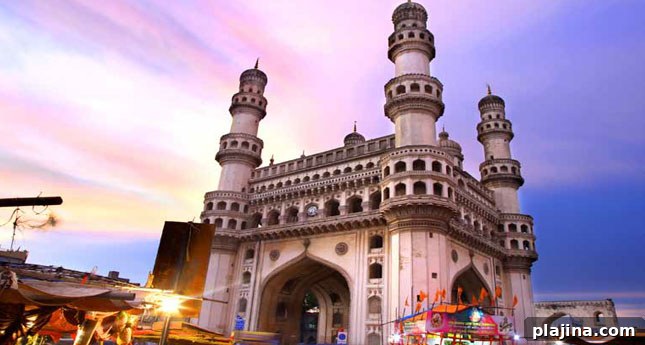
Hyderabad’s appeal goes beyond convention infrastructure. Known as the “City of Pearls” for its historical role in pearl and gem trading, the city blends historic sites with modern facilities. Dominating the old city skyline, Charminar is an iconic monument built in 1591 and remains a cultural symbol for residents and visitors.
Nearby Laad Bazaar is a bustling market famous for jewelry, especially gem-studded bangles and traditional ornaments. Bargaining is common, so shoppers should feel comfortable negotiating prices.
For leisure and educational experiences, the Birla Planetarium offers an advanced sky-viewing facility ideal for evening relaxation after conference sessions. The Hyderabad Botanical Garden, spanning 120 acres and divided into 19 thematic vanams, showcases a wide range of plant collections—from medicinal gardens and fruit trees to ornamental and aquatic plants—providing a tranquil escape within the city.
As India continues to develop its infrastructure and expand its role in the global economy, cities like Hyderabad are well positioned to attract a growing share of the international meetings and events market, offering modern venues, hotel support and rich cultural experiences for attendees.