My first visit to Saudi Arabia’s Red Sea coast now feels like a chapter from another era. It was 1995, and I was traveling with my cousin, an ornithologist, and his wife. Visiting the kingdom was not straightforward: I needed sponsorship letters and a pre-trip interview at the Saudi Arabian Embassy. At the time there was virtually no tourist infrastructure. We explored by SUV and often slept beneath the stars. One morning we woke on roll-out mattresses on a remote Red Sea beach about 200 miles from Jeddah.
When daylight arrived, the sea revealed startlingly turquoise waves washing onto pristine sand. We assumed we were alone until voices approached. Two fishermen appeared along the beach, carrying their overnight catch on poles slung over their shoulders. We spoke little Arabic and they knew no English, but we invited them to join us for morning tea. In return, they offered several fish to grill on an improvised barbecue — possibly the best breakfast I’ve ever had.
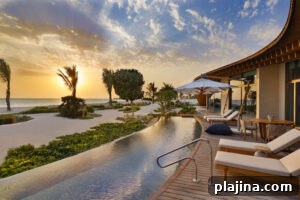
PHOTOS: SIX SENSES SOUTHERN DUNES
Fast-forward three decades and Saudi Arabia has emerged as one of the world’s fastest-growing tourist destinations, led by ambitious developments such as the Red Sea Project. In the once-neglected Tabuk Region — which covers the northern portion of Saudi Arabia’s 1,100-mile Red Sea coastline — a major plan is transforming mainland beaches and 90 offshore islands into an international tourist hub. The first resorts have already opened, and in 2023 Red Sea International Airport began operations, with plans to handle 1 million passengers per year by 2030.
The project emphasizes sustainability: it aims to use 100 percent renewable energy, relying mainly on solar power backed by what is planned to be the world’s largest battery storage facility. Desalination plants will supply fresh water, while treated wastewater will be used to create new wetland habitats. While sustainability is often a tourism buzzword, Saudi planners are pushing further toward regenerative tourism — restoring and improving natural systems rather than merely reducing harm.
Before construction began, the project invested in regenerating marine and coastal habitats damaged by overfishing, pollution, coral destruction and climate change. Development plans were adjusted to support those conservation efforts, with the aim of protecting 75 percent of the 90 islands from development. For example, Waqqadi Island — noted for white-sand beaches and clear waters — was initially proposed for a major resort, but researchers identified it as an essential breeding ground for hawksbill turtles, and the resort plan was abandoned.
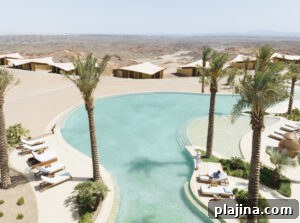
© ST. REGIS RED SEA RESORT
The Red Sea, which separates Africa from the Arabian Peninsula, is a global biodiversity hotspot. It hosts around 1,120 species of fish, roughly 14 percent of which are endemic. Its warm, highly saline waters with relatively weak currents offer excellent visibility and exceptional diving opportunities. Historically, the most famous dive sites have been in the Gulf of Aqaba off Egypt, Jordan and Israel, leaving much of Saudi Arabia’s underwater potential underexplored — a situation that is rapidly changing.
Over the next five years the plan envisions 50 new hotels with about 8,000 rooms combined. Diving, watersports and secluded beaches will be the central attractions, but the coastal developments will also provide easier access to inland treasures such as AlUla, about 150 miles from the coast. This UNESCO World Heritage site has been occupied for more than 7,000 years and features Nabatean tombs carved into sandstone cliffs. Nearby Maraya, a 500-seat mirrored concert hall, reflects the surrounding desert in its facade, creating a mirage-like effect.
Both the Red Sea Project and AlUla form part of Saudi Vision 2030 — a multibillion-dollar initiative to diversify the nation’s economy. One of Vision 2030’s most talked-about proposals was The Line, initially conceived as a 110-mile-long linear city designed to house millions. That plan has since been scaled back, but even with revisions it remains a striking, futuristic concept.
Despite the headline-grabbing scale of these projects, many travelers will still treasure simpler experiences: the quiet pleasure of sitting on a remote Red Sea beach, sharing a freshly grilled fish with local fishermen and listening to the sea. Those unhurried moments capture why this coastline can be so memorable.
INFO TO GO
Red Sea International Airport lies about 11 miles inland and currently receives domestic flights from Riyadh, Jeddah and international service from Dubai, with more routes expected to be added. U.S. citizens must obtain a visa to enter Saudi Arabia, which can be purchased online or on arrival; at present, a single-entry 30-day visa costs approximately $117.