
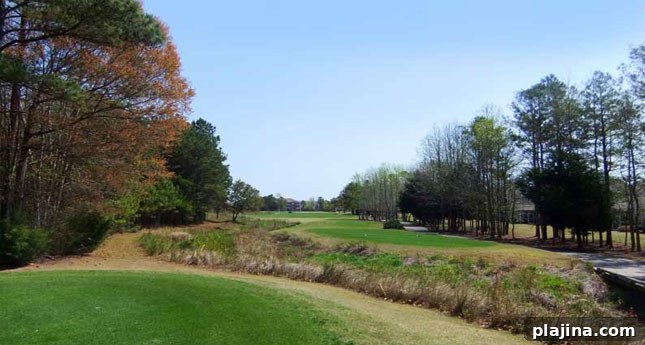
This is the final installment in my reviews of the courses at Barefoot Landing in Myrtle Beach, South Carolina. Earlier installments covered the Dye (July 2013), Love (August 2013) and Fazio (January 2014) courses. The Norman Course, the fourth in popularity, was designed by “The Shark” to encourage strategic “bump-and-run” shots around the greens.
Located along the Intracoastal Waterway, seven holes border the navigation route and offer striking views and demanding shots. Native vegetation blends with open green complexes and fairways that frequently run into sand. Waste areas and native grasses frame each hole, giving parts of the routing a Southwest feel. The course reflects Alister MacKenzie–influenced principles: flowing lines, subtle shaping and bunkers with sloping white faces often accented by layered sod walls.
The par-72 Norman Course stretches roughly 7,200 yards and features Champion UltraDwarf greens, with GN-1 turf (developed by Greg Norman Turf Co.) on tees and fairways. Approach areas use Tifdwarf, delivering consistent playing surfaces throughout the course.
Hole 1 | 377 yards, par 4
The opening hole can intimidate. A wide waste area sits in front of the tee, followed by a narrow landing zone where a left miss remains playable but a right miss disappears into thick overgrowth. On my round I found a groove and placed my tee shot left-of-center, leaving a clear approach. Others in the group struggled with errant drives into the trees or the rough. The hole rewards a thoughtful bump-and-run into the green, and I rolled in a one-putt par.
Hole 5 | 571 yards, par 5
This long par 5 is guarded by waste bunkers along both sides and throughout the landing areas, forcing shot-makers to consider placement on every stroke. The fairway doglegs heavily left and is flat, which means stray shots tend to keep rolling toward trouble. Playing the hole typically requires three solid shots — a confident drive, a strong long-wood and a precise mid-iron — otherwise you’ll find sand and trees. It’s a classic risk-reward par 5 that can punish aggressive play.
Hole 6 | 448 yards, par 4
Another long par 4, hole 6 demands two excellent shots to reach the green in regulation. The ideal tee shot favors left-center to open up the approach, while the right side presents waste bunkers that cross in front of the putting surface. Staying out of the trees and avoiding those bunkers are the primary keys to a routine score here.
Hole 9 | 568 yards, par 5
This par 5 adds complication with a deep ravine you must clear to reach the tucked green on the right. A clean tee shot sets up a thoughtful second shot; brute force with a long club often carries too far and lands below the green in the ravine. A high wood or long iron to position for the final approach is usually the smarter play. The green is well-guarded by bunkers and runs downhill from back to front, so precise distance control is critical.
Hole 10 | 203 yards, par 3
Set along the Intracoastal, this par 3 is a favorite and showcases the Norman aesthetic. It plays similarly to several regional par 3s but with its own character. Club selection and trajectory are important; a high, soft shot will hold this green, while anti-climactic misses can find bunkers or the water. On my round, a well-struck 5-wood landed and bounced toward the green while others in the group found trouble around the hole.
Hole 12 | 438 yards, par 4
Hole 12 is a textbook example of the bump-and-run concept: the green invites shots that roll toward the hole. The challenge is getting into the right position to play that shot. The left side is hazardous because a marsh runs from the tee area toward the green, so approaches must avoid that slope. A conservative plan from the right can leave a short pitch or bump-and-run that rewards precision.
Hole 18 | 552 yards, par 5
The finishing hole is a bold Norman design that doglegs and offers the chance to cut the corner for added distance. Players who successfully shorten the hole with a big tee shot gain a significant advantage, but the second shot must avoid drifting too far right, which blocks the line to the green. Live oaks and wet waste areas claim many wayward balls, and the green complex is defended by trouble on the front and sides. It’s a fitting, risk-reward cap to the round.
The Norman Course
Barefoot Resort and Golf
4980 Barefoot Resort Bridge Road
North Myrtle Beach, SC 29582
tel 866 638 4818
barefootgolf.com