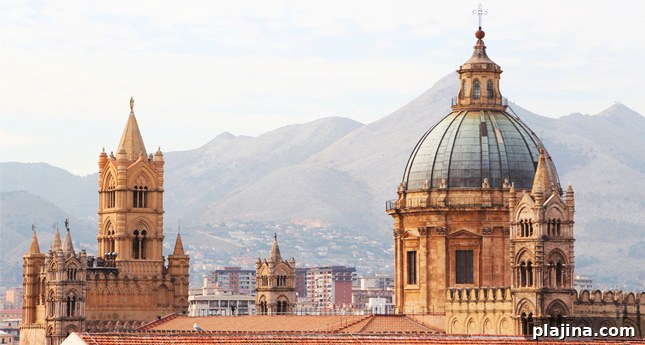
This year, UNESCO added the Arab-Norman architectural ensemble of Sicily to its World Heritage list, highlighting one of the island’s most exceptional cultural assets. Centered on the northern coast, the Arab-Norman Palermo site comprises nine civil and religious buildings that reflect the island’s multicultural legacy under the Norman Kingdom of Sicily (1130–1194). The ensemble includes two palaces, three churches, a cathedral, a bridge and the cathedrals of nearby Cefalù and Monreale. These monuments, dating from the 12th century, demonstrate the productive coexistence of diverse communities — Muslim, Byzantine, Latin, Jewish, Lombard and French — whose artistic and architectural influences merged to create a distinctive regional style.
UNESCO’s recognition underscores both the historical and artistic importance of these structures. The palaces and religious buildings combine Norman structural engineering with Byzantine mosaics and Islamic decorative motifs, producing interiors and facades that are striking for their craftsmanship, symbolism and fusion of techniques. The site’s cathedrals and churches preserve mosaics, marble inlays and architectural forms that document how different traditions were adapted and harmonized during a period when Sicily was a major cultural crossroads in the Mediterranean.
In addition to the Arab-Norman designation, Sicily is home to several other UNESCO World Heritage sites that reveal the island’s layered past. In 2002 UNESCO inscribed eight late-Baroque towns in southeastern Sicily — Caltagirone, Militello Val di Catania, Catania, Modica, Noto, Palazzolo Acreide, Ragusa and Scicli — recognizing their outstanding Baroque architecture and urban planning. Many of these towns have medieval origins but were largely rebuilt following the catastrophic earthquake of 1693, which devastated large parts of the Val di Noto and resulted in tens of thousands of casualties. The post-earthquake reconstruction led to a distinct regional Baroque style characterized by elegant facades, ornate balconies and carefully planned streets and squares.
Other UNESCO-listed sites on the island include the archaeological area of Agrigento, inscribed in 1996, which preserves one of the most important concentrations of ancient Greek temples and ruins outside Greece, illustrating the wealth and urban organization of a major classical city. The ancient city of Syracuse and its necropolis, added to the list in 2005, highlight a continuum of Greek, Roman and later influences, with well-preserved archaeological remains, Greek theaters and monumental structures that trace centuries of Mediterranean civilization.
Together, these World Heritage sites showcase Sicily’s unique position as a meeting point of cultures, languages and artistic traditions. From ancient Greek settlements and Roman urbanism to Byzantine mosaics, Islamic decorative art and Norman architecture, through to the expressive Baroque reinvention after the 1693 earthquake, the island’s monuments offer a rich and tangible record of historical interaction and creative synthesis. Visitors and scholars alike can read Sicily’s complex history in stone, mosaic and urban form — a testament to the island’s enduring cultural significance within the Mediterranean region.