
Despite global economic uncertainty, prosperity continues to shine in southern China’s Pearl River Delta, and Guangzhou remains a strong regional center. Since hosting the 16th Asian Games two years ago, Guangzhou—traditionally known in the West as Canton—has experienced a notable resurgence. Its commercial, financial and retail sectors are expanding, and manufacturing remains robust. New riverside developments are reinforcing Guangzhou’s economic momentum.
As the largest city in southern China, Guangzhou is growing quickly. Over the last decade the population rose by roughly 25 percent to about 12.7 million residents. The city has advanced to a Beta World City classification, identifying it as an important node in global finance and trade. Guangzhou hosts the largest comprehensive port in South China—ranked fifth worldwide by volume—and the revitalized Tianhe business district accounts for nearly 40 percent of China’s production of personal computers and digital devices. On the ground, this translates into significant investment in electronics manufacturing and international trade. In July, Guangzhou opened the Bund Financial Street on Changdi Road, the city’s first private financial avenue: a half-mile stretch of refurbished arcade architecture housing 32 firms involved in investment, securities and venture capital. The city aims to grow the financial sector to about 12 percent of Guangzhou’s GDP by 2020.
Major developments now line both banks of the Pearl River, transforming formerly overlooked districts such as Haizhu on the south bank and Tianhe on the north. Haizhu’s expansion accelerated after the Canton Trade Fair relocated to the Pazhou Complex. With more available land than older downtown cores, Haizhu presented development opportunities and now includes some of the city’s most valuable riverside real estate.
Haizhu also hosts Canton Tower, China’s tallest structure. Opened in 2010 and rising to 1,969 feet, the tower is among the world’s tallest free-standing structures and draws tourists with multiple observation decks, dining options, a 4-D cinema and glass-floor attractions.
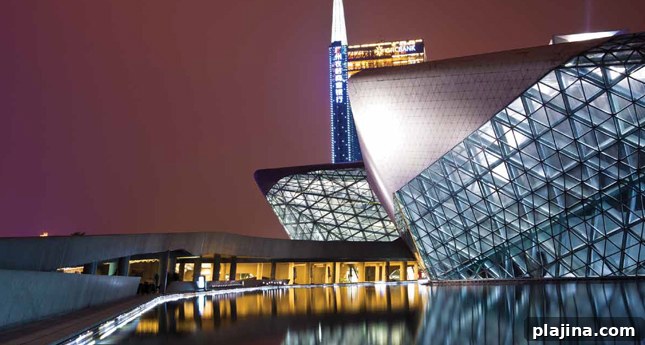
Across the river in Tianhe, the Guangzhou International Finance Center symbolizes the shift of Guangzhou’s commercial heart toward the riverside. Also opened in 2010, the 103-story tower reaches 1,440 feet and ranks among China’s tallest skyscrapers. Surrounding towers form a modern skyline above Zhujiang New Town Square, adjacent to the former Asian Games site. The square is bordered by notable cultural landmarks: the Guangzhou Museum to the east and the Guangzhou Opera House, designed by Zaha Hadid, to the west. The Guangzhou Opera House is one of the nation’s largest performance venues. The area’s profile is further enhanced by the presence of the U.S. Consulate, which has been developing a significant compound in Zhujiang New Town.
Guangzhou has invested heavily in transportation. The Metro system already operates eight lines and ranks among the world’s top ten metro systems by ridership and route length, with plans to more than double its network before the decade’s end. The city also launched a Bus Rapid Transit system in 2010, one of the world’s largest, serving about 800,000 passengers daily. To address taxi shortages during peak periods, Guangzhou licensed 1,000 additional GPS-equipped taxis operating from sunrise to sunset. As the capital of the 40 million-person Pearl River Delta region, which includes Shenzhen and borders Hong Kong, Guangzhou has accelerated rail links to neighboring cities. The Guangzhou–Zhuhai Intercity Railway, opened in 2011, operates trains averaging about 124 mph, while the high-speed line to Wuhan reaches higher average speeds for long-distance travel.
Much of Guangzhou’s recent commercial activity centers on the Pearl River, drawing roughly half a million foreign business visitors annually to the Canton Trade Fair. Held twice a year at the Pazhou Complex in Haizhu, the fair attracts roughly 210,000 visitors from more than 210 countries and regions and hosts around 24,000 exhibitors, mostly based in China. Each spring and autumn session is divided into three five-day phases covering a wide array of products from footwear to consumer electronics. During fair periods hotels fill quickly and prices rise sharply, so business travelers should plan and book well in advance. The Canton Fair often reflects global trade trends: while recent sessions have seen modest declines in export volume and orders from Europe and the United States, the number of exhibitors and buyers has increased and buyers from non-Western regions have helped offset some declines.
While global economic headwinds may temper China’s broader growth, Guangzhou continues to expand and modernize, positioning the city to benefit as conditions improve.
Diversions
The 14-mile Scenic Corridor along the Pearl River highlights both historic and modern Guangzhou. To the west, Shamian Island stands out: a compact, half-mile-long enclave that preserves 19th- and early-20th-century European architecture. Of the island’s roughly 150 historic buildings, about 42 survive in Gothic, Baroque or Neoclassical styles, making it a pleasant area for a leisurely walk.
North of Shamian Island is Shangxiajiu Pedestrian Street, Guangzhou’s first pedestrian-only commercial avenue, running nearly a mile through the old Xiguan neighborhood. Around 300 shops occupy arcade-style 1920s and 1930s buildings. While souvenir stores and boutiques draw visitors, teahouses and traditional shops are the cultural highlight. Shangxiajiu is a popular spot for yum cha—the Cantonese morning tea tradition featuring dim sum, steamed dumplings and rolls that define Cantonese cuisine.
A short distance north lies the Chen Clan Academy at 34 Enlong Lane, Zhongshan 7th Road. Completed in 1894, this ancestral hall complex includes 19 buildings and six courtyards and now houses the Guangdong Folk Art Museum, notable for its ornate architecture and decorative arts.
Further downstream on the south bank, Canton Tower offers sweeping panoramas of the river and city. Opposite the tower, Zhujiang New Town Square showcases the contemporary face of Guangzhou: skyscrapers to the north, the former Asian Games grounds to the south, the Guangzhou Opera House to the west and the Guangdong Provincial Museum to the east. The provincial museum’s multi-level galleries present around 166,000 artifacts spanning Cantonese art, history and customs, along with natural history exhibits, including dinosaur fossils.
For a memorable evening, consider a dinner cruise on the Pearl River to enjoy the city’s nightly light displays and views of Guangzhou’s illuminated skyline.
Info To Go
Guangzhou Baiyun International Airport (CAN) is connected to downtown by Metro Line 3, a trip of about 50 minutes with fares typically around $2. The Airport Express Bus No. 1 serves many central hotels for roughly $2.50, and airport taxis generally charge about $20. Urban Metro fares start at approximately $0.30, and station signage commonly includes English. LPG-fueled taxis have relatively low starting fares, roughly $2 for the first 1.5 miles.
Just The Facts
Time Zone: GMT +8
Phone Code: Country code: 86; city code: 20
Currency: Chinese yuan (renminbi)
Entry/Exit Requirements: U.S. citizens must hold a passport valid for at least six months and obtain a visa prior to travel through official channels such as Chinese consulates or authorized travel agencies.
Official Language: Mandarin Chinese (Putonghua); Cantonese is widely spoken locally. Using an interpreter can be helpful.
Key Industries: Manufacturing, shipping, international trade, finance, automobile assembly, pharmaceuticals, textiles and garments, information technology, electronics and computers.
Lodging
Grand Hyatt Guangzhou
This 350-room, five-star hotel offers a 24-hour business center, technology concierges, airport limousine service and a rooftop spa and fitness center, making it popular with corporate travelers. 12 Zhujiang Xi Lu, Tianhe District. Price tier: high.
The Ritz-Carlton, Guangzhou
The Ritz-Carlton anchors Zhujiang New Town with 351 guestrooms beginning on higher floors and a Club Level lounge. 3 Xing’an Lu, Tianhe District. Price tier: high.
Shangri-La Hotel, Guangzhou
With 704 guest rooms, executive floors, golf practice facilities and proximity to the Canton Fair, this luxury hotel is a leading option in the new Guangzhou. 1 Hui Zhan Dong Lu, Haizhu District. Price tier: high.
Dining
Robata Bar and Grill
A refined steakhouse and Japanese-style restaurant featuring charcoal grills, a sushi bar, sake lounge and wine selection. Located in Sofitel Guangzhou Sunrich Hotel, 988 Guangzhou Da Dao Zhong, Tianhe District. Price tier: high.
Summer Palace
An elegant Cantonese restaurant with private dining rooms where dim sum is a weekday lunch and weekend brunch specialty. Shangri-La Hotel, 1 Hui Zhan Dong Lu, Haizhu District. Price tier: moderate to high.
Tao Tao Ju
A 132-year-old staple on Shangxiajiu Pedestrian Street renowned for abundant dim sum offerings, including traditional dishes such as pork with ginger vinegar and eggs. 20 Dishifu Lu, Liwan District. Price tier: moderate.
Checking In With Frank Wen
Vice President and General Manager, Shangri-La Hotel, Guangzhou
Tips for Business Travelers, Especially During the Canton Trade Fair
Check recent traveler reviews to compare hotels on location, services and amenities. Contact your chosen hotel to learn about business-focused services such as shuttle service to the Trade Fair, on-site registration centers to avoid long lines, diverse dining options for meetings, and attentive staff who can troubleshoot logistics during a busy visit.
What the Shangri-La Hotel Offers
The Shangri-La Hotel in Guangzhou blends business and relaxation. Its location in the new commercial district on the Pearl River places it within easy reach of the Pazhou Trade Fair. Guests enjoy river and skyline views, landscaped gardens, a private putting green, diverse dining choices and a comprehensive fitness center. WiFi is available throughout guest rooms, restaurants, meeting rooms and public areas.
Recommendations for Visitors
Since the 2010 Asian Games, Guangzhou has modernized rapidly while retaining rich cultural traditions. If possible, extend a business trip by a day or two to experience both sides of the city: enjoy yum cha at a local teahouse, browse wholesale markets such as Qingping Market or the Onelink Wholesale Market, and visit cultural sites like the Guangdong Museum, the Chen Clan Academy and Shamian Island to appreciate Guangzhou’s role as the center of Cantonese culture for more than two millennia.