
I saw the future in 1973. Aged six, at Johannesburg Airport, I stood on the viewing deck and stared in wonder at an airplane unlike any other. With swept-back wings and a sharp nose it looked like a paper dart, its name painted on the tail: Concorde.
The aircraft was a prototype, visiting South Africa for tests in “hot and high” conditions. It sat among older propeller airliners and more modern Boeing jets on the apron and clearly represented a dramatic leap in aviation — a glimpse of a world where supersonic flight might become routine.
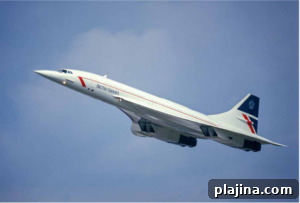
PHOTO: © WIRESTOCK | DREAMSTIME
That future effectively ended on Oct. 24, 2003. After 27 years of commercial service, mostly with British Airways and Air France, Concorde made its final passenger flight from New York (JFK) to London (LHR). It marked not only the end of an era but also the fading belief that air transport would continuously advance at the same rapid pace.
Modern jet airliners still resemble the Boeings I saw in 1973. The biggest changes have taken place in the cockpit, where analogue instruments have been replaced by powerful computers, and in engine efficiency. Fifty years on, Concorde remains an anomaly.
What happened? The decisive blow came around the same time I watched from the viewing deck. In March 1973 the FAA banned civilian supersonic flights over the United States. American carriers that had ordered Concordes — including Trans World Airlines, Pan Am, Continental, American, Eastern, United and Braniff — canceled their orders, which instantly undermined the aircraft’s economics. In the end, only 14 Concordes were delivered.
The principal concern then, as now, was the sonic boom. When an aircraft breaks the sound barrier it creates shockwaves that are audible on the ground. Regulators worried that frequent booms would disrupt sleep, alarm people and distress pets and livestock.
Ironically, the first aircraft-produced sonic boom over the mainland United States came in 1947 when Chuck Yeager flew the Bell X-1 through the sound barrier at 40,000 feet over Rogers Dry Lake, California. Reaching Mach 1 — the speed of sound — changes an aircraft’s aerodynamics. Engineers learned to design efficient subsonic aircraft and, separately, shapes and engines suited to supersonic flight. The challenge was combining those qualities into a commercially viable airliner.
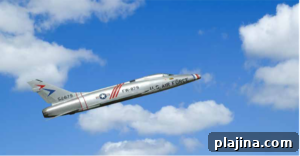
PHOTO: © JEFFREY BANKE | DREAMSTIME.COM
The military solved many of the technical challenges first. In the arms race that followed World War II, speed was an obvious advantage. The North American F-100 Super Sabre in 1953 became the first fighter capable of supersonic speed in level flight, soon followed by Soviet designs such as the MiG-19. These early supersonic fighters were sometimes unstable and produced loud booms that disturbed people on the ground. I remember living in Seoul in the 1980s when the SR-71 Blackbird’s supersonic runs regularly rattled city windows.
For commercial manufacturers the remaining obstacle was economics. Supersonic designs required a high power-to-passenger ratio, limiting fuselage size, and burned far more fuel per passenger than conventional jets. Lockheed and Boeing explored supersonic airliner concepts, but it took a Franco-British partnership to get an airliner built. Concorde emerged with a narrow, single-aisle fuselage carrying 92–128 passengers, cruising at about 60,000 feet and Mach 2.04 — more than twice the speed of sound — cutting London–New York flying time from over six hours to under three.
Early ambitions planned for 350 aircraft and airlines placed around 100 firm orders. The FAA’s ban on overland supersonic flight removed many potential routes overnight, and Concorde’s prospects were diminished.
Despite the odds, Concorde turned a profit. Beyond sheer speed, it offered exclusivity and became the transatlantic choice for many wealthy and famous travelers. Over its 27 years in service Concorde generated nearly £500 million ($600 million) in profit for British Airways and delivered a smaller profit to Air France. No other major airlines purchased the type, though Concorde briefly wore the liveries of Singapore Airlines and Braniff International on short-term leases.
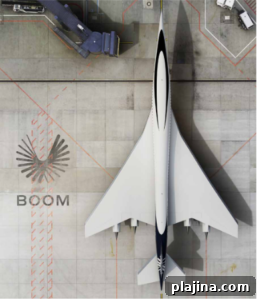
PHOTO: © BOOM SUPERSONIC
Concorde was glamorous but not particularly comfortable. Its narrow cabin offered none of the amenities modern travelers expect: no personal screens, no fully flat seats, and cramped dining spaces. The cabin was noisy and could feel claustrophobic. Yet passenger satisfaction for the experience remained high.
The aircraft’s fate was sealed on July 25, 2000, when an Air France Concorde struck debris on the runway at Paris Charles de Gaulle Airport. The fuel tank ruptured and the aircraft crashed into a nearby suburb, killing all 109 people aboard and four on the ground. Concorde fleets were grounded immediately; they returned to service after safety upgrades, but the decision had been taken to retire them.
That appeared to be the end of commercial supersonic flight. New programs have been announced since, but airlines remained reluctant to commit to aircraft that cannot operate supersonically over much of the world.
Today we are closer than we’ve been to a return to supersonic travel. Since 2016 Colorado-based Boom Supersonic has developed the 65–88 passenger Overture. A one-third-scale demonstrator, the XB-1, was planned to begin testing in the early 2020s, with the full-scale Overture originally targeted for first flight in the mid-2020s.
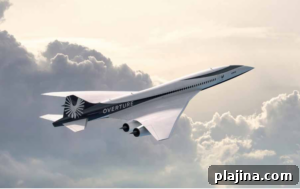
PHOTO: © BOOM SUPERSONIC
Overture has already attracted more than 200 orders. Early customers included Virgin Group, joined by Japan Airlines and United Airlines, and American Airlines announced a firm order with options for more. The new designs aim to solve some problems that held supersonic travel back. Takeoff noise is a major issue: Concorde relied on very loud afterburners for initial climb. Boom has worked with engine partners to develop engines that produce needed thrust with lower noise and better fuel efficiency. The company also intends to operate on sustainable aviation fuels and explore technologies to reduce net CO2 emissions.
One remaining hurdle is regulatory. The FAA’s ban on supersonic flight over land is still in force. NASA and Lockheed Martin have developed the X-59 QueSST, an experimental aircraft intended to fly over U.S. territory to collect data on technologies designed to reduce sonic booms. If that research persuades regulators, the FAA could lift the ban in the future, opening many supersonic routes.
Half a century after I watched Concorde at Johannesburg Airport, supersonic air travel has barely advanced — but change is coming. Before long a new generation of children may look out at airport aprons and recognize the silhouette of supersonic airliners as a familiar part of the sky.