
Mexico City long flew under the radar compared with North American peers like Toronto and Washington, D.C., but in recent years its many attractions have drawn growing attention. Home to more museums than any other city in the world and a wealth of cultural institutions, Mexico City has had to overcome major setbacks — from the 2017 earthquake to the global pandemic — yet it keeps recovering and reinventing itself.
With each recovery the city refines what it offers: public spaces get cleaner, neighborhoods become more polished, and the tourism experience grows more confident. As Mexico City marks its 500th anniversary, it stands ready for a strong rebound.
Author Jim Johnston, who wrote Mexico City: An Opinionated Guide for the Curious Traveler, points to 2015 as a turning point. That year saw a surge of coverage celebrating the city’s renewed energy. New restaurants, bakeries and shops — many started by foreigners — added a fresh spirit of adventure and expanded the city’s offerings. “Fear has been replaced by fabulousness,” Johnston says, noting improvements in infrastructure, air quality and public transit.
Transportation options have broadened: ride‑hail services like Uber and several bike‑share programs make getting around simpler and more comfortable for visitors. Airbnb and other platforms have opened up more neighborhoods to travelers, allowing them to explore beyond the historic center. According to Mexico City writer Lydia Carey, who authored Mexico City Streets: La Roma, the growth of English-language culinary and cultural tours has also helped international visitors engage with local life in ways that were harder to find a decade ago.
“Mexico City has become the hub for innovation across Latin America,” says José Pablo Toscano, founder and CEO of local travel startup Jubel. Significant investment and a more tech-forward atmosphere have made the city increasingly dynamic.
PHOTO: © KMIRAGAYA | DREAMSTIME.COM
The city’s geography and history contribute to ongoing challenges. Built atop an Aztec island in former lakes and marshes, Mexico City’s foundations have shifted for centuries. Spanish colonists drained wetlands and built heavy stone structures that began to settle and sink. Infrastructure projects, including a proposed international airport expansion, have faced engineering hurdles because of the swampy terrain. The government later shifted plans toward a combined military and civilian airport at the Santa Lucía Air Force Base, scheduled for completion in 2022.
Despite these complexities, people continue to move to and visit the city. Mexico City now has five convention centers, more than 600 hotels and over 53,000 rooms across budget, boutique and luxury categories. Many visitors spend a week exploring the center, while business travelers sometimes head to the modern office district of Santa Fe.
Air quality has improved as older buses and Beetle taxis have been retired, and the city’s liberal traditions have helped spur a vibrant arts and cultural scene. Toscano notes that social movements, including gay rights and environmental activism, have drawn a young, entrepreneurial crowd into the business community and helped fuel progressive change.
Over the past decade gentrification has shaped neighborhoods such as Coyoacán, La Condesa, Roma and San Ángel. While rising rents can challenge longtime residents, these pedestrian-friendly areas have become attractive places to stay, dine and explore. Where travelers once restricted themselves to the corridor between the historic center and Polanco, they now discover eclectic offerings across many neighborhoods.
“There are more great gourmet food and drink options all the time, with Mexican craft beer and designer cocktails really taking center stage,” says Carey. Microbreweries and specialty bars have proliferated, giving locals and visitors new ways to sample Mexico’s culinary creativity.
Foreign investment and business opportunities are also expanding. “The city is better positioned now to cater to all levels of tourism,” Carey says. High-end hotels, contemporary art venues and luxury retail coexist with excellent street food, markets and historic sites. Investment is reaching lesser-known but centrally located neighborhoods like Santa María la Ribera, San Rafael and Juárez, broadening the city’s appeal.
Toscano adds that recent pro-investment policies have made it easier for foreigners to participate in Mexico City’s growing market. After decades of relatively low profile among global travelers and business visitors, Mexico City is finding renewed momentum.
CHECKING IN WITH RAFAEL LIZÁRRAGA
Chief commercial officer, Grupo Posadas
Historically, Mexico City has a reputation for recovering from adversity, including the 2017 earthquake. How will the city bounce back from the COVID-19 pandemic?
Throughout our history we have faced events that forced adaptation and renewal. Mexican service culture is defined by warm hospitality and a commitment to quality, which drives our competitiveness. Since the pandemic began, Grupo Posadas implemented action plans to safeguard operations and guest experience, and during the last 15 months those measures have supported a positive reactivation that we are already seeing.
How has Grupo Posadas adapted during the global health crisis to maintain its high level of hospitality? Will it affect future plans in Mexico City?
Anticipating the crisis, we developed detailed operational protocols to remain efficient while preserving guest experience. We also focused on energy savings and cost controls to navigate uncertainty. Our commitment to service remains unchanged, and these adjustments will not disrupt future offerings; we will continue introducing new experiences as travelers return.
What is the outlook for business and investment opportunities in Mexico City?
Mexico City continues to present investment opportunities across sectors. Its vast size means there is room to develop new hotels and services, and the city remains an important platform for national and foreign investors.
Which activities do you recommend first-time visitors pursue to get a true sense of the city’s diverse culture, history and heritage?
A seven-day visit is ideal to sample the breadth of the city. Must-sees include the Historic Center with its Cathedral and Templo Mayor, a walk along Paseo de la Reforma and a photo by the Angel of Independence, the National Museum of Anthropology, Chapultepec Castle, and the gastronomic scenes in Polanco and La Condesa. Coyoacán and the Frida Kahlo Museum are highly recommended, as are a trajinera ride in Xochimilco and a drive through Santa Fe to view the city’s modern business district.
DIVERSIONS
Museums or neighborhoods? Ruins or food tours? History or modern art? Mexico City offers all of these options, and it’s easy to tailor a trip to your interests.
The National Museum of Anthropology is one of the most impressive institutions in the country, with an extensive collection of pre‑Columbian artifacts displayed in a striking building that spans nearly 20 acres of exhibition space.
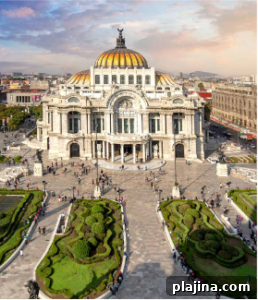
Near Alameda Park, two adjacent early‑20th‑century buildings capture the city’s Belle Époque and Art Deco elegance. The gilded Palacio Postal remains a functioning post office, and the Palacio de Bellas Artes houses an opera hall and museum showcasing fine art and performance.
© RICHIE CHAN | DREAMSTIME.COM
The vast Plaza de la Constitución, commonly called the Zócalo, anchors the historic center. Palacio Nacional overlooks the square and displays a sweeping Diego Rivera mural, while the Metropolitan Cathedral — constructed over centuries — remains an iconic landmark.
A day trip northeast of the city takes you to the extraordinary ruins of Teotihuacán, about 31 miles away. These archaeological sites, which flourished between A.D. 100 and 750 and were later revered by the Aztecs, offer a profound glimpse into the region’s ancient past.
LODGING
Las Alcobas, a Luxury Collection Hotel, Mexico City
A chic, high‑design boutique hotel featuring modern rooms, private‑elevator suites and acclaimed dining for travelers seeking exclusivity.
Av. Presidente Masaryk 390, Polanco
Live Aqua Urban Resort México
A refined luxury resort focused on sensory experiences, with spa treatments and contemporary Mexican cuisine.
Av. Paseo de los Tamarindos No. 98, Colonia Bosque de las Lomas
The St. Regis Mexico City
A gleaming, modern luxury hotel with popular dining venues and spaces suited to business meetings.
Paseo de la Reforma 439, Colonia Cuauhtémoc
DINING
Nicos
A respected lunch spot that honors Mexico’s culinary traditions with seasonal, locally sourced dishes.
Av. Cuitláhuac 3102, Clavería
Pasillo de Humo
A relaxed Condesa restaurant focusing on Oaxacan cuisine, with regional specialties such as tlayudas.
Ave. Nuevo León 107, Hipódromo Condesa
Pujol
A fine‑dining institution offering a multi‑course tasting menu centered on sustainable sourcing and contemporary Mexican flavors.
Tennyson 133, Polanco
INFO TO GO
Benito Juárez International Airport lies less than 10 miles from most central hotels and has two terminals connected by train. Official taxi tickets are available before exiting for a zone‑based fee. The metro connects to the airport but is not recommended for luggage. Within the city, ride‑hail services or hotel‑arranged radio taxis are convenient and reliable options.
JUST THE FACTS
Time zone: GMT -6
Phone code: Country code 52, City code 55
Currency: Mexican peso
Key industries: Finance, food and beverage, tourism, textiles, chemicals, furniture, plastics, metals, telecom and pharmaceuticals
COMING AND GOING
U.S. citizens should travel with a passport valid at least three months beyond the planned departure date and with two blank pages. No visa is required for stays under 180 days.
OFFICIAL LANGUAGE
Spanish