
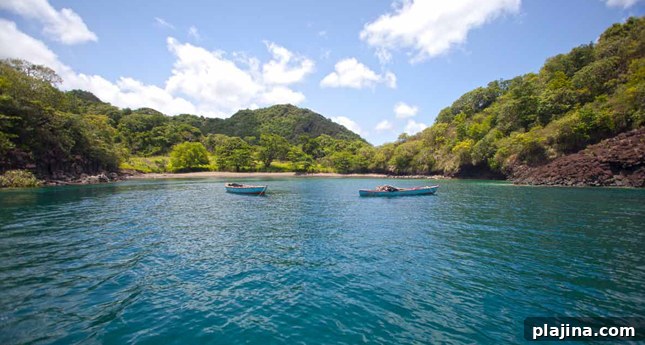
We cut the engine as we approached an islet that seemed to float above aquamarine water so clear I could make out the reef 30 feet below. With our scuba gear on, my dive guide and I slipped into that sunlit world and glided through a gallery of brilliant corals, neon sponges and an endless procession of colorful reef fish. An eagle ray glided by on an invisible current, and a four-foot-wide hawksbill turtle grazed on seagrass. Two reef sharks cruised about 100 feet beneath us before drifting into the cobalt depths—ordinary sights in these waters, though they felt extraordinary to me.
These islands are the Tobago Cays: five deserted islets set amid a marine park and a reef system that beggars description. I’d never heard of them until I began island-hopping across the 32-island nation of St. Vincent and the Grenadines (SVG). The name alone evokes images of idyllic, unspoiled beaches and turquoise lagoons, yet SVG has remained relatively unknown to many North American travelers who tend to favor more promoted Caribbean destinations. That obscurity has been part of the country’s appeal, treasured by yachtsmen and independent travelers who prize its sheltered harbors, secluded cays and quiet anchorages.
St. Vincent is the largest and northernmost island in the chain, dominated by the 4,048-foot Soufrière volcano and carved by deeply embayed inlets and boulder-strewn shallows. Southward, the Grenadines unfurl like a kite’s tail for about 45 miles, a scatter of nearly 600 islets and islands between St. Vincent and Grenada. Only seven islands are inhabited and lightly developed: Bequia, Mustique, Canouan, Mayreau, Union Island, Palm Island and Petit St. Vincent, each offering coral reefs and white-sand beaches.
The islands’ relative isolation owes something to their history. When Europeans arrived, the Kalinago people—known to outsiders as Caribs—defended their land fiercely, delaying colonization long after many neighboring islands were occupied. Pirates also used the islands as hideouts, discouraging settlement. Over time, escaped or shipwrecked Africans mingled with the indigenous population, forming the Garifuna community whose descendants live across SVG today. Even after independence in 1979, large-scale tourism never took hold; natural disasters in the late 1970s and 1980 slowed development further. In recent decades, government efforts to diversify the economy embraced tourism carefully, preserving much of the islands’ low-key character.
Direct access is improving: a new international airport on St. Vincent will soon expand arrival capacity with a long runway able to receive large jets, which is expected to reduce travel times and increase visitor numbers. For now, most travelers still reach SVG via regional connections or ferry services, which helps keep the crowds away.
St. Vincent itself is a compact, vibrant island of about 98,000 residents. Outside Kingstown, the capital, it’s earthy and unpretentious—villages with colorful homes, agricultural terraces, forested valleys and a coastline that alternates between inviting beaches and dramatic rocky points. For a raw, virtually untouched experience, head to the Windward Coast. Cliffs drop into the Atlantic, freshwater creeks tumble from the rainforest, and small hamlets cling to the shore. Georgetown, halfway up the Windward side, is a modest town surrounded by coconut groves—an ideal place to stop for a cool drink and meet friendly Vincentians. A rugged drive beyond the paved road brings you to the Owia Salt Pond, a natural sea pool framed by lava ridges that’s great for snorkelers and adventurers.
On the calmer Caribbean side of St. Vincent are most resorts and tourist services. I stayed on Young Island, a private 35-acre retreat just off the southwest coast, where barefoot luxury, beach bars and water toys make it easy to relax or stay active. Daily boat trips revealed why the area is celebrated by divers: shy seahorses, sea turtles, and a profusion of marine life have earned St. Vincent the nickname “Critter Capital” of the Caribbean. Close to Young Island stands Fort Duvernette, also called Rock Fort, a small monolithic islet with steep steps and cannons left from colonial times—a dramatic vantage point for sunset.
Further up the Leeward Coast is Buccament Bay Resort, a larger-scale, all-inclusive development tucked into a rainforested valley. It contrasts with the smaller boutique properties typical of SVG, offering luxury suites, multiple dining options, a spa and a full-service dive operation, Indigo Dive. With dive staff as guides I explored Bat Cave, an airy cavern that opens back to the sea 40 feet underwater, and vibrant reefs just minutes offshore. Night dives revealed a different world: turtles, octopus, cuttlefish and a host of nocturnal animals show up when the sun goes down.
The Leeward Coast also offers rainforest hikes and waterfalls. Dark View Falls is a standout: a twin 70-foot cascade hidden among ancient bamboo stands, reachable after a scenic drive and a short hike. The pool beneath the falls is a refreshing reward, and the surrounding orchids, hummingbirds and butterflies make the setting almost otherworldly.
Moving south into the Grenadines, Bequia is the first and largest of the chain’s inhabited islands. A 25-minute ferry from Kingstown, this seven-square-mile island has a charming main town, Port Elizabeth, and the protected Admiralty Bay, a hub for sailing and diving. From the Bequia Beach Hotel on quiet Friendship Beach I dove on a sunken tugboat and explored aquarium-like reefs with local operators. Bequia’s attractions include Hamilton Fort, with sweeping bay views, and the Old Hegg Turtle Sanctuary, a grassroots project where hatchlings are incubated and raised to improve survival rates. Evenings along the Belmont Walkway showcase a bohemian waterfront scene of friendly bars, local restaurants and daily island life.
My final stop was Canouan, a five-square-mile emerald island with a broad barrier reef that forms a vast, calm lagoon locals call The Bathtub. Development is under way in parts, including a resort and golf course, but much of the island remains traditional, especially in tiny Charleston Bay where chickens, goats and iguanas roam freely. Staying at the intimate Tamarind Beach Hotel & Yacht Club put me within easy reach of the Tobago Cays Marine Park; day trips to the cays produced some of the most memorable snorkeling and diving of the trip.
Across SVG I encountered healthy reefs, powdery white beaches, islets fringed with palms and friendly locals—an atmosphere of authenticity and relative solitude that felt increasingly rare. For travelers seeking genuine Caribbean scenery, vibrant marine life and an array of small-island experiences without throngs of tourists, St. Vincent and the Grenadines remains a quietly compelling destination.
Info To Go
International flights arrive at E.T. Joshua Airport (SVD) in Arnos Vale near Kingstown on St. Vincent. Regional gateways include Barbados, Grenada, Trinidad, St. Lucia, Martinique and Puerto Rico. Taxis are readily available on St. Vincent, and many resorts on the outlying islands provide complimentary transfers.
Weblinks
Bequia Beach Hotel
Buccament Bay Resort
Canouan Dive Center
Dive Bequia
Dive St. Vincent
Driftwood Restaurant
Indigo Dive St. Vincent
Old Hegg Turtle Sanctuary
St. Vincent & the Grenadines Tourism
Tamarind Beach Hotel & Yacht Club
Tobago Cays Marine Park
Young Island Resort