
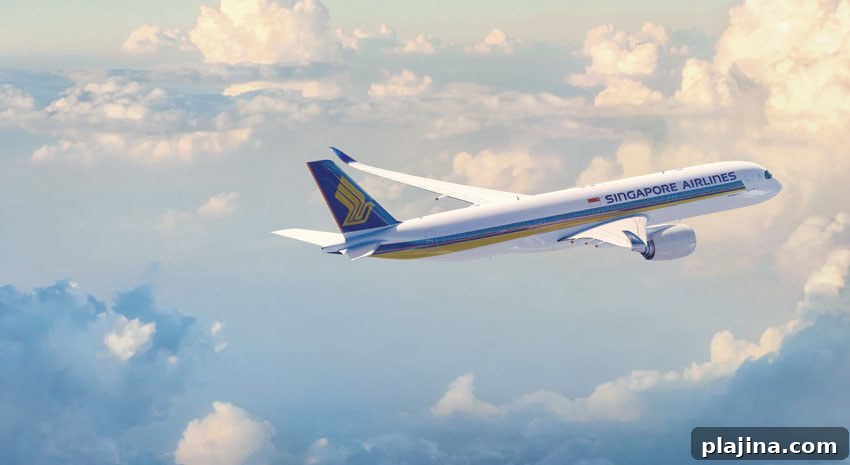
It’s hard to believe 2017 marks Singapore Airlines’ 70th anniversary. The name has changed, destinations have multiplied and the aircraft have grown from tiny planes to modern long-haul jets, but in one form or another, Singapore has maintained a presence in the sky for seven decades.
The airline began in 1947 as Malayan Airways Limited, operating three weekly flights to Kuala Lumpur, Ipoh and Penang in a five-seat, twin-engine Airspeed Consul. The company became Malaysian Airlines Limited in 1963 and later adopted the name Malaysia-Singapore Airlines in May 1966. In 1972 the airline split into two entities: Malaysian Airline System and Singapore Airlines (SIA), the carrier we know today.
Since the 1970s Singapore Airlines has constantly evolved and set aviation milestones. In 1983 it operated the first Boeing 747-300 service from Los Angeles via Tokyo. In 1989 SIA flew the first commercial Boeing 747-400 across the Pacific from Singapore. The carrier established its International Culinary Panel in 1998, recruiting world-acclaimed chefs to elevate onboard dining. In 2001 SIA became the first airline to offer audio and video on demand to every passenger across all classes.
Sek Eng Lee, regional vice president, Americas, Singapore Airlines, notes, “Any airline can sell a seat, but service is what really sets us apart.” That focus on service has earned the airline frequent recognition: Skytrax has placed Singapore Airlines among its top three in the Airline of the Year awards multiple times, and SIA has been named the No. 1 international carrier throughout the history of Travel + Leisure’s World’s Best Awards. In recent reader surveys, Singapore Airlines has also been recognized as Best Overall Airline in the World and Best Airline for Business Class.
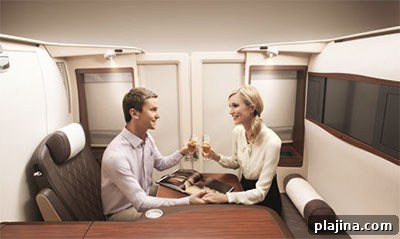
SIA Suite © SINGAPORE
AIRLINES
Customer service has always been central to the brand, and the Singapore Girl remains one of the airline’s most recognizable symbols. In the early 1950s the carrier employed “female pursers” to serve passengers onboard. In 1968 Pierre Balmain designed the sarong kebaya uniform that became synonymous with SIA. When the airline was renamed Singapore Airlines in 1972, the sarong kebaya-clad cabin crew members were branded the Singapore Girls.
Today, approximately 40 percent of those performing the role are men; while their uniforms include gender-appropriate tailoring, training standards remain equally rigorous for all crew members.
SIA’s cabin crew reputation reflects a highly selective recruitment process followed by intensive training. New hires undergo a demanding 15-week program that covers grooming standards, service technique and emergency procedures. Grooming rules are precise—right down to the signature chignon, which must measure between 6.5 and 7 centimeters in width and sit centered on the back of the head. Training emphasizes flawless, seamless service, conflict resolution and responses to onboard emergencies, from cabin fires to water evacuations.
As it enters its 70th year, Singapore Airlines continues to maintain its place among the world’s leading carriers. Competition from Middle Eastern airlines, which have raised expectations for luxury and innovation, means SIA must continually invest and adapt to remain competitive.
One major change from the airline’s early days is its fleet. From the original five-seater, SIA now operates roughly 105–109 aircraft and prides itself on maintaining some of the world’s most modern and fuel-efficient airplanes.
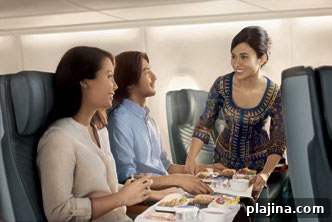
Airbus A350 cuisine © SINGAPORE AIRLINES
SIA invests continually in cabin comfort and service. In 1998 the airline completed an extensive $350 million refurbishment that introduced new cabin products, expanded dining options and enhanced entertainment choices. In 2006 SIA rolled out a new generation of cabin products across all classes, including some of the widest first- and business-class seats in the industry that convert into fully flat beds. In 2015 the carrier added a premium economy class after an $80 million investment.
SIA Suites represent the carrier’s pinnacle of luxury: private sliding doors and window blinds, a standalone bed, gourmet meals served on Wedgwood bone china and turndown service with pajamas. To remain competitive with other premium carriers, SIA planned to unveil redesigned Airbus A380 first-class suites in 2017 ahead of a new superjumbo fleet arriving later that year. Details were kept confidential, reflecting the airline’s careful approach to premier product enhancements.
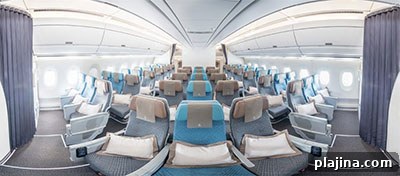
Airbus A350 economy class © SINGAPORE
AIRLINES
Route expansion has also marked SIA’s recent years. In October 2016 the airline launched its first trans-Atlantic service between the United States and the United Kingdom, flying non-stop from Houston (IAH) to Manchester (MAN). A non-stop San Francisco (SFO) to Singapore (SIN) service on the Airbus A350-900 also started in 2016. Looking ahead, SIA planned to introduce non-stop flights from Los Angeles (LAX) and New York (route details to be announced) using Airbus’ ultra long-range A350-900ULR variant.
Technology plays a central role in SIA’s passenger experience. The airline’s Companion App, recognized with an industry award, allows travelers to preview and schedule films, music and TV shows before boarding and to link selections with seatback screens. Passengers can continue in-flight entertainment across connecting flights, picking up a movie where they left off after landing.
Onboard service also benefits from technology designed for crew use. The “Beyond Excellent Service through Technology” app, deployed in premium cabins, runs on iPads and lets crew access and record passenger preferences. The system stores small details—such as a frequent flyer’s preference for extra Tabasco in a Bloody Mary—as well as broader trends, enabling the airline to tailor offerings like language-specific magazines or preferred meal choices for particular flights.
Through continual product investment, route expansion and a relentless focus on service, Singapore Airlines aims to preserve the qualities that built its reputation. As James Bradbury-Boyd, vice president of public relations for Singapore Airlines, says, “Great service is just part of our DNA.”