
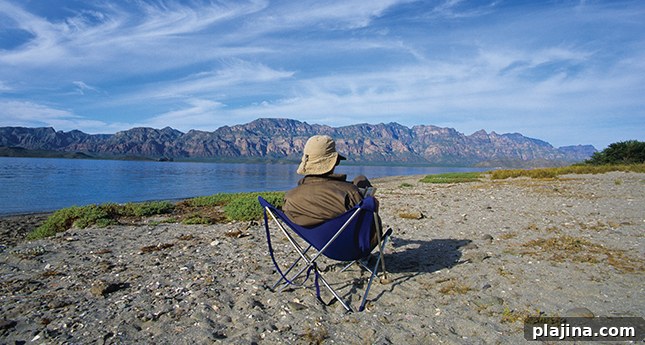
“I’ve got frequent-flyer miles that I need to use within the next month,” my friend from Portland, Ore., announced. “Not enough for an exotic trip abroad, but I want to go somewhere that feels at least a little foreign, where I can get a nature fix. Any suggestions?”
Suggestions were easy. “How about an ecotour of Baja?” I replied.
When most people think of Baja, ecotourism doesn’t immediately come to mind. The region’s best-known destinations are the bustling border city of Tijuana and the tourist-packed beaches of Cabo San Lucas. Yet between those two points, along more than a thousand miles of Mexico Highway 1, Baja offers mountains, desert, coastline and small towns that appeal to travelers seeking solitude, natural beauty and a break from the rat race.
We didn’t have time to travel the full length of the peninsula and return in less than two weeks, so we narrowed our options. We decided to fly into Cabo San Lucas—convenient because it has the most flights from Los Angeles—rent a car and drive north as far as time allowed.
From Cabo San Lucas we drove to La Paz, the capital of Baja California Sur. La Paz is a larger city and not the ideal destination for someone seeking only wilderness, but its location gives access to a variety of desert and marine ecosystems. It’s also a hub for reputable guides and ecotour operators who can take you to those wild places.
One of Baja California Sur’s most celebrated natural features is the Sea of Cortés, an ecosystem so rich and unique that Jacques Cousteau dubbed it “The Aquarium of the World.” Underwater mountains and canyons create habitats for an impressive array of tropical and pelagic fish, sustained by heavy plankton blooms fueled by nutrient-rich currents.
Beyond fish, the Sea of Cortés supports marine mammals, sea turtles and hundreds of bird species. In winter, gray whales migrate south to spend the season in Baja’s protected lagoons. More than 200 species of migratory birds also use the region’s bays, islands, estuaries and lagoons as feeding and nesting grounds.
Our first outing from La Paz was a day trip into these productive waters. A 45-minute boat ride brought us to a lively sea lion colony where we donned flippers and snorkels to swim among the sleek, whiskered animals. Later we visited a deserted beach on Espiritu Santo Island, where we swam in warm water and ate fresh ceviche. That short taste left us wanting more, so we booked an overnight excursion to Espiritu Santo to experience the island in greater depth on our return.
The next morning we set out on a long drive from La Paz to Mulegé, roughly 300 miles. We left early, took our time and stopped in small towns along the way, taking short off-road hikes to observe desert plants and wildlife.
Mulegé felt like the quintessential laid-back Baja town. Nestled between date-palm-covered hills, the town has a river lined with a palm oasis, bright bougainvillea, and a sleepy central square. We stayed at Las Casitas Hotel, where a foliage-filled courtyard surrounded simple but spotless rooms and a popular restaurant.
For beaches, Bahía Concepción was our destination. This more-than-25-mile-long bay is a national marine preserve and is said to be one of the cleanest marine systems in the world. Fishing in the bay is prohibited. Locals recommended Playa Los Cocos as one of the prettiest and least populated beaches near Mulegé. Limited camping facilities help keep crowds down, and the calm, warm water glows turquoise thanks to limestone cliffs. We spent the day on the peaceful shore, swimming, reading and soaking in the quiet.
Despite the temptation to linger on the sand, we pressed on the following day to San Ignacio. A surprising date-palm oasis appears in the middle of the arid landscape, with a spring-fed pond and a small river leading to the town’s quiet square and the lovely mission of San Ignacio de Loyola, completed in 1786. Built from four-foot-thick blocks of volcanic rock, the mission has endured largely unchanged for centuries.
It was Sunday when we arrived, and the square came alive as ranchers in cowboy boots and straw hats and children in their Sunday best emerged from the mission. Families gathered to socialize, children played and ate ice cream, and the scene offered an authentic glimpse of everyday Baja life—far removed from luxury resorts and spas.
San Ignacio is worth visiting for its culture alone, but the area also offers special attractions for travelers with more time. In winter, nearby San Ignacio Lagoon is a premier site for watching migrating gray whales; some multi-day tours even include a stay at a solar-powered ecolodge on the water’s edge. The region is also home to ancient cave paintings in the Sierra de San Francisco, some of which are estimated to be thousands of years old and are recognized by UNESCO. Because the sites are remote and protected, visits require a registered guide and permits available through the local National Institute of Anthropology and History office beside the mission.
All too soon we began retracing our route south. After an overnight stop in Loreto—where we toured the town’s mission and small museum—we returned to La Paz for an overnight kayaking trip on the Sea of Cortés.
A motor launch carried us to Espiritu Santo Island, where a bilingual naturalist outlined activities for the next day and a half: snorkeling, swimming, kayaking, hiking, or simply relaxing on the beach. All meals and cleanup were handled by our cook; our only responsibility was to enjoy the environment. The red sunset over the water was dazzling, and sleeping on the quiet beach felt utterly restorative. We kayaked through a mangrove lagoon among egrets, herons and frigatebirds; snorkeled among schools of bright yellow sergeant major fish; and shared shores with red, polka-dotted sally lightfoot crabs. At dawn we hiked past desert cacti to a hilltop to watch the sun rise over the Baja mainland.
As our road trip wound down, we returned to the Cabo area but avoided the high-rise mega-resorts and stayed at the unpretentious El Delfin Blanco, a short drive from the more traditionally Mexican town of San José del Cabo. The thatched-roof bungalows were modest but comfortable—ideal for a casual, friendly stay.
For our final evening we dined on the tree-shaded patio of Tequila Restaurant in San José, under hanging straw lanterns. A squash-blossom chile relleno followed by local shrimp with plantains and black beans in a tequila sauce—paired with a crisp Pinot Grigio—made for a delicious last meal in Baja.
Before heading home we took an early-morning trip to the San José Estuary. This marshy lagoon, nearly 2,000 acres, is the largest freshwater body in southern Baja and is legally protected as a natural preserve and sanctuary. It supports hundreds of species of tropical and migratory birds, as well as marine life, amphibians, reptiles, mammals and insects. A narrow strip of white sand separates the estuary from the Sea of Cortés, and at sunrise the sky fills with brilliant reds and yellows while birdcalls rise from the water’s edge—an unforgettable final moment of our Baja ecotour.